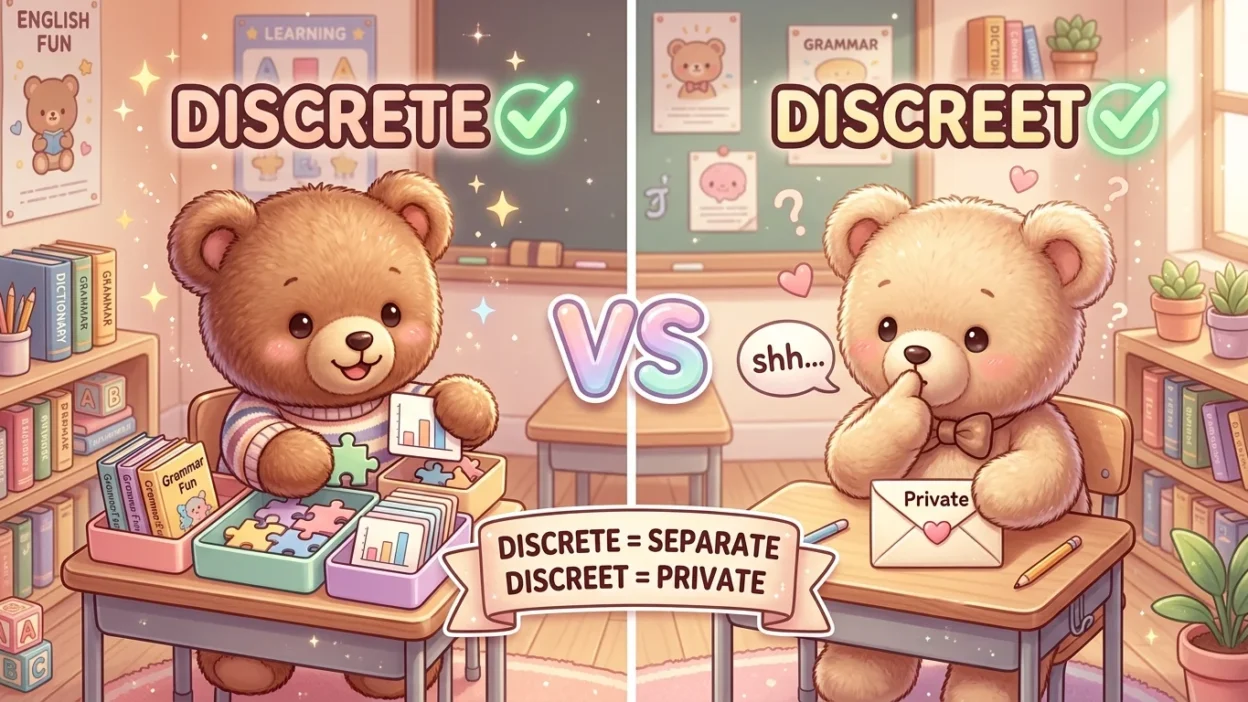
Have you ever confused discrete vs discreet? You’re not alone. These two words look almost identical, and they are pronounced differently only by a subtle sound, but their meanings are completely different. Discrete means separate or distinct, while discreet means careful, tactful, or private.
In this guide, you’ll learn the difference between discrete and discreet, their meanings, examples, common mistakes, usage rules, American and British English differences, FAQs, and an easy memory trick.
Quick Answer
- Discrete ✅ = separate, distinct, or individually different.
- Discreet ✅ = careful, tactful, private, or not attracting attention.
Examples:
- The report contains several discrete sections. ✅
- Please be discreet about the situation. ✅
The easiest rule is:
Discrete = separate
Discreet = careful/private
What Does Discrete Mean?
Discrete is an adjective that describes something that is separate, distinct, or individually identifiable.
If things are discrete, they exist as separate units rather than as one continuous whole.
Examples:
- The data was divided into discrete categories.
- The machine has several discrete components.
- The study examined three discrete groups.
- These are discrete events rather than one continuous process.
Discrete in Mathematics
Discrete is especially common in mathematics, statistics, and computer science.
In these fields, discrete generally refers to things that are separate or countable rather than continuous.
Examples:
- Discrete mathematics studies structures that are separate or countable.
- The researcher collected discrete data.
- The system uses discrete values instead of a continuous range.
For example, the number of students in a classroom is discrete data because you can count students as individual units.
What Does Discreet Mean?
Discreet means careful, tactful, private, or intentionally unobtrusive.
Someone who is discreet knows how to avoid drawing unnecessary attention or revealing private information.
Examples:
- Please be discreet about the meeting.
- She was discreet when discussing the confidential information.
- He made a discreet inquiry.
- The security guard kept a discreet distance.
- They found a discreet location for the conversation.
A discreet person uses good judgment about what to say, reveal, or do.
Discrete vs Discreet Comparison Table
| Word | Meaning | Common Uses | Example |
|---|---|---|---|
| Discrete | Separate or distinct | Data, groups, objects, categories | The study examined discrete groups. |
| Discreet | Careful, tactful, or private | Behavior, communication, situations | Please be discreet about the matter. |
Why Are Discrete and Discreet Confused?
The main reason is their spelling.
Both words begin with discr- and contain almost the same letters:
- Discrete
- Discreet
They also have closely related pronunciations.
However, their meanings are very different.
Think:
- Discrete → separate things
- Discreet → careful behavior
Discrete Examples in Sentences
Here are some correct examples of discrete:
- The project has five discrete stages.
- The researcher divided participants into discrete groups.
- Each machine operates as a discrete unit.
- The survey measures several discrete variables.
- The system processes discrete signals.
- These are two discrete problems.
- The company operates through several discrete departments.
- The graph contains several discrete points.
Discreet Examples in Sentences
Here are some correct examples of discreet:
- Please be discreet when discussing the issue.
- She gave him a discreet warning.
- He was discreet about his friend’s personal information.
- The hotel provides a discreet entrance.
- She made a discreet phone call.
- He tried to be discreet while leaving the room.
- They had a discreet conversation.
- The employee handled the situation in a discreet manner.
Discrete Data vs Discreet Data
This is an important distinction.
The correct term in mathematics and statistics is:
discrete data ✅
It refers to data that consists of separate, countable values.
For example:
- Number of children in a family
- Number of cars in a parking lot
- Number of books on a shelf
You would not normally write:
- ❌ discreet data
Discreet relates to being tactful or private, not to numerical categories.
Discreet Person vs Discrete Person
When describing someone’s behavior, use discreet.
Correct:
- She is very discreet.
This means she is careful with private information and does not attract unnecessary attention.
Discrete person would mean something different and is generally not what you want when describing someone’s tactfulness.
Discrete vs Discreet in Business
Both words can appear in professional writing, but they describe different things.
Discrete
- The company has discrete business units.
- The project consists of several discrete phases.
- Each department has a discrete responsibility.
Here, discrete means separate.
Discreet
- Please be discreet with client information.
- The manager made a discreet inquiry.
- The company arranged a discreet meeting.
Here, discreet means careful or private.
Common Mistakes People Make
Mistake 1: Using Discreet for Separate
Incorrect:
- ❌ The project has three discreet stages.
Correct:
- ✅ The project has three discrete stages.
The stages are separate from one another.
Mistake 2: Using Discrete for Privacy
Incorrect:
- ❌ Please be discrete about the situation.
Correct:
- ✅ Please be discreet about the situation.
You’re asking someone to be tactful and private.
Mistake 3: Writing Discreet Data
Incorrect:
- ❌ The researcher collected discreet data.
Correct:
- ✅ The researcher collected discrete data.
Mistake 4: Calling Someone Discrete
If you mean someone is tactful and careful with information, use:
- ✅ She is discreet.
Not:
- ❌ She is discrete.
Simple Memory Trick
💡 Memory Trick
Spelling Box
DISCRETE = SEPARATE 🧩
Think: discrete = distinct
DISCREET = CAREFUL / PRIVATE 🤫
Think: discreet = secret
Remember:
Discrete things are separate.
Discreet people keep things private.
Discrete Synonyms
Depending on the context, synonyms for discrete include:
- Separate
- Distinct
- Individual
- Independent
- Unconnected
- Separable
- Distinguishable
Example:
- discrete categories → separate categories
- discrete units → individual units
Discreet Synonyms
Synonyms for discreet include:
- Tactful
- Careful
- Cautious
- Private
- Circumspect
- Unobtrusive
- Reserved
- Diplomatic
Example:
- discreet conversation → private conversation
- discreet person → tactful person
Discrete vs Distinct
Discrete and distinct can sometimes have similar meanings.
Both can describe things that are separate or distinguishable.
Examples:
- The study contains several discrete categories.
- The study contains several distinct categories.
However, discrete is especially common when emphasizing that things are separate units.
Discreet vs Secretive
Discreet and secretive can both relate to privacy, but they are not exact synonyms.
Discreet usually has a positive or neutral sense. It suggests good judgment and tact.
Secretive can suggest that someone deliberately hides information.
Examples:
- She was discreet about her friend’s situation.
- He was secretive about his plans.
American vs British English
There is no meaningful spelling difference between American and British English for these words.
Both use:
- discrete = separate or distinct
- discreet = tactful, careful, or private
The distinction remains the same in both varieties.
When Should You Use Discrete?
Use discrete when you mean:
- Separate
- Distinct
- Individual
- Independent
- Countable
Examples:
- discrete categories
- discrete units
- discrete values
- discrete groups
- discrete events
- discrete data
Ask yourself:
“Are these things separate from one another?”
If yes, use discrete.
When Should You Use Discreet?
Use discreet when you mean:
- Careful
- Tactful
- Private
- Unobtrusive
- Cautious about revealing information
Examples:
- discreet behavior
- discreet conversation
- discreet inquiry
- discreet person
- discreet location
- discreet handling of information
Ask yourself:
“Am I talking about privacy or careful behavior?”
If yes, use discreet.
Related Words and LSI Keywords
- discrete meaning
- discreet meaning
- discrete vs discreet
- discreet vs discrete
- discrete definition
- discreet definition
- discrete data
- discrete mathematics
- discrete categories
- discreet person
- discreet behavior
- discreet conversation
- discreet meaning in English
- separate vs private
- distinct meaning
- tactful meaning
- commonly confused words
- common spelling mistakes
- English grammar
- English vocabulary
- correct English usage
Tips for Remembering the Difference
- Discrete = separate or distinct.
- Discreet = careful or private.
- Think discrete = distinct.
- Think discreet = secret.
- Use discrete data in statistics.
- Use discreet person when describing someone tactful.
- Discrete categories are separate.
- Discreet behavior avoids unnecessary attention.
- Both American and British English use the same spellings.
Frequently Asked Questions
What is the difference between discrete and discreet?
Discrete means separate, distinct, or individual. Discreet means careful, tactful, private, or unobtrusive.
Is it discrete or discreet data?
The correct phrase is discrete data.
Is a person discreet or discrete?
If you mean the person is careful, tactful, or good at keeping information private, the correct word is discreet.
Is it discrete or discreet information?
It depends on the meaning. Discrete information means information separated into distinct units or categories. If you mean information that should be handled privately, discreet describes the person or manner of handling it.
Is discrete mathematics correct?
Yes. Discrete mathematics is the standard term for the branch of mathematics dealing with distinct or countable structures.
What does discreet mean?
Discreet means careful, tactful, private, or unobtrusive.
What does discrete mean?
Discrete means separate, distinct, or individually identifiable.
How do you remember discrete vs discreet?
Remember DISCRETE = DISTINCT and DISCREET = SECRET. Separate things are discrete, while private or tactful behavior is discreet.
Is discrete a synonym for separate?
Yes. Separate, distinct, and individual can often be synonyms for discrete, depending on the context.
Is discreet a synonym for secretive?
They can overlap, but they are not identical. Discreet usually means tactful and careful, while secretive can suggest deliberately hiding information.
Is there a difference in American and British English?
No. American and British English use discrete and discreet with the same meanings and spellings.
Can discrete and discreet be used in the same sentence?
Yes.
Example:
- The report contains several discrete sections, and the manager asked everyone to be discreet about its contents.
Summary
The difference between discrete vs discreet is easy to remember once you connect each word with its meaning. Discrete means separate, distinct, or individually identifiable, while discreet means careful, tactful, private, or unobtrusive.
Use discrete for things that are separate, such as discrete categories, discrete groups, and discrete data. Use discreet for people or actions involving privacy and tact, such as a discreet person or a discreet conversation. Remember the simple trick: discrete = distinct; discreet = secret.

Alistair Fenwicke is a quiet observer of rural life and forgotten histories.
His novels explore memory, solitude, and the passing of time.
He writes from a small countryside cottage surrounded by fields.