
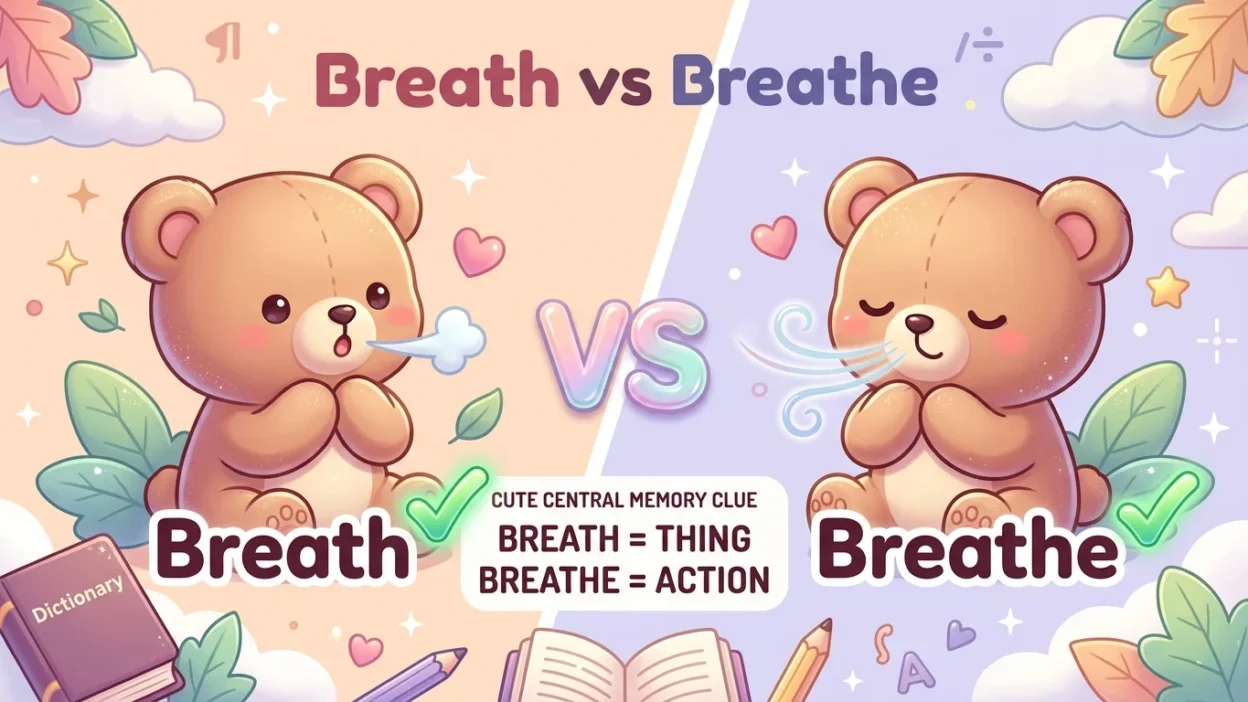
Have you ever confused breath vs breathe? You’re not alone. These two words look almost identical, but they have different meanings and grammatical roles. Breath is a noun that refers to the air you take into or release from your lungs, while breathe is a verb meaning to take air into your lungs and release it.
In this guide, you’ll learn the difference between breath and breathe, their meanings, pronunciation, examples, common mistakes, American and British English usage, FAQs, and an easy memory trick.
Quick Answer
- Breath ✅ = a noun meaning the air taken into or released from the lungs.
- Breathe ✅ = a verb meaning to take air into and release it from the lungs.
Examples:
- Take a deep breath. ✅
- Remember to breathe slowly. ✅
The easiest rule is:
Breath = thing
Breathe = action
What Does Breath Mean?
Breath is a noun. It refers to the air that enters or leaves your lungs when you breathe.
Examples:
- Take a deep breath.
- She held her breath.
- He took a quick breath before speaking.
- I could see my breath in the cold air.
- She was out of breath after running.
The word can also describe the smell of air coming from someone’s mouth.
Example:
- He had fresh breath.
What Does Breathe Mean?
Breathe is a verb. It means to take air into your lungs and release it.
Examples:
- Try to breathe slowly.
- It’s difficult to breathe in the smoke.
- Remember to breathe deeply.
- She stopped to breathe.
- Plants need carbon dioxide to breathe and grow.
Because breathe is a verb, it describes an action.
Breath vs Breathe Comparison Table
| Word | Part of Speech | Meaning | Example |
|---|---|---|---|
| Breath | Noun | Air taken into or released from the lungs | Take a deep breath. |
| Breathe | Verb | To take air in and release it | Try to breathe slowly. |
Why Are Breath and Breathe Confused?
The words are confusing because they are spelled almost the same.
Compare:
Breath
Breathe
The main difference is the final e.
However, the pronunciation also changes.
- Breath has a short vowel sound.
- Breathe has a long vowel sound.
This distinction makes the words easier to recognize when you hear them.
How Do You Pronounce Breath?
Breath is pronounced with a sound similar to:
breth
The ending has the unvoiced th sound, like in:
- think
- health
- mouth
Example:
- Take a deep breath.
How Do You Pronounce Breathe?
Breathe is pronounced approximately:
breeth
The th sound is voiced, like in:
- these
- this
- smooth
Example:
- Remember to breathe.
So you can remember:
breath → breth
breathe → breeth
Breath as a Noun
A noun names a person, place, thing, or idea.
Breath names the air involved in respiration.
Examples:
- I took a breath.
- She held her breath.
- His breath was visible in the cold.
- Take another breath.
You can often put words such as a, your, or his before breath.
Examples:
- a breath
- your breath
- his breath
- one breath
Breathe as a Verb
A verb describes an action.
Breathe describes the action of taking air into your lungs and releasing it.
Examples:
- Breathe deeply.
- Try to breathe slowly.
- We need to breathe fresh air.
- She couldn’t breathe properly.
You can often place to before breathe.
Examples:
- to breathe
- trying to breathe
- learning to breathe
Examples of Breath in Sentences
Here are some correct examples:
- Take a deep breath before you begin.
- She held her breath underwater.
- He was short of breath after the race.
- I could see his breath in the winter air.
- She took a slow breath.
- He lost his breath while climbing the stairs.
- Take a moment to catch your breath.
- The singer took a deep breath before performing.
Examples of Breathe in Sentences
Here are some correct examples:
- Breathe slowly and calmly.
- Try to breathe through your nose.
- The doctor told him to breathe deeply.
- It is difficult to breathe in this room.
- Don’t forget to breathe while exercising.
- She paused to breathe.
- The fresh air made it easier to breathe.
- He struggled to breathe after running.
Breath vs Breathe in Common Phrases
Learning common expressions can make the difference easier to remember.
Common phrases with Breath
- take a breath
- hold your breath
- catch your breath
- out of breath
- short of breath
- bad breath
- fresh breath
- take someone’s breath away
Examples:
- I need to catch my breath.
- She was completely out of breath.
Common phrases with Breathe
- breathe deeply
- breathe slowly
- breathe normally
- breathe in
- breathe out
- breathe fresh air
- breathe easily
Examples:
- Breathe in slowly.
- Breathe out gently.
Breath vs Breathe in “Take a Deep…”
This is one of the easiest ways to remember the difference.
Say:
Take a deep breath. ✅
Not:
- ❌ Take a deep breathe.
Why?
Because take needs a noun here, and breath is the noun.
Compare:
Take a deep breath.
Breathe deeply.
Breath vs Breathe in “Hold Your…”
The correct phrase is:
Hold your breath. ✅
Not:
- ❌ Hold your breathe.
Breath is correct because it is a noun.
Example:
- I had to hold my breath underwater.
Breath vs Breathe in “I Can’t…”
Both can be correct, but they work differently.
I can’t breathe.
This means you cannot perform the action of breathing.
I can’t catch my breath.
Here, breath is the noun.
Compare:
- I can’t breathe.
- I can’t catch my breath.
Common Mistakes People Make
Mistake 1: Writing Breathe Instead of Breath
Incorrect:
- ❌ Take a deep breathe.
Correct:
- ✅ Take a deep breath.
Mistake 2: Writing Breath Instead of Breathe
Incorrect:
- ❌ Remember to breath slowly.
Correct:
- ✅ Remember to breathe slowly.
Mistake 3: Confusing “Breath” With “Breathe” in Instructions
Incorrect:
- ❌ Breath deeply.
Correct:
- ✅ Breathe deeply.
Because breathe is the verb.
Mistake 4: Adding the Extra E to the Noun
Incorrect:
- ❌ Hold your breathe.
Correct:
- ✅ Hold your breath.
Remember that the noun has no final e.
Simple Memory Trick
💡 Memory Trick
Spelling Box
BREATH = THING 🌬️
BREATHE = ACTION 💨
Think:
Take a breath.
Breathe deeply.
The extra E in breathe can remind you that breathe is the action word.
Breath vs Breathe vs Breathing
These three forms are related but have different grammatical roles.
Breath
Noun:
- Take a breath.
Breathe
Verb:
- Breathe slowly.
Breathing
Present participle or gerund:
- Breathing deeply can help you relax.
A simple pattern is:
breath → noun
breathe → verb
breathing → -ing form
Breath vs Breathe in the Past Tense
The past tense of breathe is:
breathed
Examples:
- She breathed deeply.
- He breathed a sigh of relief.
The noun remains:
breath
Example:
- She took a deep breath.
Don’t confuse:
- breath
- breathe
- breathed
- breathing
Breath vs Breathe in American and British English
Both American and British English use:
- breath
- breathe
There is no spelling difference between the two varieties.
The pronunciation can vary slightly depending on accent, but the grammatical distinction remains the same.
When Should You Use Breath?
Use breath when you need a noun.
Examples:
- Take a breath.
- Hold your breath.
- Catch your breath.
- I was out of breath.
- His breath smelled fresh.
Ask yourself:
“Am I talking about the air or the thing?”
If yes, use breath.
When Should You Use Breathe?
Use breathe when you need a verb describing the action.
Examples:
- Breathe slowly.
- Try to breathe deeply.
- I can’t breathe.
- Remember to breathe.
- She stopped to breathe.
Ask yourself:
“Am I talking about the action?”
If yes, use breathe.
Related Words and LSI Keywords
- breath meaning
- breathe meaning
- breath vs breathe
- breathe vs breath
- breath definition
- breathe definition
- breath spelling
- breathe spelling
- how to pronounce breath
- how to pronounce breathe
- take a deep breath
- breathe deeply
- hold your breath
- catch your breath
- out of breath
- breathing
- breathed
- English grammar
- English spelling
- commonly confused words
- common spelling mistakes
- English vocabulary
- correct English usage
Tips for Remembering the Difference
- Breath is a noun.
- Breathe is a verb.
- Take a breath.
- Breathe deeply.
- Hold your breath.
- Remember to breathe.
- The extra e in breathe can remind you that it is the action.
- Breath is pronounced roughly like breth.
- Breathe is pronounced roughly like breeth.
Frequently Asked Questions
What is the difference between breath and breathe?
Breath is a noun referring to air taken into or released from the lungs. Breathe is a verb meaning to take air into the lungs and release it.
Is it take a breath or take a breathe?
The correct phrase is take a breath.
Example:
- Take a deep breath.
Is it breathe deeply or breath deeply?
The correct phrase is breathe deeply because breathe is the verb.
Is it hold your breath or hold your breathe?
The correct phrase is hold your breath.
Is breathe a verb?
Yes. Breathe is a verb meaning to take air into the lungs and release it.
Is breath a noun?
Yes. Breath is a noun referring to the air involved in breathing.
How do you pronounce breath?
Breath is commonly pronounced approximately “breth,” with an unvoiced th sound.
How do you pronounce breathe?
Breathe is commonly pronounced approximately “breeth,” with a voiced th sound.
What is the past tense of breathe?
The past tense of breathe is breathed.
Example:
- She breathed deeply.
Is breathed related to breath and breathe?
Yes. Breathed is the past-tense and past-participle form of the verb breathe.
Is breathing a noun or verb?
Breathing can function as a gerund or present participle, depending on how it is used.
Example:
- Breathing slowly can help you relax.
Is there a difference between American and British spelling?
No. Both American and British English use breath and breathe with the same spellings.
What is an easy way to remember breath vs breathe?
Remember: BREATH = THING and BREATHE = ACTION. Say “Take a breath” but “Breathe deeply.”
Summary
The difference between breath vs breathe is easy once you remember their grammatical roles. Breath is a noun that refers to the air you take into or release from your lungs, while breathe is a verb describing the action of taking in and releasing air. The extra e in breathe can help you remember that it is the action word.
Use breath in phrases such as “take a deep breath,” “hold your breath,” and “catch your breath.” Use breathe in phrases such as “breathe deeply,” “breathe slowly,” and “remember to breathe.” When in doubt, remember: breath = thing, breathe = action.

Alistair Fenwicke is a quiet observer of rural life and forgotten histories.
His novels explore memory, solitude, and the passing of time.
He writes from a small countryside cottage surrounded by fields.