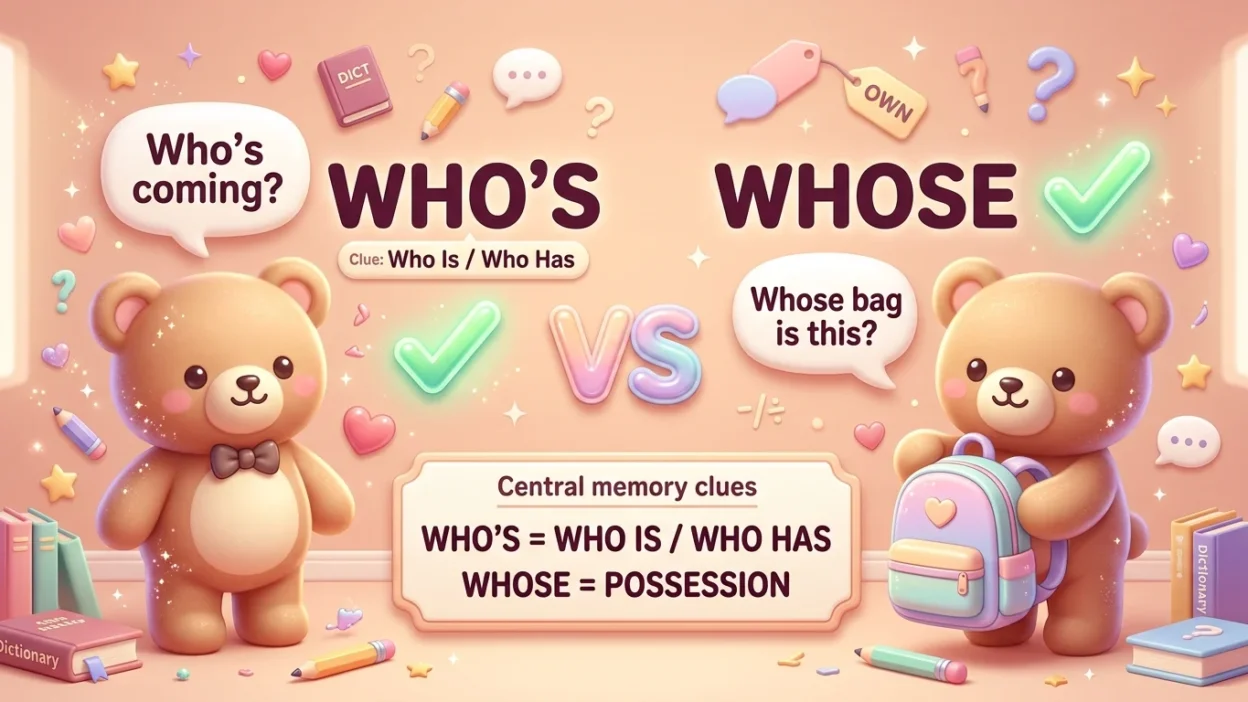
Have you ever confused who’s vs whose? You’re not alone. These two words sound exactly the same, but they have different meanings and grammatical functions. Who’s is a contraction of who is or who has, while whose is a possessive word used to ask or show who something belongs to.
In this guide, you’ll learn the difference between who’s and whose, their meanings, examples, common mistakes, pronunciation, American and British English usage, FAQs, and an easy memory trick.
Quick Answer
- Who’s ✅ = contraction of who is or who has.
- Whose ✅ = shows possession or asks who something belongs to.
Examples:
- Who’s coming to the party? ✅
- Whose phone is this? ✅
The easiest rule is:
Who’s = who is / who has
Whose = possession
What Does Who’s Mean?
Who’s is a contraction. It can mean either:
- Who is
- Who has
The apostrophe in who’s shows that letters have been omitted.
Who’s = Who Is
Examples:
- Who’s at the door?
- Who’s coming with us?
- Who’s responsible for this?
- Who’s your teacher?
- Who’s ready to leave?
You can expand each example:
- Who is at the door?
- Who is coming with us?
- Who is responsible for this?
If who is makes sense, use who’s.
Who’s = Who Has
Who’s can also mean who has.
Examples:
- Who’s finished the assignment?
- Who’s seen my keys?
- Who’s got the answer?
- Who’s been calling me?
You can expand them:
- Who has finished the assignment?
- Who has seen my keys?
- Who has got the answer?
If who has works, who’s is correct.
What Does Whose Mean?
Whose is a possessive word. It asks or tells us who owns something or who something belongs to.
Examples:
- Whose book is this?
- Whose car is parked outside?
- Whose phone are you using?
- Whose idea was it?
- Do you know whose jacket this is?
In each sentence, whose relates to ownership or possession.
Who’s vs Whose Comparison Table
| Word | Meaning | Function | Example |
|---|---|---|---|
| Who’s | Who is / who has | Contraction | Who’s coming? |
| Whose | Belonging to whom | Possessive | Whose bag is this? |
Why Are Who’s and Whose Confused?
The main reason is pronunciation.
Who’s and whose are pronounced the same way in standard English.
They sound like:
hooz
Because they sound identical, it’s easy to choose the wrong spelling when writing.
However, their meanings are different:
- Who’s → who is / who has
- Whose → possession
This is a classic example of homophones: words that sound the same but have different spellings and meanings.
Examples of Who’s in Sentences
Here are some correct examples of who’s:
- Who’s coming to dinner?
- Who’s your favorite author?
- Who’s knocking on the door?
- Who’s responsible for this project?
- Who’s going to help us?
- Who’s been using my computer?
- Who’s finished their work?
- Who’s got the keys?
Examples of Whose in Sentences
Here are some correct examples of whose:
- Whose bag is this?
- Whose phone is ringing?
- Whose car is blocking the driveway?
- Whose idea was this?
- Whose book did you borrow?
- Whose house are we visiting?
- Whose jacket is on the chair?
- Do you know whose dog this is?
The Best Test: Expand Who’s
Whenever you’re unsure about who’s, replace it with who is or who has.
For example:
Who’s coming?
Replace it:
Who is coming?
It works, so who’s is correct.
Another example:
Who’s finished?
Replace it:
Who has finished?
It works, so who’s is correct.
But:
Who’s phone is this? ❌
Replace it:
Who is phone is this? ❌
That doesn’t work.
The correct version is:
Whose phone is this? ✅
The Possession Test for Whose
If you’re talking about ownership or belonging, use whose.
Examples:
- Whose shoes are these?
- Whose laptop is this?
- Whose responsibility is it?
- Whose idea was that?
Ask yourself:
“Does this sentence ask who something belongs to?”
If yes, use whose.
Who’s vs Whose With People
Both words can appear before words related to people, but they perform different jobs.
Who’s
- Who’s your manager?
Here, who’s means who is.
Whose
- Whose manager is she?
Here, whose asks about possession or relationship.
Compare:
- Who’s your manager? = Who is your manager?
- Whose manager is she? = She is the manager of whom?
Common Mistakes People Make
Mistake 1: Using Who’s for Possession
Incorrect:
- ❌ Who’s phone is this?
Correct:
- ✅ Whose phone is this?
You are asking who owns the phone.
Mistake 2: Using Whose for Who Is
Incorrect:
- ❌ Whose coming to dinner?
Correct:
- ✅ Who’s coming to dinner?
You mean:
- Who is coming to dinner?
Mistake 3: Assuming the Apostrophe Shows Possession
This is an especially common mistake.
People often think the apostrophe in who’s means ownership.
But who’s is a contraction, not a possessive form.
Compare:
- Who’s = who is / who has
- Whose = possessive
Interestingly, whose has no apostrophe even though it expresses possession.
Simple Memory Trick
💡 Memory Trick
Spelling Box
WHO’S = WHO IS / WHO HAS 👤
WHOSE = POSSESSION 🎒
Try the replacement test:
If you can replace who’s with who is or who has, use who’s.
If you’re asking “Who does this belong to?”, use whose.
Remember:
Who’s coming?
Whose bag is this?
Who’s vs Whose in Questions
Questions make the difference especially easy to see.
Who’s
- Who’s calling?
- Who’s at the door?
- Who’s responsible?
- Who’s coming?
These mean:
- Who is calling?
- Who is at the door?
- Who is responsible?
- Who is coming?
Whose
- Whose phone is ringing?
- Whose car is that?
- Whose coat is this?
- Whose idea was it?
These ask about ownership or belonging.
Who’s vs Whose in Formal Writing
Both who’s and whose are standard English.
However, in formal writing, some writers prefer to avoid contractions.
For example:
- Who’s responsible? → Who is responsible?
Both are grammatically correct, but who is can sound more formal.
You should still use whose normally when expressing possession:
- Whose responsibility is this?
American vs British English
There is no meaningful spelling difference between American and British English for who’s and whose.
Both varieties use:
- who’s = who is / who has
- whose = possession
The same distinction applies in both forms of English.
When Should You Use Who’s?
Use who’s when you mean:
- Who is
- Who has
Examples:
- Who’s coming?
- Who’s your teacher?
- Who’s calling?
- Who’s been here?
- Who’s finished?
Ask yourself:
“Can I replace who’s with who is or who has?”
If yes, use who’s.
When Should You Use Whose?
Use whose when you’re expressing or asking about possession or belonging.
Examples:
- Whose phone is this?
- Whose car is that?
- Whose idea was it?
- Whose book did you borrow?
- Do you know whose keys these are?
Ask yourself:
“Am I asking who something belongs to?”
If yes, use whose.
Related Words and LSI Keywords
- who’s meaning
- whose meaning
- who’s vs whose
- whose vs who’s
- who’s definition
- whose definition
- who’s spelling
- whose spelling
- who is vs who’s
- who has vs who’s
- possessive pronouns
- possessive words
- who’s coming
- whose phone is this
- homophones
- commonly confused words
- common spelling mistakes
- English grammar
- English vocabulary
- correct English usage
Tips for Remembering the Difference
- Who’s = who is or who has.
- Whose = possession or belonging.
- Use the who is/who has test for who’s.
- Use the ownership test for whose.
- Who’s has an apostrophe because it is a contraction.
- Whose has no apostrophe.
- Both American and British English use the same forms.
- Remember: Who’s coming? Whose bag is this?
Frequently Asked Questions
Is it who’s or whose?
Both are correct words, but they have different meanings. Who’s means who is or who has, while whose expresses possession.
What’s the difference between who’s and whose?
Who’s is a contraction of who is or who has. Whose is a possessive word used to ask or show who something belongs to.
Is “whose” possessive?
Yes. Whose is used to express or ask about possession or belonging.
Is “who’s” a possessive word?
No. Who’s is a contraction of who is or who has. It does not indicate possession.
Is “who’s” short for “who is”?
Yes. For example:
- Who’s coming?
means:
- Who is coming?
Can who’s mean who has?
Yes. For example:
- Who’s finished the work?
can mean:
- Who has finished the work?
Is “whose” short for “who is”?
No. Whose is not a contraction. It is a possessive word.
Is “whose” short for “who has”?
No. Whose does not mean who has.
Why do who’s and whose sound the same?
They are pronounced essentially the same in standard English, which makes them easy to confuse when writing.
Which is correct: “who’s phone” or “whose phone”?
The correct phrase is “whose phone” because you’re asking who owns the phone.
Which is correct: “whose coming” or “who’s coming”?
The correct phrase is “who’s coming” because who’s means who is.
Is who’s used in formal English?
Yes. Who’s is grammatically correct, although some formal writing may use who is instead because it avoids contractions.
Is there an American and British difference?
No. American and British English use who’s and whose with the same meanings and spellings.
What is an easy way to remember who’s vs whose?
Remember: WHO’S = WHO IS / WHO HAS, while WHOSE = POSSESSION. If you can replace it with who is or who has, use who’s.
Summary
The difference between who’s vs whose is easy once you remember what each word does. Who’s is a contraction meaning who is or who has, while whose is used to express or ask about possession or belonging. Although they sound exactly the same, their spellings and grammatical functions are different.
Whenever you’re unsure, use the replacement test. If who is or who has fits the sentence, choose who’s. If you’re asking who something belongs to, choose whose. Remember the simple rule: Who’s = who is/who has; whose = possession.

Rowan Blythecroft crafts atmospheric fiction filled with mystery and folklore.
Her stories often blur the line between reality and imagination.
She spends most of her days wandering forests and writing by candlelight.