Have you ever wondered whether a word should be plural or possessive? You’re not alone. Apostrophes can make English grammar confusing, especially when you’re deciding between forms like boys, boy’s, and boys’.
The good news is that the difference between plural or possessive is much easier once you understand what each form does. A plural word tells you that there is more than one person, place, thing, or idea. A possessive word shows ownership, belonging, or a relationship.
In this guide, you’ll learn how to identify plural and possessive nouns, when to use an apostrophe, common mistakes, easy memory tricks, and plenty of examples.
Quick Answer
The basic difference is simple:
- Plural = more than one.
- Possessive = shows ownership, belonging, or relationship.
- Plural possessive = shows ownership by more than one person or thing.
For example:
- The boys are playing. → Plural
- The boy’s bicycle is new. → Singular possessive
- The boys’ bicycles are new. → Plural possessive
The apostrophe is the key clue. However, an apostrophe does not automatically mean plural.
What Does Plural Mean?
A plural noun refers to more than one person, place, animal, object, or idea.
Most regular nouns form their plural by adding -s or -es.
Examples:
- one book → two books
- one car → several cars
- one teacher → many teachers
- one box → several boxes
- one apple → many apples
Notice that plural nouns normally do not need an apostrophe.
Examples of Plural Nouns
- The dogs are barking.
- Three students entered the classroom.
- The cars are parked outside.
- Several houses were damaged.
- The children are playing together.
The important point is that the plural form simply tells you there is more than one.
What Does Possessive Mean?
A possessive noun shows that something belongs to, is connected to, or is associated with someone or something.
Possessive nouns usually use an apostrophe.
Examples:
- Sarah’s book → the book belongs to Sarah.
- The dog’s collar → the collar belongs to the dog.
- The teacher’s desk → the desk belongs to the teacher.
- James’s phone → the phone belongs to James.
The possessive form can show more than literal ownership. It can also show relationships or associations.
For example:
- the company’s policy
- the school’s principal
- the baby’s name
- today’s news
Plural vs Possessive Comparison Table
| Form | Meaning | Apostrophe? | Example |
|---|---|---|---|
| Plural | More than one | Usually no | The dogs are outside. |
| Singular possessive | Belonging to one | Yes | The dog’s bowl is full. |
| Plural possessive | Belonging to more than one | Usually yes | The dogs’ bowls are full. |
This table gives you the basic rule:
Plural tells you how many. Possessive tells you whose.
Plural vs Possessive: The Main Difference
The easiest way to understand the difference is to ask two questions.
Question 1: Are there more than one?
If the answer is yes, you need a plural form.
Example:
- One student
- Two students
- Many students
Here, students is plural.
Question 2: Does something belong to someone or something?
If the answer is yes, you need a possessive form.
Example:
- The student’s notebook.
The notebook belongs to the student, so student’s is possessive.
What If There Are Multiple Owners?
Then you usually need a plural possessive.
Example:
- The students’ notebooks were collected.
There are multiple students, and the notebooks belong to them.
So:
students = plural
students’ = plural possessive
Singular Plural and Possessive Examples
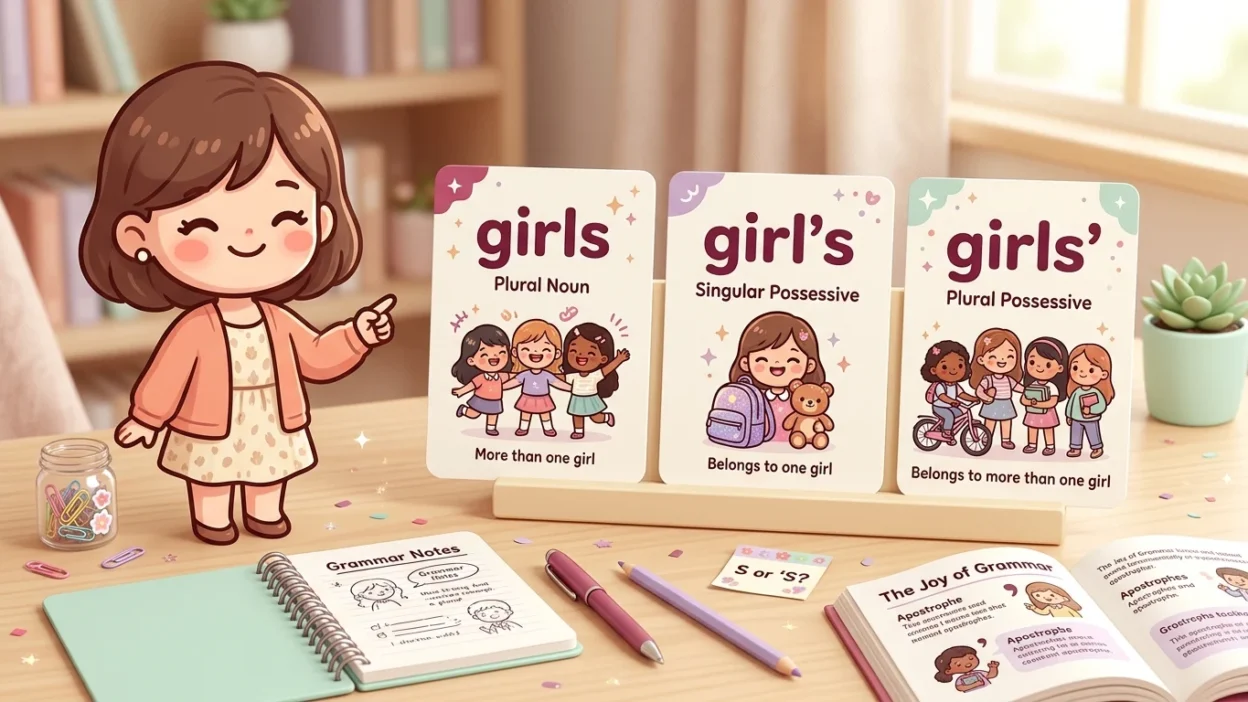
Let’s compare the forms using the word girl.
| Form | Example | Meaning |
|---|---|---|
| Girl | The girl is smiling. | One girl |
| Girls | The girls are smiling. | More than one girl |
| Girl’s | The girl’s bag is blue. | Bag belongs to one girl |
| Girls’ | The girls’ bags are blue. | Bags belong to multiple girls |
This pattern works with many regular nouns.
For example:
- teacher → teachers → teacher’s → teachers’
- student → students → student’s → students’
- friend → friends → friend’s → friends’
- customer → customers → customer’s → customers’
How to Form Singular Possessives
For most singular nouns, add ‘s.
Examples:
- the boy’s toy
- the girl’s dress
- the teacher’s book
- the dog’s food
- the company’s website
The general pattern is:
Singular noun + ‘s = singular possessive
For example:
boy + ‘s = boy’s
The apostrophe and s together show possession.
How to Form Plural Possessives
If a regular plural noun already ends in s, place the apostrophe after the s.
Examples:
- boys → boys’
- girls → girls’
- teachers → teachers’
- students → students’
- parents → parents’
For example:
- The boys’ room was messy.
- The teachers’ lounge is upstairs.
- The students’ books are on the table.
- The parents’ meeting starts at six.
The basic pattern is:
Plural noun ending in s + apostrophe = plural possessive
Irregular Plural Possessives
Some plural nouns do not end in s. These usually take ‘s to form the possessive.
Examples include:
- children → children’s
- men → men’s
- women → women’s
- people → people’s
- mice → mice’s
Examples:
- The children’s toys are everywhere.
- The men’s room is on the left.
- The women’s team won the match.
- The people’s choice surprised everyone.
So remember:
Regular plural ending in s → add apostrophe
Irregular plural not ending in s → add ‘s
Common Plural Mistakes
One of the most common mistakes is adding an apostrophe just because a word is plural.
Incorrect:
- ❌ Apple’s are expensive.
- ❌ Car’s are outside.
- ❌ Dog’s are friendly.
Correct:
- ✅ Apples are expensive.
- ✅ Cars are outside.
- ✅ Dogs are friendly.
The apostrophe is unnecessary because these words simply show more than one.
Common Possessive Mistakes
Another common mistake is forgetting the apostrophe when showing ownership.
Incorrect:
- ❌ The dog collar is dirty.
- ❌ The girl bag is missing.
- ❌ The teacher desk is clean.
Correct:
- ✅ The dog’s collar is dirty.
- ✅ The girl’s bag is missing.
- ✅ The teacher’s desk is clean.
The apostrophe helps show the relationship between the noun and the thing connected to it.
Simple Memory Trick
Plural = how many. Possessive = whose.
Think of it this way:
Books → How many? More than one.
Book’s → Whose book? It belongs to one person or thing.
Books’ → Whose books? They belong to multiple owners.
This simple question-and-answer trick can help you choose the correct form quickly.
Plural or Possessive in Sentences
Here are some examples that show the difference clearly.
Plural
- The students are studying.
- The teachers arrived early.
- The dogs are sleeping.
- The cars need cleaning.
Singular Possessive
- The student’s notebook is missing.
- The teacher’s desk is clean.
- The dog’s bowl is empty.
- The car’s engine sounds strange.
Plural Possessive
- The students’ notebooks are missing.
- The teachers’ desks are clean.
- The dogs’ bowls are empty.
- The cars’ engines sound strange.
Plural or Possessive in Questions
The same rules apply when you ask questions.
Plural:
- Where are the students?
- Are the dogs outside?
- How many books do you have?
Possessive:
- Where is the student’s notebook?
- Is that the dog’s toy?
- Whose book’s cover is damaged?
Plural possessive:
- Where are the students’ notebooks?
- Are those the dogs’ toys?
- Where are the teachers’ books?
Plural Possessive vs Singular Possessive
This is another area that often causes confusion.
Compare:
The girl’s shoes
This means the shoes belong to one girl.
The girls’ shoes
This means the shoes belong to multiple girls.
The position of the apostrophe changes the meaning.
- girl’s = one girl owns something
- girls’ = multiple girls own something
That tiny apostrophe can completely change the sentence.
What About Words That Already End in S?
Singular nouns that end in s can be confusing.
For example:
- James’s book
- the class’s schedule
- the boss’s office
Many modern style guides accept ‘s for singular possessive nouns, even when the noun already ends in s.
However, style conventions can vary for names and certain words. The most important thing is to follow the style guide used by your school, workplace, or publication.
Joint and Separate Possession
Plural and possessive grammar also matters when two or more people are connected to the same thing.
For joint possession:
- John and Mary’s house
This usually means John and Mary share one house.
For separate possession:
- John’s and Mary’s cars
This means John has one car and Mary has another.
The apostrophe placement helps communicate whether the owners share something or possess separate things.
Plural or Possessive With Family Names
Family names can also create confusion.
When talking about more than one member of a family, use the plural form:
- The Smiths are coming.
- We visited the Johnsons.
- The Browns moved to town.
When showing possession by the family as a group, the possessive form is used:
- The Smiths’ house is beautiful.
- The Johnsons’ car is new.
Remember:
Smiths = more than one Smith
Smiths’ = something belongs to the Smith family
Plural or Possessive in Signs and Business Writing
Businesses sometimes use possessive forms in names and descriptions.
Examples:
- Children’s Clothing
- Women’s Shoes
- Men’s Clothing
- Teachers’ Resources
- Students’ Services
These forms show that the products or services relate to a particular group.
For example, children’s clothing means clothing intended for children.
American vs British English
The basic difference between plural and possessive is the same in American and British English.
Both varieties use:
- boys for plural
- boy’s for singular possessive
- boys’ for plural possessive
There can be differences in style preferences for certain possessive constructions, especially with proper names, but the core rule remains the same.
Pronunciation Differences
Plural and possessive forms can sometimes sound identical.
For example:
- boys
- boy’s
- boys’
These forms can all be pronounced similarly in normal speech.
The difference often appears in writing, where the apostrophe provides important grammatical information.
That’s why proofreading matters when writing possessive nouns.
How to Tell If a Word Is Plural or Possessive
Use this quick three-step test:
Step 1: Look for an apostrophe
If there is no apostrophe, the word may simply be plural.
Example:
The girls are laughing.
Step 2: Ask “more than one?”
If yes, the word is probably plural.
Example:
The girls are laughing.
There is more than one girl.
Step 3: Ask “whose?”
If the sentence answers whose?, you probably need a possessive form.
Example:
The girl’s phone is ringing.
Whose phone?
The girl’s phone.
This method makes the difference much easier to spot.
Related Words and LSI Keywords
- plural or possessive
- plural vs possessive
- plural possessive
- singular possessive
- apostrophe rules
- plural noun
- possessive noun
- possessive apostrophe
- apostrophe grammar
- plural grammar rules
- singular vs plural
- boys vs boy’s vs boys’
- girls vs girl’s vs girls’
- teachers vs teacher’s vs teachers’
- students vs student’s vs students’
- English grammar
- common grammar mistakes
- English punctuation
- possessive nouns examples
- plural noun examples
Tips for Remembering the Difference
Keep these simple rules in mind:
- Plural means more than one.
- Possessive shows ownership or relationship.
- Regular plurals usually do not need apostrophes.
- Singular possessives usually take ‘s.
- Regular plural possessives usually take an apostrophe after the s.
- Irregular plural possessives usually take ‘s.
- Ask “How many?” for plural.
- Ask “Whose?” for possessive.
The easiest rule is:
Plural = how many?
Possessive = whose?
Frequently Asked Questions
What is the difference between plural and possessive?
A plural noun shows more than one person, place, thing, or idea. A possessive noun shows ownership, belonging, or a relationship.
Does a plural noun need an apostrophe?
Usually, no. Regular plural nouns normally use s or es without an apostrophe.
For example:
- books
- cars
- teachers
What is a plural possessive?
A plural possessive shows that something belongs to more than one person or thing.
Example:
The students’ classroom
The classroom belongs to or is associated with multiple students.
What is the difference between boys and boy’s?
Boys is plural and means more than one boy.
Boy’s is singular possessive and means something belongs to one boy.
What is the difference between boys and boys’?
Boys means more than one boy.
Boys’ shows that something belongs to or is associated with multiple boys.
Is it students or student’s?
Use students when you mean more than one student.
Use student’s when something belongs to one student.
For example:
- The students are learning.
- The student’s book is open.
Is it students or students’?
Use students for the plural.
Use students’ for the plural possessive.
For example:
- The students are outside.
- The students’ bags are outside.
Is children’s plural or possessive?
Children is already plural.
Children’s is the possessive form of the irregular plural noun children.
Example:
The children’s toys are colorful.
Can a word be both plural and possessive?
Yes. A word can be both plural and possessive at the same time.
For example:
teachers’
It refers to multiple teachers and shows possession or association.
Why do possessive nouns use apostrophes?
Apostrophes help show ownership, belonging, or a relationship between a noun and another word.
For example:
Sarah’s phone
The phone belongs to Sarah.
How can I remember plural vs possessive?
Ask two questions:
How many? → plural
Whose? → possessive
This quick test works in many everyday sentences.
Are plural and possessive the same thing?
No. A plural noun tells you that there is more than one. A possessive noun tells you that something belongs to or relates to someone or something.
Summary
Understanding plural or possessive becomes much easier when you remember one simple distinction: plural tells you how many, while possessive tells you whose. A plural noun usually does not need an apostrophe, while a possessive noun normally uses one.
For example, girls means more than one girl, girl’s shows possession by one girl, and girls’ shows possession by multiple girls. Once you learn to ask “How many?” or “Whose?”, you can quickly choose the correct form and avoid common apostrophe mistakes in your writing.

Rowan Blythecroft crafts atmospheric fiction filled with mystery and folklore.
Her stories often blur the line between reality and imagination.
She spends most of her days wandering forests and writing by candlelight.