Have you ever paused while writing and wondered whether girls or girl’s is correct? You’re not alone. This is one of those small English grammar differences that can completely change the meaning of a sentence. The good news is that once you understand the role of the apostrophe, the difference becomes very easy.
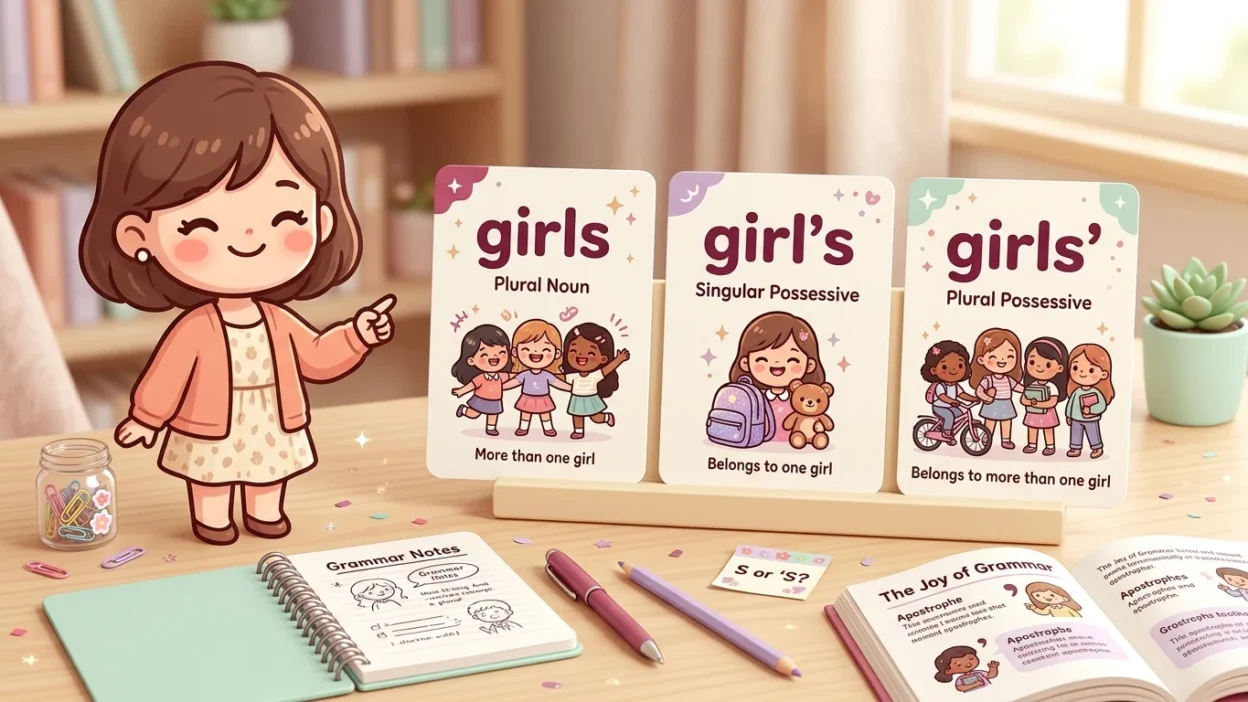
Girls is the plural form of girl, meaning more than one girl. Girl’s, on the other hand, is the singular possessive form, meaning that something belongs to or is associated with one girl. There is also a third form worth knowing: girls’, which shows possession by multiple girls.
Quick Answer
The difference is simple:
- Girls ✅ = more than one girl.
- Girl’s ✅ = something belongs to one girl.
- Girls’ ✅ = something belongs to multiple girls.
Examples:
- The girls are playing outside. ✅
- The girl’s bag is blue. ✅
- The girls’ bags are blue. ✅
So remember:
Girls = plural
Girl’s = singular possessive
Girls’ = plural possessive
What Does Girls Mean?
Girls is the plural form of girl.
Use girls when you are talking about two or more girls.
Examples:
- The girls are studying.
- Three girls joined the team.
- The girls went to school together.
- Those girls are my friends.
- Several girls were waiting outside.
When girls simply means more than one girl, it does not need an apostrophe.
For example:
- The girls are happy. ✅
- The girl’s are happy. ❌
The second version is incorrect because girl’s does not mean plural.
What Does Girl’s Mean?
Girl’s is the singular possessive form of girl.
Use girl’s when something belongs to, is connected to, or is associated with one girl.
Examples:
- The girl’s bag is on the chair.
- The girl’s bicycle is outside.
- The girl’s name is Emma.
- I found the girl’s jacket.
- The girl’s mother called.
In each example, the apostrophe comes before the s because the possession belongs to one girl.
For example:
The girl’s book
means:
The book belongs to one girl.
What Does Girls’ Mean?
Girls’ is the plural possessive form of girls.
Use girls’ when something belongs to or is associated with multiple girls.
Examples:
- The girls’ bags are on the floor.
- The girls’ classroom is upstairs.
- The girls’ team won the match.
- The girls’ parents attended the meeting.
- The girls’ bicycles are outside.
The apostrophe comes after the s because girls is already plural.
Compare:
- girl’s = belonging to one girl
- girls’ = belonging to multiple girls
Girls vs Girl’s Comparison Table
| Form | Correct? | Meaning | Example |
|---|---|---|---|
| Girl | ✅ Yes | One girl | The girl is reading. |
| Girls | ✅ Yes | More than one girl | The girls are reading. |
| Girl’s | ✅ Yes | Belonging to one girl | The girl’s book is here. |
| Girls’ | ✅ Yes | Belonging to multiple girls | The girls’ books are here. |
The key difference is:
Girls = many
Girl’s = one owner
Girls’ = many owners
Girls in Sentences
Use girls when you simply mean more than one girl.
Examples:
- The girls are playing football.
- Two girls entered the room.
- The girls went shopping.
- Several girls joined the club.
- Those girls are classmates.
- The girls finished their homework.
Notice that there is no apostrophe.
Correct
- The girls are outside. ✅
- Five girls entered the classroom. ✅
- The girls won the competition. ✅
Incorrect
- The girl’s are outside. ❌
- Five girl’s entered the classroom. ❌
- The girl’s won the competition. ❌
If you are simply talking about multiple girls, always use girls.
Girl’s in Sentences
Use girl’s when one girl owns something or is connected to something.
Examples:
- The girl’s phone is ringing.
- The girl’s dress is beautiful.
- The girl’s shoes are dirty.
- The girl’s room is upstairs.
- The girl’s father is a doctor.
- The girl’s handwriting is neat.
For example:
The girl’s shoes are dirty.
This means the shoes belong to one girl.
The fact that shoes is plural does not change the possessive form because the owner is still one girl.
Girls’ in Sentences
Use girls’ when multiple girls own or are associated with something.
Examples:
- The girls’ shoes are dirty.
- The girls’ room is upstairs.
- The girls’ uniforms are ready.
- The girls’ parents arrived early.
- The girls’ team practiced yesterday.
For example:
The girls’ shoes are dirty.
This means the shoes belong to multiple girls.
Girls vs Girl’s vs Girls’ Main Difference
The difference is based on number and possession.
Girls
Means more than one girl.
Example:
- The girls are laughing.
There is no possessive meaning.
Girl’s
Means belonging to one girl.
Example:
- The girl’s bag is missing.
There is one owner.
Girls’
Means belonging to multiple girls.
Example:
- The girls’ bags are missing.
There are multiple owners.
Therefore:
Girls = plural
Girl’s = singular possessive
Girls’ = plural possessive
Why Are Girls and Girl’s Confused?
The confusion usually happens because the words look almost identical.
The only visible difference is the apostrophe.
Some writers also mistakenly believe that an apostrophe is needed to make a noun plural.
That is not normally true.
For example:
- girl → girls
- boy → boys
- student → students
- teacher → teachers
The apostrophe is used for possession, not simply to create a plural.
So:
- girls = plural
- girl’s = singular possessive
- girls’ = plural possessive
Common Mistakes People Make
Mistake 1: Using Girl’s as the Plural
Incorrect:
- ❌ There are three girl’s in the classroom.
Correct:
- ✅ There are three girls in the classroom.
You need girls because you are talking about more than one girl.
Mistake 2: Forgetting the Apostrophe
Incorrect:
- ❌ The girls bag is missing.
Correct:
- ✅ The girl’s bag is missing.
If the bag belongs to one girl, use girl’s.
Mistake 3: Using Girl’s for Multiple Owners
Incorrect:
- ❌ The girl’s bags are outside.
If the bags belong to multiple girls, write:
- ✅ The girls’ bags are outside.
The apostrophe moves after the s.
Mistake 4: Using Girls’ as the Plural
Incorrect:
- ❌ The girls’ are playing outside.
Correct:
- ✅ The girls are playing outside.
Girls’ is possessive, so it should not be used simply as the plural form.
Simple Memory Trick
💡 Memory Trick
Girls = many girls
Girl’s = one girl owns or has something
Girls’ = many girls own or have something
Ask yourself:
How many girls? → girls
Whose? One girl? → girl’s
Whose? Multiple girls? → girls’
Remember:
No apostrophe = plural
’s = one owner
s’ = multiple owners
Singular Possessive: Girl’s
For a singular noun such as girl, add ’s to form the possessive.
Pattern:
girl + ’s = girl’s
Examples:
- the girl’s book
- the girl’s bicycle
- the girl’s phone
- the girl’s room
- the girl’s jacket
Sentence examples:
- The girl’s book is on the desk.
- The girl’s bicycle is red.
- I found the girl’s phone.
The apostrophe comes before the s.
Plural Possessive: Girls’
For the regular plural noun girls, which already ends in s, add only an apostrophe.
Pattern:
girls + ’ = girls’
Examples:
- the girls’ books
- the girls’ bicycles
- the girls’ room
- the girls’ uniforms
- the girls’ team
Sentence examples:
- The girls’ books are on the desk.
- The girls’ bicycles are outside.
- The girls’ uniforms are ready.
The apostrophe comes after the s.
Girls vs Girl’s With “Are” and “Is”
Verb agreement can help you understand the difference.
Use girls with a plural verb such as are:
- The girls are playing.
- The girls are happy.
- The girls are ready.
Use girl with a singular verb:
- The girl is playing.
- The girl is happy.
- The girl is ready.
For possession:
- The girl’s bag is blue.
- The girls’ bags are blue.
This gives you another useful clue:
girl’s bag is → one girl
girls’ bags are → multiple girls
Girls or Girl’s in Questions
The same rules apply in questions.
Examples:
- Where are the girls?
- Are the girls ready?
- Is this the girl’s bag?
- Where is the girl’s bicycle?
- Are these the girls’ shoes?
- Where is the girls’ classroom?
Compare:
Where are the girls?
You are asking about multiple girls.
Where is the girl’s bag?
You are asking about a bag belonging to one girl.
Where are the girls’ bags?
You are asking about bags belonging to multiple girls.
Girls or Girl’s in Negative Sentences
Examples with girls:
- The girls are not outside.
- The girls didn’t leave.
- The girls aren’t ready.
Examples with girl’s:
- The girl’s bag isn’t here.
- The girl’s bicycle isn’t working.
Examples with girls’:
- The girls’ bags aren’t here.
- The girls’ classroom isn’t open.
The grammatical rules remain exactly the same in negative sentences.
Girls or Girl’s in Clothing
This distinction often appears in clothing and shopping phrases.
Correct examples include:
- girls’ clothing
- girls’ shoes
- girls’ dresses
- girls’ jackets
- girls’ fashion
These phrases refer to clothing intended for or associated with multiple girls.
By contrast:
- girl’s dress = a dress belonging to one girl.
- girls’ dresses = dresses belonging to or intended for multiple girls.
Compare:
The girl’s dress is beautiful.
One girl owns the dress.
The girls’ dresses are beautiful.
Multiple girls have dresses.
Girls vs Girl’s in School and Education
You may see all three forms in educational contexts.
Examples:
- The girls are studying.
- The girl’s notebook is missing.
- The girls’ notebooks are missing.
- The girls’ classroom is upstairs.
- The girls’ team won the competition.
Again, the apostrophe tells you whether possession is involved.
Girls’ vs Women’s
Both girls’ and women’s can be plural possessive forms, but they follow different spelling patterns.
Girls ends in s, so:
girls → girls’
Women does not end in s, so:
women → women’s
Examples:
- girls’ clothing
- women’s clothing
- girls’ shoes
- women’s shoes
This is a useful way to understand why the apostrophe appears in different positions.
Girls vs Girl’s Pronunciation
In ordinary speech, girls and girl’s may sound very similar.
Girls has the plural ending.
Girl’s has a possessive ending.
Girls’ is generally pronounced the same as girls.
This means that context is especially important when you’re listening.
The written apostrophe tells the reader whether the word is plural or possessive.
American vs British English
American and British English follow the same basic rules for girls, girl’s, and girls’.
Both use:
- girls = plural
- girl’s = singular possessive
- girls’ = plural possessive
Examples:
- The girls are outside.
- The girl’s bag is here.
- The girls’ bags are here.
There is no significant spelling difference between American and British English in these forms.
Girls or Girl’s in Professional Writing
Using the correct form is especially important in:
- School assignments
- Business writing
- Product descriptions
- Websites
- Reports
- Emails
- Advertisements
- Educational content
For example, if you’re describing a clothing category, write:
Girls’ clothing
not:
Girl’s clothing or Girls clothing
The correct form depends on whether you’re referring to one girl or a group.
Girls vs Girl’s vs Girls’ Examples
Correct Uses of Girls
- The girls are playing. ✅
- Several girls joined the club. ✅
- The girls are studying. ✅
- Those girls are my classmates. ✅
Correct Uses of Girl’s
- The girl’s book is missing. ✅
- The girl’s phone is ringing. ✅
- The girl’s bicycle is red. ✅
- The girl’s jacket is wet. ✅
Correct Uses of Girls’
- The girls’ books are missing. ✅
- The girls’ phones are ringing. ✅
- The girls’ bicycles are red. ✅
- The girls’ jackets are wet. ✅
Incorrect Uses
- ❌ The girl’s are playing.
- ❌ The girls book is missing.
- ❌ The girls’ are playing.
- ❌ Three girl’s joined the club.
Correct versions:
- ✅ The girls are playing.
- ✅ The girl’s book is missing.
- ✅ The girls’ books are missing.
- ✅ Three girls joined the club.
How to Choose Between Girls and Girl’s
Use this simple process.
Step 1: Ask “How many girls?”
If you mean more than one:
Girls
Example:
- The girls are laughing.
Step 2: Ask “Is something connected to or owned by one girl?”
If yes:
Girl’s
Example:
- The girl’s backpack is heavy.
Step 3: Ask “Is something connected to or owned by multiple girls?”
If yes:
Girls’
Example:
- The girls’ backpacks are heavy.
This method makes the difference much easier to remember.
When Should You Use Girls?
Use girls when:
- You mean two or more girls.
- You are using the plural noun.
- You are not showing possession.
Examples:
- The girls are outside.
- Five girls joined the team.
- The girls won the match.
- Those girls are students.
When Should You Use Girl’s?
Use girl’s when:
- You mean one girl.
- Something belongs to one girl.
- Something is associated with one girl.
Examples:
- The girl’s bag is blue.
- The girl’s name is Sara.
- The girl’s bicycle is outside.
- The girl’s parents arrived.
When Should You Use Girls’?
Use girls’ when:
- Multiple girls own something.
- Something is associated with multiple girls.
- You are forming a plural possessive from girls.
Examples:
- The girls’ bags are blue.
- The girls’ team won.
- The girls’ classroom is clean.
- The girls’ parents arrived.
Related Words and LSI Keywords
- girls or girl’s
- girls vs girl’s
- girl’s vs girls
- girls vs girls’
- girl’s meaning
- girls meaning
- girls’ meaning
- girls apostrophe
- girl possessive
- singular possessive
- plural possessive
- girls plural
- girl’s possessive
- girls’ possessive
- when to use girls
- when to use girl’s
- when to use girls’
- girls grammar
- girl’s grammar
- girls’ grammar
- apostrophe rules
- apostrophe after s
- plural apostrophe
- English grammar
- English spelling
- commonly confused words
- possessive nouns
- plural nouns
- grammar mistakes
- correct English usage
- English language learning
- grammar guide
Tips for Remembering the Difference
- Girl = one girl.
- Girls = more than one girl.
- Girl’s = belonging to one girl.
- Girls’ = belonging to multiple girls.
- Don’t use an apostrophe simply to make girl plural.
- Use girls when you’re talking about several girls.
- Use girl’s when one girl owns or is connected to something.
- Use girls’ when multiple girls own or are connected to something.
- Remember: ’s = one owner.
- Remember: s’ = multiple owners.
- Ask “How many?” to identify a plural.
- Ask “Whose?” to identify a possessive.
FAQs
What is the difference between girls and girl’s?
Girls is the plural form of girl, meaning more than one girl. Girl’s is the singular possessive form, meaning something belongs to one girl.
Is girls a plural word?
Yes. Girls is the plural of girl.
Example:
- One girl
- Two girls
Is girl’s correct?
Yes. Girl’s is correct when showing possession by one girl.
Example:
- The girl’s bag is blue.
Is girls’ correct?
Yes. Girls’ is the plural possessive form.
Example:
- The girls’ bags are blue.
Is it girls or girl’s for more than one?
Use girls.
Example:
- Three girls are waiting outside.
Do not use girl’s to make the word plural.
What is the difference between girl’s and girls’?
Girl’s means belonging to one girl.
Girls’ means belonging to multiple girls.
Examples:
- The girl’s bag = one girl.
- The girls’ bags = multiple girls.
Should girls have an apostrophe?
Not when you simply mean more than one girl.
Correct:
- The girls are playing.
Use an apostrophe when showing possession:
- The girls’ bags are outside.
Is “the girl’s are playing” correct?
No.
The correct sentence is:
- The girls are playing.
Girl’s is possessive, not plural.
Is “the girls’ are playing” correct?
No.
The correct sentence is:
- The girls are playing.
The form girls’ should be used to show possession.
Is “girls clothing” correct?
In standard English, girls’ clothing is the preferred form when referring to clothing intended for or associated with girls.
Is “girl’s clothing” correct?
It can be correct if you’re talking about clothing belonging to one specific girl.
For example:
- The girl’s clothing was packed into a suitcase.
For a general category intended for multiple girls, girls’ clothing is more appropriate.
What is the difference between girls’ clothing and girl’s clothing?
Girls’ clothing refers generally to clothing for or associated with multiple girls.
Girl’s clothing refers to clothing belonging to or associated with one specific girl.
Are girls and girls’ pronounced the same?
Yes. Girls and girls’ are generally pronounced the same. The apostrophe changes the grammatical meaning, not the pronunciation.
Is girls’ singular or plural?
Girls’ is plural possessive. It comes from the plural noun girls and shows possession or association involving multiple girls.
How do I remember girls vs girl’s?
Remember:
Girls = many girls
Girl’s = one girl owns something
Girls’ = many girls own something
Then ask yourself:
How many? → girls
Whose? One? → girl’s
Whose? Many? → girls’
Is girls or girl’s correct?
Both can be correct, but they have different meanings. Girls is plural, while girl’s is singular possessive. The correct choice depends on the sentence.
Summary
The difference between girls or girl’s is easy once you understand plural and possessive nouns. Girls means more than one girl and does not need an apostrophe. Girl’s means that something belongs to or is associated with one girl, so the apostrophe comes before the s. The third form, girls’, shows possession or association involving multiple girls, with the apostrophe placed after the s.
The easiest way to remember the difference is to ask two questions: “How many?” and “Whose?” If you’re talking about more than one girl, use girls. If something belongs to one girl, use girl’s. If something belongs to multiple girls, use girls’. Once you understand this simple pattern, choosing the correct form becomes much easier.

Rowan Blythecroft crafts atmospheric fiction filled with mystery and folklore.
Her stories often blur the line between reality and imagination.
She spends most of her days wandering forests and writing by candlelight.