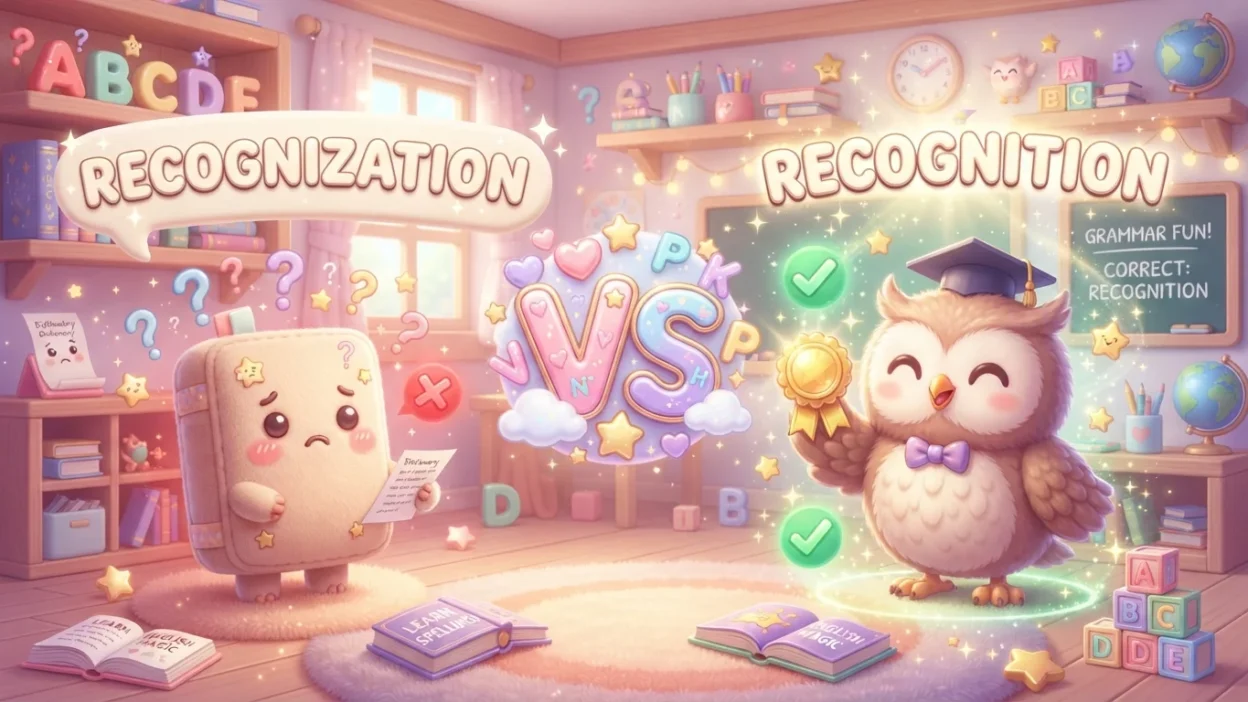
The keyword recognization vs recognition helps explain a common English spelling question clearly and naturally for everyday and professional writing purposes today. Have you ever wondered whether recognization or recognition sounded more natural in English? Many people make this mistake in everyday writing because the verb recognize ends in -ize. It is easy to assume that the noun form should naturally be recognization. However, English does not always follow predictable patterns.
The good news is that the answer is simple. In modern English, recognition is the standard, correct, and widely accepted word. It is the right choice for both professional and everyday writing. Recognition is generally preferred because it fits standard usage and sounds more natural.
The word recognization has appeared in historical and technical contexts, but it is rarely used today. It is generally considered nonstandard in modern English. If you want clear and professional writing, recognition remains the best choice.
Quick Answer
- Recognition is the correct and standard noun form in modern English.
- Recognization is considered nonstandard and is rarely used today.
- In almost all situations, you should use recognition.
Examples:
- She received recognition for her hard work.
- The company gained international recognition.
- His talent deserves recognition from his peers.
What Does Recognization vs Recognition Mean?
Both words are related to the verb “recognize,” which means to identify, acknowledge, or appreciate someone or something.
However, they are not equally accepted in modern English.
- Recognition is the widely accepted noun used in everyday and professional writing.
- Recognization exists historically and occasionally appears in technical or older texts, but it is uncommon and generally discouraged.
If you’re unsure which word to use, recognition is almost always the right choice.
Why Is Recognition Correct?
English does not always form nouns by simply adding a common suffix to a verb. While many people assume:
- Recognize → Recognization
The standard noun is actually:
- Recognize → Recognition
This follows historical language development rather than a simple spelling rule.
Recognition has been used for centuries in literature, academic writing, business communication, and everyday English. Today, dictionaries, style guides, and professional writers overwhelmingly prefer recognition.
Recognization vs Recognition Comparison Table
| Feature | Recognization | Recognition |
|---|---|---|
| Correct Modern English Usage | Rarely | Yes |
| Dictionary Acceptance | Limited/Historical | Yes |
| Common in Professional Writing | No | Yes |
| Used in Everyday English | Very Rare | Very Common |
| Recommended for Students | No | Yes |
| Accepted Worldwide | Rarely | Yes |
Meaning of Recognition
The word recognition can mean:
- Identifying someone or something.
- Receiving praise or acknowledgment.
- Being officially accepted or approved.
- Becoming well known or respected.
Examples:
- The scientist received recognition for her research.
- Facial recognition technology is widely used today.
- The charity earned public recognition for its efforts.
- His work deserves greater recognition.
Recognition is commonly used in:
- Business writing
- Academic writing
- Professional communication
- Legal and governmental documents
- Everyday conversations
Meaning of Recognization
The word recognization is an uncommon noun that occasionally appears in older writings and highly specialized contexts.
Although some dictionaries acknowledge that the word has existed historically, it is not considered standard English today.
Modern writers almost always replace it with recognition.
Examples of uncommon historical usage include:
- Philosophical texts
- Older linguistic discussions
- Technical language from previous centuries
Unless you are quoting historical materials, it is best to avoid using recognization.
Examples of Correct Usage
Using Recognition:
- She received recognition for her volunteer work.
- The school gained national recognition.
- Recognition of employee achievements improves workplace morale.
- The artist earned worldwide recognition.
Incorrect or Nonstandard Usage:
- The recognization of his efforts was appreciated.
- Their recognization in the industry continues to grow.
Better alternatives:
- Their recognition in the industry continues to grow.
- The recognition of his efforts was appreciated.
Common Mistakes People Make
Many writers mistakenly:
- Use recognization because it sounds logical.
- Assume every “-ize” verb becomes “-ization.”
- Copy uncommon spellings found online.
- Use recognization in academic writing.
- Fail to proofread spelling differences.
Remember:
- Organize → Organization
- Realize → Realization
- Recognize → Recognition
English loves exceptions, and this is one of them.
Easy Memory Trick
Remember this simple rule:
If you’re talking about praise, acknowledgment, or identification, choose recognition, not recognization.
Another helpful trick is:
Recognition is recognized by modern English.
If it sounds professional and familiar, it’s probably recognition.
American vs British English
Good news! There is no spelling difference here.
Both American English and British English use:
- Recognition
Neither variety of English commonly uses recognization.
So whether you’re writing for readers in the United States, Canada, Australia, or the United Kingdom, recognition remains the correct choice.
Related Words and LSI Keywords
The following related terms can naturally improve your understanding of the topic:
- recognition meaning
- recognization meaning
- recognize vs recognition
- noun forms in English
- English spelling rules
- commonly confused words
- vocabulary guide
- grammar tips
- professional writing
- correct English usage
- English language learning
- recognition examples
- standard English spelling
- language patterns
- business writing
When Should You Use Recognition?
Use recognition when discussing:
- Awards and achievements
- Professional acknowledgment
- Brand recognition
- Academic writing
- Legal recognition
- Facial recognition technology
- Public appreciation
- Official acceptance
When Should You Avoid Recognization?
Avoid recognization in:
- Essays
- Professional documents
- Business communication
- Blogs and websites
- Academic assignments
- Formal writing
Unless you are intentionally referencing historical language usage, recognition is the preferred option.
Frequently Asked Questions
Is recognization a real word?
Yes, it has existed historically, but it is rarely used and is considered nonstandard in modern English.
Which is correct: recognization or recognition?
Recognition is the correct and widely accepted word in modern English.
Why do people use recognization?
People often assume it follows the same pattern as organization or realization because it comes from the verb recognize.
Is recognization grammatically wrong?
It is not completely wrong historically, but it is inappropriate for most modern writing situations.
Is recognition used in American and British English?
Yes. Both varieties of English use recognition.
Can I use recognization in professional writing?
No. Recognition is strongly recommended for professional and academic writing.
What does recognition mean?
Recognition refers to acknowledgment, identification, appreciation, or official acceptance of someone or something.
Summary
The difference between recognization vs recognition is simple once you know the history behind the words.
Recognition is the standard noun form used throughout modern English. It is clear, professional, and universally accepted in both formal and informal writing.
Although recognization has historical roots, it is rarely used today and may sound incorrect or awkward to most readers. When in doubt, recognition is the safest and most natural choice for virtually every situation.

Cedric Halewood is known for his intricate historical narratives.
His work reflects a deep fascination with lost civilizations.
He lives near the coast, where he finds inspiration in the sea.