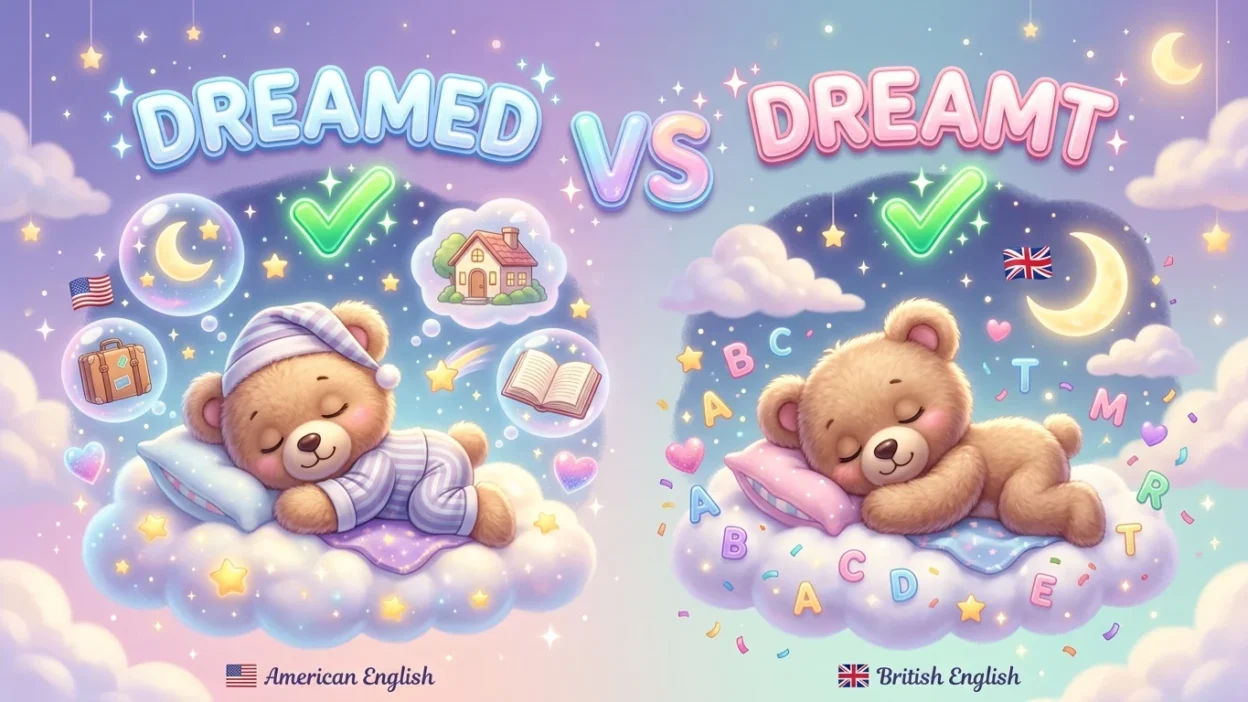
Have you ever wondered whether dreamed or dreamt is the correct past tense of dream? You’re not alone. Both forms are grammatically correct, but their usage can depend on regional preference, writing style, and context. Dreamed is especially common in American English, while dreamt is more common in British English and other varieties.
In this guide, you’ll learn the difference between dreamed vs dreamt, including their meanings, grammar rules, examples, American and British English differences, common mistakes, and an easy memory trick. By the end, you’ll know which form to use confidently in everyday and formal writing.
Quick Answer
- Dreamed ✅ — The regular past tense and past participle of dream; especially common in American English.
- Dreamt ✅ — An alternative past tense and past participle; especially common in British English.
Examples:
- I dreamed about traveling last night.
- I dreamt about traveling last night.
Both sentences are correct.
What Do Dreamed and Dreamt Mean?
What Does Dreamed Mean?
Dreamed is the regular past tense and past participle of the verb dream.
It means that someone experienced a dream while sleeping or imagined, hoped for, or strongly desired something.
Examples:
- I dreamed about my childhood last night.
- She dreamed of becoming a writer.
- He dreamed about visiting Japan.
- They dreamed of building their own home.
Dreamed is particularly common in American English and is completely standard.
What Does Dreamt Mean?
Dreamt is an alternative past tense and past participle of dream.
It has the same basic meaning as dreamed.
Examples:
- I dreamt about my childhood last night.
- She dreamt of becoming a writer.
- He dreamt about traveling around the world.
Dreamt is especially common in British English and can give writing a slightly more traditional or literary feel.
Dreamed vs Dreamt Comparison Table
| Feature | Dreamed | Dreamt |
|---|---|---|
| Meaning | Past form of dream | Past form of dream |
| Grammar | Past tense/past participle | Past tense/past participle |
| American English | Very common | Less common |
| British English | Common | Very common |
| Formality | Standard | Standard |
| Example | I dreamed about it. | I dreamt about it. |
Why Are Dreamed and Dreamt Confused?
The confusion comes from the fact that dreamed and dreamt are both accepted past forms of dream.
Unlike some spelling differences where one form is considered incorrect, neither word is wrong.
For example:
- I dreamed about flying.
- I dreamt about flying.
Both are grammatically correct.
The main difference is usually regional preference.
American English tends to favor dreamed, while British English often favors dreamt.
Examples of Dreamed in Sentences
- I dreamed about the ocean last night.
- She dreamed of becoming a doctor.
- He dreamed about his old school.
- We dreamed of traveling the world.
- They dreamed about their future together.
- I had dreamed of visiting that city for years.
- She dreamed that she was flying.
Examples of Dreamt in Sentences
- I dreamt about the ocean last night.
- She dreamt of becoming a doctor.
- He dreamt about his old school.
- We dreamt of traveling the world.
- They dreamt about their future together.
- I had dreamt of visiting that city for years.
- She dreamt that she was flying.
The meanings are essentially the same as the corresponding dreamed examples.
Common Mistakes People Make
One common mistake is thinking that dreamt is incorrect because it is less familiar to some American English speakers.
That’s not true. Dreamt is a standard English form.
Another mistake is thinking that dreamed is incorrect in British English.
It isn’t. Dreamed is also grammatically correct, although dreamt may be more common in British usage.
Incorrect assumption:
- ❌ “Dreamt is always wrong.”
Correct:
- ✅ Dreamt is a standard alternative past tense of dream.
Another incorrect assumption:
- ❌ “Dreamed is only American English.”
Better:
- ✅ Dreamed is widely used in American English and is also used in British English.
Simple Memory Trick
💡 Memory Trick
Spelling Box
Remember:
DREAMED = AMERICAN FAVORITE
DREAMT = BRITISH FAVORITE
Both forms are correct.
Rule: Choose based on your audience and keep your usage consistent.
Dreamed and Dreamt as Past Tense
Both dreamed and dreamt can function as the simple past tense of dream.
Examples:
- I dreamed about flying.
- I dreamt about flying.
They can also be used as past participles.
Examples:
- I have dreamed about this moment for years.
- I have dreamt about this moment for years.
Both forms work grammatically.
Dreamed vs Dreamt for Aspirations
The verb dream doesn’t only refer to sleeping.
It can also mean to hope for or strongly desire something.
Both forms work in this meaning.
Examples:
- She dreamed of becoming a successful artist.
- She dreamt of becoming a successful artist.
Another example:
- He had always dreamed of owning a business.
- He had always dreamt of owning a business.
The meaning remains the same.
Dreamed vs Dreamt in Literature
Dreamt can sometimes feel more literary, traditional, or poetic because of its strong association with British English and older forms of English.
For example:
- He dreamt of a distant land.
This can sound slightly more poetic than:
- He dreamed of a distant land.
However, the choice is stylistic rather than a strict grammatical rule.
Dreamed vs Dreamt in Everyday English
Both forms can be used in everyday conversation.
In American English, you’ll probably hear:
- I dreamed about you last night.
In British English, you may hear:
- I dreamt about you last night.
Neither is incorrect.
The best choice often depends on the variety of English you’re using.
When Should You Use Dreamed?
Use dreamed when:
- Writing primarily for an American audience.
- Following American English conventions.
- You prefer the regular -ed form.
- You want a familiar form for a broad international audience.
Examples:
- I dreamed about traveling.
- She dreamed of becoming a writer.
When Should You Use Dreamt?
Use dreamt when:
- Writing primarily for a British audience.
- Following British English conventions.
- You prefer traditional or literary wording.
- The surrounding text uses other British-style forms.
Examples:
- I dreamt about traveling.
- She dreamt of becoming a writer.
Dreamed vs Dreamt in Formal Writing
Both forms are acceptable in formal writing.
The important thing is consistency.
If you’re writing in American English, dreamed will generally sound more natural.
If you’re writing in British English, dreamt may feel more natural.
Neither form is inherently more formal or more grammatically correct.
American vs British English
This is where the main difference appears.
American English
Dreamed is generally more common.
Example:
- I dreamed about traveling last night.
British English
Dreamt is generally more common.
Example:
- I dreamt about traveling last night.
However, British speakers can also use dreamed, and American speakers can understand and use dreamt.
Both forms are standard English.
Related Words and LSI Keywords
- dreamed meaning
- dreamt meaning
- dreamed vs dreamt
- dream past tense
- past tense of dream
- dream past participle
- dreamt British English
- dreamed American English
- British English spelling
- American English spelling
- dream about
- dream of
- dreamed about
- dreamt about
- English grammar
- verb forms
- irregular verbs
- commonly confused words
- English vocabulary
- correct English usage
Tips for Remembering the Difference
- Dreamed and dreamt are both correct.
- Dreamed is more common in American English.
- Dreamt is more common in British English.
- Both can refer to sleeping dreams or hopes for the future.
- Use the form that matches your preferred variety of English.
- Be consistent throughout a piece of writing.
Frequently Asked Questions
Is dreamed or dreamt correct?
Both dreamed and dreamt are correct past forms of dream.
Is dreamt British or American?
Dreamt is especially common in British English, while dreamed is generally more common in American English.
Is dreamed correct in British English?
Yes. Dreamed is grammatically correct in British English, although dreamt is often more common.
Is dreamt correct in American English?
Yes. Dreamt is understood and accepted in American English, although dreamed is more common.
Which is more common, dreamed or dreamt?
Usage depends on region. Dreamed is generally more common in American English, while dreamt is more common in British English.
Can dreamed and dreamt mean the same thing?
Yes. They can both refer to experiencing a dream while sleeping or imagining and hoping for something.
Which form should I use in formal writing?
Both are acceptable. Choose the form that matches your target variety of English and maintain consistency.
What is the past tense of dream?
Both dreamed and dreamt are correct past-tense forms of dream.
Summary
The difference between dreamed vs dreamt is mainly a matter of regional preference rather than correctness. Both words are standard past tense and past participle forms of dream, and both can describe dreams during sleep or hopes and aspirations.
Dreamed is more common in American English, while dreamt is more common in British English. However, both forms can appear in either variety. If you’re writing for an American audience, dreamed may feel more natural; for a British audience, dreamt may be the preferred choice.

Rowan Blythecroft crafts atmospheric fiction filled with mystery and folklore.
Her stories often blur the line between reality and imagination.
She spends most of her days wandering forests and writing by candlelight.