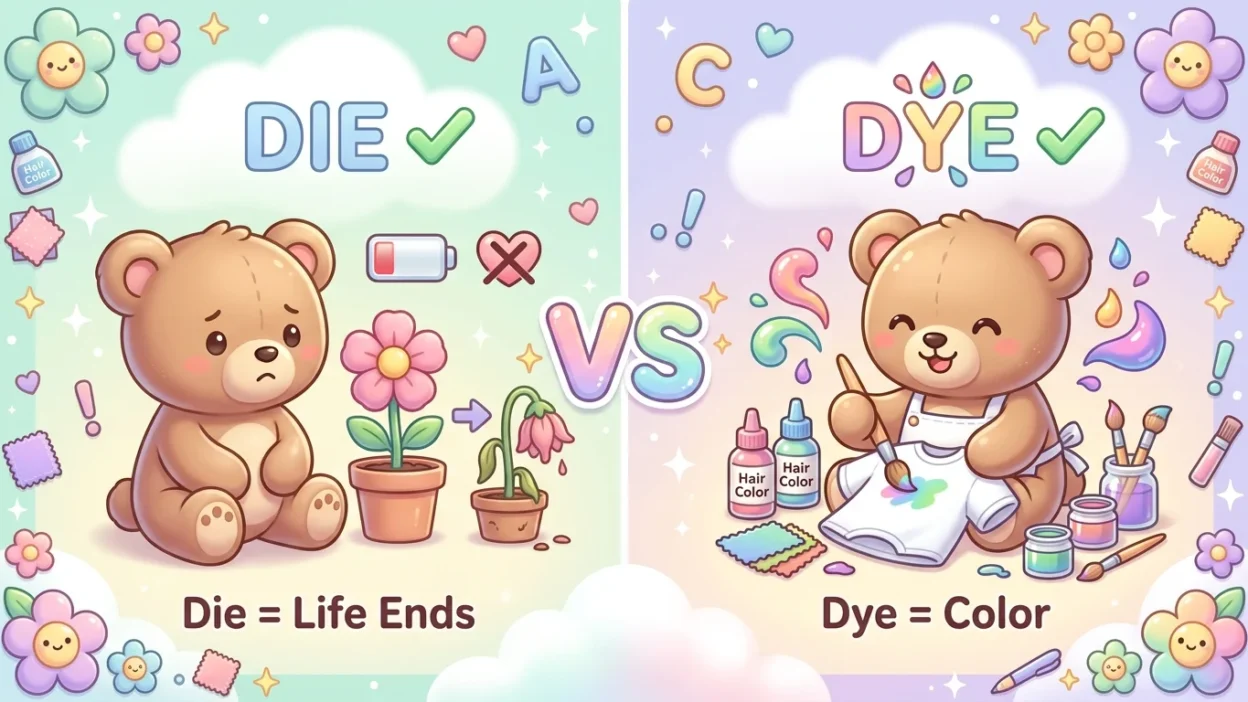
Have you ever wondered whether die or dye is the correct word? You’re not alone. These words sound exactly alike, but they have completely different meanings and uses. Die commonly refers to losing life or can describe a tool used for cutting or shaping materials, while dye refers to a substance used to change the color of something.
In this guide, you’ll learn the difference between die vs dye, including their meanings, examples, grammar rules, common mistakes, and an easy memory trick. Once you connect each spelling with its meaning, you’ll find it much easier to use the right word.
Quick Answer
- Die ✅ — To stop living; it can also refer to a tool, a singular gaming cube, or other specific meanings.
- Dye ✅ — A substance used to change the color of something, or the act of coloring something.
Examples:
- Plants die without enough water.
- I want to dye my shirt blue.
What Do Die and Dye Mean?
What Does Die Mean?
Die has several meanings, but the most common one is related to life.
As a verb, die means to stop living.
Examples:
- Plants die without water.
- The fish died yesterday.
- Everyone eventually dies.
It can also be used in phrases and expressions.
Examples:
- I was dying of laughter.
- He almost died from embarrassment.
- The flowers began to die.
Die also has other meanings.
For example, a die can be a tool used for cutting, shaping, or forming material.
In games, die can refer to a single cube marked with numbers, while dice usually refers to multiple such cubes.
What Does Dye Mean?
Dye refers to a substance used to change the color of something.
As a noun:
- The fabric was treated with a blue dye.
As a verb:
- She wants to dye her hair.
- They dyed the fabric red.
Dye is commonly associated with hair, clothing, fabrics, paper, and other materials.
Die vs Dye Comparison Table
| Feature | Die | Dye |
|---|---|---|
| Main Meaning | Stop living | Change or add color |
| Part of Speech | Verb, noun | Verb, noun |
| Common Context | Life, games, tools | Hair, clothing, fabrics |
| Past Tense | Died | Dyed |
| Example | Flowers die without water. | She will dye her hair. |
| Memory Clue | Die = life ends | Dye = color |
Why Are Die and Dye Confused?
Die and dye are homophones. That means they sound alike but have different spellings and meanings.
When speaking, you cannot hear the difference between:
- die
- dye
You need to use the context to understand which word is intended.
For example:
- The flowers may die without water.
- I want to dye the flowers for a craft project.
The spelling changes the meaning completely.
Examples of Die in Sentences
- Plants can die without sunlight.
- The old tree eventually died.
- Some insects die after a short life cycle.
- The battery may die soon.
- I thought my phone would die before I got home.
- He was dying to know the answer.
- The flowers began to die after several days.
Examples of Dye in Sentences
- I want to dye my hair.
- She used blue dye on the fabric.
- They dyed the shirt green.
- The artist used natural dye.
- We need red dye for this project.
- The company dyes fabric in several colors.
- She learned how to dye wool naturally.
Common Mistakes People Make
One common mistake is using die when talking about coloring something.
Incorrect:
- ❌ I want to die my hair purple.
Correct:
- ✅ I want to dye my hair purple.
Another mistake is using dye when referring to death.
Incorrect:
- ❌ The flowers will dye without water.
Correct:
- ✅ The flowers will die without water.
Remember that the extra y in dye is associated with coloring.
Simple Memory Trick
💡 Memory Trick
Spelling Box
Remember:
DIE = LIFE ENDS
DYE = COLOR
If something stops living, use die.
If you’re changing the color of something, use dye.
Rule: DYE has a Y for Your color.
Die as a Verb
The most common use of die is as a verb meaning to stop living.
Examples:
- Animals die.
- Plants die.
- People die.
- Insects die.
It can also describe something stopping to function.
Examples:
- My phone died.
- The battery died.
- The engine died.
In informal English, die can also be used figuratively.
Examples:
- I was dying of laughter.
- I’m dying to see the movie.
- She nearly died of embarrassment.
Dye as a Verb
Dye as a verb means to change the color of something using a coloring substance.
Examples:
- She wants to dye her hair.
- They dyed the fabric blue.
- He plans to dye his shoes black.
- We can dye the material a darker color.
The verb changes form like this:
- Present: dye
- Past: dyed
- Present participle: dyeing
Example:
- She is dyeing her hair.
Notice the spelling dyeing, not dying, when you mean coloring.
Die vs Dye in Hair Coloring
Hair coloring creates one of the most common spelling mistakes.
If you’re talking about changing hair color, use dye.
Correct:
- I want to dye my hair.
- She dyed her hair blonde.
- He is dyeing his hair black.
Incorrect:
- ❌ I want to die my hair.
Here, die would have a completely different and serious meaning.
Die vs Dye in Clothing
The same distinction applies to clothing and fabric.
Use dye when changing the color of material.
Examples:
- We dyed the fabric blue.
- She used natural dye on the cotton.
- I want to dye this shirt red.
Use die only when referring to death or one of its other meanings.
Die vs Dye in Nature
When something loses its life, use die.
Examples:
- Flowers die without water.
- Leaves die during certain seasons.
- Some plants die after severe frost.
If you’re coloring a natural material, use dye.
Example:
- The artist used plant-based dye to color the fabric.
Die vs Dye in Gaming
Die has another meaning in gaming.
A die is a single numbered cube used in games such as board games.
Examples:
- Roll the die.
- The die landed on six.
The plural is generally dice.
So:
- One → die
- More than one → dice
This meaning has nothing to do with dye, which relates to coloring.
When Should You Use Die?
Use die when you mean:
- Stop living.
- Stop functioning.
- A single gaming cube.
- A tool used for cutting or shaping.
- Certain figurative expressions.
Examples:
- Plants die without water.
- My phone might die.
- Roll the die.
When Should You Use Dye?
Use dye when you mean:
- A coloring substance.
- The act of changing the color of something.
- Coloring hair.
- Coloring fabric or other materials.
Examples:
- She used dye on the fabric.
- I want to dye my hair.
- They dyed the clothes red.
Die vs Dye: Past Tense
The past forms are different.
Die → Died
Examples:
- The plant died.
- His phone died.
Dye → Dyed
Examples:
- She dyed her hair.
- They dyed the fabric.
Don’t confuse died with dyed.
Die vs Dye: -ing Forms
The present participles are also different.
Die → Dying
Example:
- The plant is dying.
Dye → Dyeing
Example:
- She is dyeing her hair.
This distinction is especially important because dying and dyeing have completely different meanings.
American vs British English
The basic distinction between die and dye is the same in American and British English.
Both varieties use:
- Die for death or related meanings.
- Dye for coloring.
There is no major regional difference in their standard spelling or meaning.
Related Words and LSI Keywords
- die meaning
- dye meaning
- die vs dye
- dye definition
- die definition
- dye hair
- hair dye
- dye fabric
- fabric dye
- dying vs dyeing
- died vs dyed
- coloring
- color hair
- change color
- stop living
- death
- homophones
- English homophones
- commonly confused words
- English spelling
- English grammar
- correct English usage
Tips for Remembering the Difference
- Die = stop living.
- Dye = add or change color.
- Died = past tense of die.
- Dyed = past tense of dye.
- Dying = approaching death.
- Dyeing = coloring something.
- Think of dye when you see hair color or fabric color.
Frequently Asked Questions
Is it die or dye?
Both are correct words, but they have different meanings. Die usually means to stop living, while dye means to color something.
What does die mean?
Die usually means to stop living. It can also have other meanings, such as a single gaming cube or a tool used for shaping materials.
What does dye mean?
Dye means a substance used to change color or the action of coloring something.
Is it dye your hair or die your hair?
The correct phrase is dye your hair because you are changing your hair’s color.
Is it dying or dyeing?
Dying relates to death, while dyeing means coloring something.
Examples:
- The plant is dying.
- She is dyeing her hair.
Is it died or dyed?
Died is the past tense of die. Dyed is the past tense of dye.
Examples:
- The plant died.
- She dyed the fabric.
What is the difference between die and dye in a sentence?
Die relates to death or other meanings such as a gaming cube, while dye relates to changing color.
What is an easy way to remember die vs dye?
Remember DIE = LIFE ENDS and DYE = COLOR. You can also remember that dye contains a Y, just like your color.
Summary
The difference between die vs dye is simple: die generally refers to stopping life or functioning, while dye refers to coloring something. Although both words sound identical, their spellings and meanings are completely different.
Remember the key rule: DIE = LIFE ENDS and DYE = COLOR. Use die for death, a dying battery, or a gaming cube, and use dye for hair, clothing, fabric, and other coloring situations. Also remember died vs dyed and dying vs dyeing to avoid common spelling mistakes.

Cedric Halewood is known for his intricate historical narratives.
His work reflects a deep fascination with lost civilizations.
He lives near the coast, where he finds inspiration in the sea.