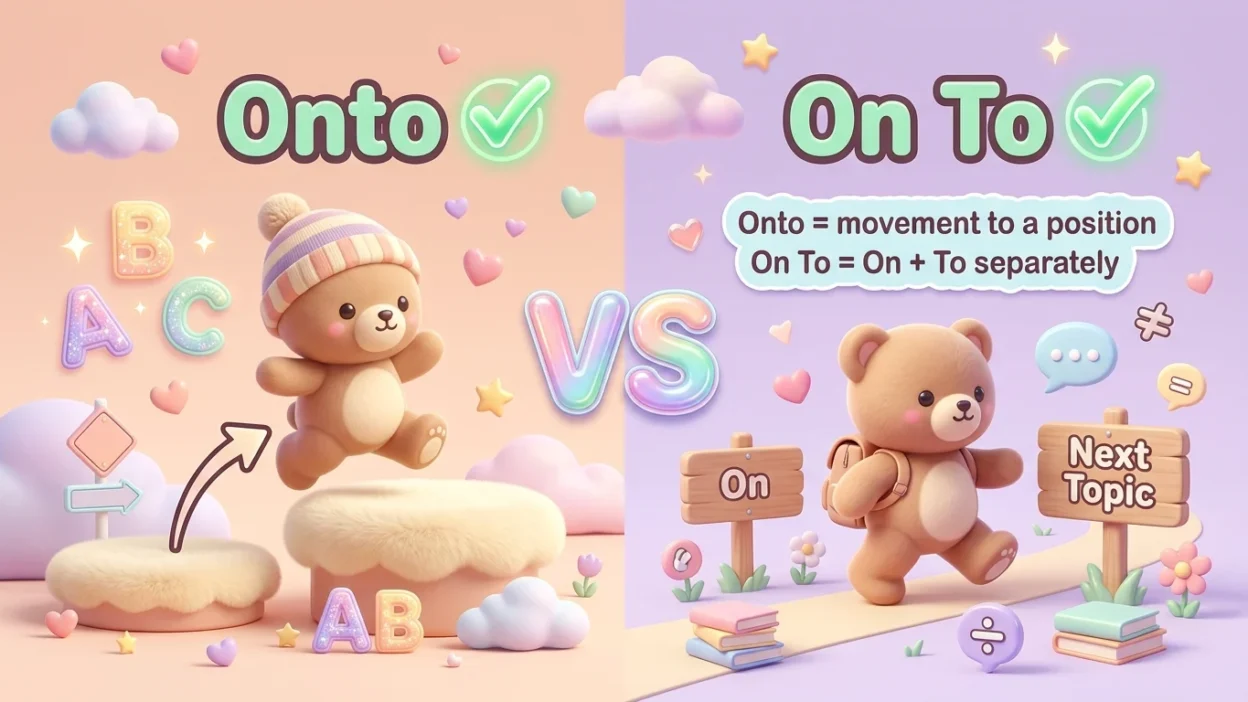
Have you ever wondered whether on to or onto is the correct form? You’re not alone. These two forms look almost identical, but they can serve different grammatical purposes. Onto is usually a preposition that shows movement toward or to a position on a surface, while on to is generally used when on and to belong to separate parts of a sentence.
In this guide, you’ll learn the difference between on to vs onto, including their meanings, grammar rules, examples, common mistakes, and an easy memory trick. Once you understand whether on belongs with the verb or to introduces the next phrase, choosing the correct form becomes much easier.
Quick Answer
- Onto ✅ — Usually a preposition meaning movement to a position on or toward a surface or location.
- On to ✅ — Two separate words used when on and to have separate grammatical roles.
Examples:
- The cat jumped onto the table.
- Let’s move on to the next topic.
What Do On To and Onto Mean?
What Does Onto Mean?
Onto is usually a preposition. It commonly describes movement from one position to another, especially movement toward a surface or position.
Examples:
- The child climbed onto the bed.
- She stepped onto the platform.
- The cat jumped onto the sofa.
- He put the books onto the desk.
In these examples, onto connects an action of movement with a destination or surface.
Onto can also describe movement toward a new state, position, or situation.
Example:
- The company moved onto a new stage of development.
What Does On To Mean?
On to consists of two separate words: on and to.
It is used when on belongs to the verb or previous phrase and to introduces the next word, phrase, or destination.
Examples:
- Let’s move on to the next question.
- She went on to become a successful writer.
- He passed the information on to his manager.
- The teacher moved on to the next lesson.
Here, combining the words into onto can change or distort the intended grammatical structure.
On To vs Onto Comparison Table
| Feature | On To | Onto |
|---|---|---|
| Form | Two words | One word |
| Main Use | Separate grammatical functions | Preposition |
| Common Meaning | Continue toward a next point/action | Movement to a position or surface |
| Example | Move on to the next topic. | Jump onto the table. |
| Memory Clue | On + to separately | Movement to a position |
Why Are On To and Onto Confused?
The confusion happens because on to and onto often sound exactly the same when spoken.
Compare:
- The cat jumped onto the table.
- Let’s move on to the next topic.
In the first sentence, onto describes movement toward a surface.
In the second sentence, on is part of the expression move on, while to introduces the next topic.
A useful question is:
Does “on” belong to the verb or phrase before it?
If yes, you may need on to.
If you’re describing movement toward a position on something, onto is often correct.
Examples of Onto in Sentences
- The cat jumped onto the chair.
- She climbed onto the roof.
- He stepped onto the stage.
- The bird flew onto the branch.
- Put the bag onto the table.
- The child climbed onto the sofa.
- The athlete stepped onto the field.
Examples of On To in Sentences
- Let’s move on to the next lesson.
- She went on to become a famous author.
- He passed the message on to his friend.
- We moved on to another subject.
- The speaker went on to explain the details.
- After finishing school, she went on to study medicine.
- Let’s get on to the main issue.
Common Mistakes People Make
One common mistake is writing onto when the sentence actually needs on to.
Incorrect:
- ❌ Let’s move onto the next topic.
Better:
- ✅ Let’s move on to the next topic.
Here, on belongs to the expression move on, and to introduces the next topic.
Another common mistake is separating onto when it clearly describes movement toward a surface.
Less natural:
- ❌ The cat jumped on to the table.
Better:
- ✅ The cat jumped onto the table.
The distinction can sometimes depend on meaning and style, but these patterns are a useful starting point.
Simple Memory Trick
💡 Memory Trick
Spelling Box
Remember:
ONTO = MOVEMENT TO A POSITION
ON TO = ON + TO SEPARATELY
If something moves to a position on a surface, onto is usually the right choice.
If on belongs to the verb or expression before to, use on to.
Rule: Check whether on and to work independently.
Onto for Movement
The most common use of onto describes movement toward a surface or position.
Examples:
- Jump onto the bed.
- Climb onto the roof.
- Step onto the stage.
- Move onto the platform.
The word onto connects the movement with the destination.
For example:
The dog jumped onto the sofa.
The dog moved from one place to a position on the sofa.
On To for Continuing
On to often appears after verbs and expressions such as:
- Move on.
- Go on.
- Pass on.
- Get on.
Examples:
- We moved on to the next chapter.
- She went on to become a doctor.
- He passed the message on to his colleague.
- Let’s get on to the main topic.
In each case, on has its own role, so it remains separate from to.
On To vs Onto with “Move”
The verb move can create confusion.
Compare:
- The child climbed onto the bed.
- The teacher moved on to the next topic.
In the first sentence, onto indicates a physical destination.
In the second, on is part of the expression move on, meaning to continue, while to introduces the next topic.
This is why context matters.
On To vs Onto with “Go”
The same distinction appears with go.
Example:
- She went onto the stage.
This means she physically moved to the stage.
But:
- She went on to become a successful scientist.
Here, went on means continued or progressed, and to become introduces what happened next.
These sentences look similar but have different meanings.
Onto in Mathematics
Onto also has a specific meaning in mathematics.
In mathematics, especially in discussions of functions, a function is called onto when every element in the target set is mapped to by at least one element of the domain.
For example, an onto function covers the entire target set.
This technical meaning is different from everyday physical movement, but the spelling remains onto as one word.
On To vs Onto in Technology
In technology and everyday digital language, both forms may appear.
Examples:
- The user dragged the file onto the icon.
- Let’s move on to the next step.
- She went on to explain the software.
- Drag the image onto the page.
The same basic distinction applies: physical or positional movement often uses onto, while continuing from one stage to another often uses on to.
When Should You Use Onto?
Use onto when:
- Something moves toward a surface.
- Something moves to a position on something.
- You’re describing physical placement.
- You’re using the mathematical term onto.
Examples:
- Jump onto the platform.
- Put the book onto the desk.
- Step onto the stage.
When Should You Use On To?
Use on to when:
- On belongs to the preceding verb or phrase.
- To introduces another action, destination, or topic.
- You’re describing continuing or progressing.
- You can separate the roles of on and to.
Examples:
- Move on to the next question.
- Go on to explain the details.
- Pass it on to me.
A Simple Test for On To vs Onto
Try removing to from the sentence.
For example:
Let’s move on to the next chapter.
Remove to:
Let’s move on.
That still works, so on is functioning independently. Therefore, on to is appropriate.
Now consider:
The cat jumped onto the table.
If you remove to, you get:
The cat jumped on the table.
This can have a different meaning. The original sentence describes movement toward the table’s surface, so onto clearly communicates the intended relationship.
American vs British English
The basic distinction between on to and onto is similar in American and British English.
Both varieties use:
- onto for movement to a position or surface.
- on to when on and to serve separate grammatical roles.
There can be stylistic variation, especially in cases where on to and onto could both be interpreted without causing confusion. However, the standard distinction remains useful in both varieties.
Related Words and LSI Keywords
- on to meaning
- onto meaning
- on to vs onto
- onto definition
- on to definition
- jump onto
- move on to
- go on to
- step onto
- climb onto
- pass on to
- continue to
- movement preposition
- prepositions in English
- English grammar
- commonly confused words
- correct English usage
- phrasal verbs
- compound prepositions
- English vocabulary
Tips for Remembering the Difference
- Onto usually describes movement to a position or surface.
- On to contains two separate words with separate functions.
- Move onto the platform = physical movement.
- Move on to the next topic = continue.
- Go onto the stage = physically enter the stage.
- Go on to become a writer = continue and later become a writer.
- Check whether on belongs to the verb before to.
Frequently Asked Questions
Is it on to or onto?
Both are correct, but they have different grammatical uses. Onto usually describes movement to a position or surface, while on to is used when on and to have separate roles.
What does onto mean?
Onto is usually a preposition describing movement toward or to a position on a surface or location.
What does on to mean?
On to consists of two separate words. It is used when on belongs to the preceding verb or phrase and to introduces the next element.
Is it “move onto the next topic” or “move on to the next topic”?
The standard choice is move on to the next topic because on is part of move on, meaning continue.
Is “jump onto the table” correct?
Yes. Jump onto the table is correct when you mean moving from another position to a position on the table.
Is “go onto the stage” correct?
Yes. Go onto the stage is correct when someone physically moves to the stage.
Is “go on to become” correct?
Yes. Go on to become means to continue or progress and later become something.
What is an easy way to remember on to vs onto?
Remember ONTO = MOVEMENT TO A POSITION and ON TO = ON + TO SEPARATELY. If on belongs to the preceding verb, keep the words separate.
Summary
The difference between on to vs onto depends on how the words function in a sentence. Onto is generally used as a preposition to describe movement toward or to a position on a surface. For example, “The cat jumped onto the table.”
On to is used when on and to have separate grammatical roles. For example, “Let’s move on to the next topic.” Here, on belongs to move on, while to introduces the next topic. When you’re unsure, check whether on belongs naturally with the verb before it.

Cedric Halewood is known for his intricate historical narratives.
His work reflects a deep fascination with lost civilizations.
He lives near the coast, where he finds inspiration in the sea.