
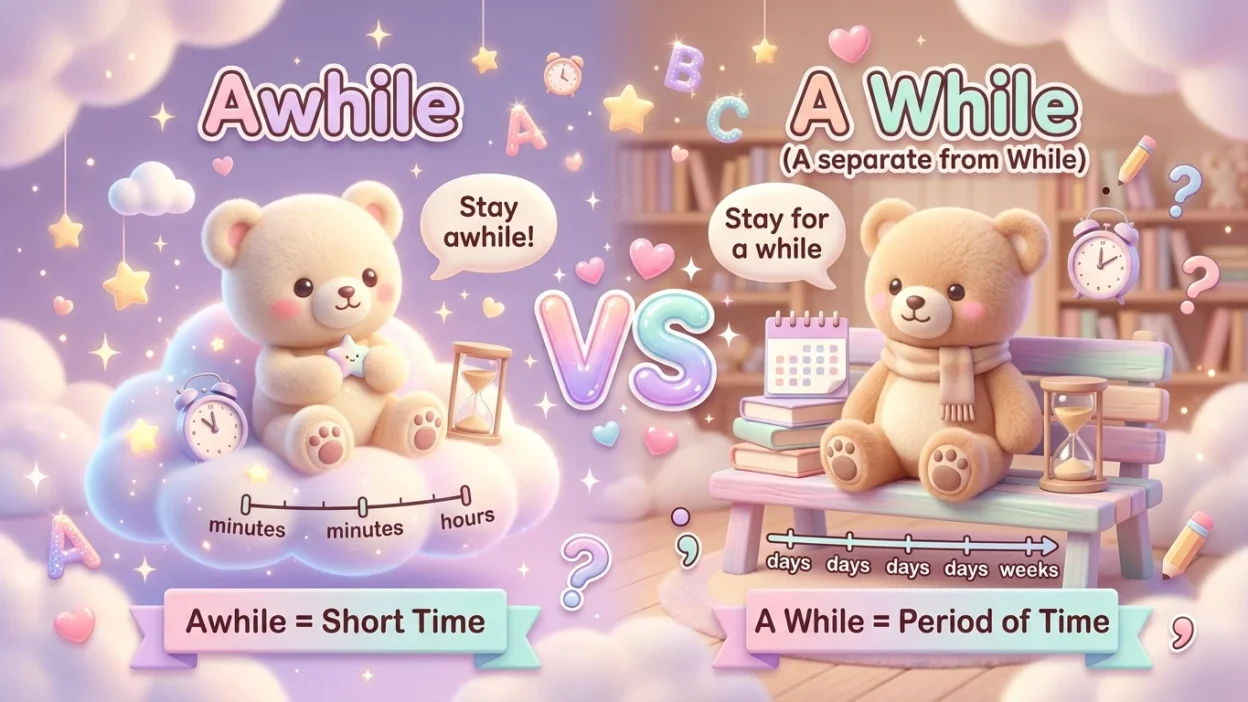
Have you ever wondered whether awhile or a while is correct? You’re not alone. These two forms are closely related and often sound exactly the same, but they have different grammatical roles. Awhile is an adverb meaning “for a short time,” while a while is a noun phrase that refers to a period of time.
In this guide, you’ll learn the difference between awhile vs a while, including their meanings, grammar rules, examples, common mistakes, and a simple memory trick. Once you understand how each form works in a sentence, choosing the correct one becomes much easier.
Quick Answer
- Awhile ✅ — An adverb meaning for a short time.
- A while ✅ — A noun phrase meaning a period of time.
Examples:
- Stay awhile.
- Stay for a while.
Both sentences are correct, but the grammar is different.
What Do Awhile and A While Mean?
What Does Awhile Mean?
Awhile is an adverb. It means for a short time or for some time.
Examples:
- Please stay awhile.
- Sit awhile and relax.
- We talked awhile before leaving.
- She waited awhile.
Because awhile is an adverb, it can directly modify a verb.
For example:
- Stay awhile.
- Rest awhile.
- Wait awhile.
What Does A While Mean?
A while is made up of the article a and the noun while.
Here, while means a period of time.
Examples:
- I haven’t seen you for a while.
- We waited for a while.
- She stayed there for a while.
- It took a while to finish.
Because a while is a noun phrase, it often appears after a preposition such as for.
Awhile vs A While Comparison Table
| Feature | Awhile | A While |
|---|---|---|
| Form | One word | Two words |
| Part of Speech | Adverb | Noun phrase |
| Meaning | For a short time | A period of time |
| Common Pattern | Verb + awhile | for a while |
| Example | Stay awhile. | Stay for a while. |
| Memory Clue | Awhile = briefly | A while = a period |
Why Are Awhile and A While Confused?
The confusion happens because awhile and a while have almost identical pronunciation and closely related meanings.
Compare:
- Stay awhile.
- Stay for a while.
Both sentences communicate a similar idea, but their grammatical structures differ.
The easiest way to understand the difference is to look at the word before a while.
If you have for, you will usually need:
- for a while
But when while directly follows a verb, awhile can often work:
- Stay awhile.
- Wait awhile.
- Rest awhile.
Examples of Awhile in Sentences
- Please stay awhile.
- Sit awhile and enjoy the view.
- We talked awhile.
- She rested awhile before continuing.
- He waited awhile.
- The children played awhile.
- Let’s remain here awhile.
In each example, awhile modifies the verb.
Examples of A While in Sentences
- I haven’t seen her for a while.
- We stayed there for a while.
- It took a while to understand.
- He waited for a while.
- She lived there for a while.
- After a while, everyone became comfortable.
- I need a while to think about it.
Here, a while refers to a period of time.
Common Mistakes People Make
One common mistake is writing for awhile.
In standard usage, the preferred form is:
- ❌ I waited for awhile.
- ✅ I waited for a while.
Why? Because for is a preposition, and a while functions as its noun phrase.
Another common mistake is using a while directly after a verb when awhile would be more natural.
For example:
- Less natural: Please stay a while.
- Better: Please stay awhile.
However, stay for a while is also completely correct.
Simple Memory Trick
💡 Memory Trick
Spelling Box
Remember:
AWHILE = FOR A SHORT TIME
A WHILE = A PERIOD OF TIME
If for comes immediately before it, use a while:
for a while ✅
If it directly modifies a verb, awhile may work:
stay awhile ✅
Rule: For + a while, but verb + awhile.
Awhile After a Verb
One of the easiest ways to recognize awhile is to look at the word immediately before it.
If a verb comes directly before awhile, the one-word form can often be correct.
Examples:
- Stay awhile.
- Wait awhile.
- Rest awhile.
- Sit awhile.
- Talk awhile.
Here, awhile tells us how long the action occurs.
A While After “For”
When for comes before the phrase, use a while.
Examples:
- Stay for a while.
- Wait for a while.
- Rest for a while.
- We talked for a while.
- She lived there for a while.
The structure is:
for + a while
not:
for + awhile
A While With “After”
The phrase after a while is also standard.
Examples:
- After a while, she returned home.
- After a while, the noise stopped.
- After a while, everyone relaxed.
- After a while, he understood the problem.
Here, a while functions as a noun phrase after after.
The one-word form awhile would not be appropriate in this construction.
A While With “In”
You may also see in a while.
Examples:
- I haven’t seen him in a while.
- We haven’t spoken in a while.
- It hasn’t rained in a while.
Here, a while refers to a period of time.
A While With “For”
For a while is one of the most common phrases containing a while.
Examples:
- I stayed there for a while.
- Let’s sit here for a while.
- She waited for a while.
- He worked there for a while.
Avoid writing for awhile in careful standard writing.
Awhile vs A While in Formal Writing
Both forms are standard, but you need to use them according to their grammatical roles.
Examples:
- Please wait awhile.
- Please wait for a while.
Both are grammatically acceptable.
However:
- ❌ Please wait for awhile.
- ✅ Please wait for a while.
When writing formally, pay attention to whether while is functioning as an adverb or as a noun phrase.
American vs British English
The distinction between awhile and a while is broadly the same in American and British English.
Both varieties recognize:
- awhile as an adverb.
- a while as a noun phrase.
Examples:
- Stay awhile.
- Stay for a while.
The main difference is not regional but grammatical.
When Should You Use Awhile?
Use awhile when it means for a short time and functions as an adverb.
Examples:
- Stay awhile.
- Rest awhile.
- Wait awhile.
- Sit awhile.
A useful test is to ask:
Can I replace it with “briefly”?
If yes, awhile may be appropriate.
Example:
- Stay awhile.
- Stay briefly.
When Should You Use A While?
Use a while when you mean a period of time and the phrase functions as a noun phrase.
Examples:
- I waited for a while.
- It took a while.
- After a while, she left.
- I haven’t seen him in a while.
A useful test is to ask:
Is it preceded by a preposition such as for, after, or in?
If yes, a while is usually the correct choice.
Awhile vs A While: Easy Sentence Test
Try these examples:
Please wait awhile.
Here, awhile directly modifies wait.
Please wait for a while.
Here, a while follows for and acts as a noun phrase.
Both sentences are correct.
But:
Please wait for awhile. ❌
This combines for with the adverb awhile, which is not the standard construction.
Related Words and LSI Keywords
- awhile meaning
- a while meaning
- awhile vs a while
- is awhile one word
- a while definition
- awhile definition
- for a while
- stay awhile
- wait awhile
- after a while
- in a while
- for awhile vs for a while
- period of time
- short time
- English grammar
- adverb
- noun phrase
- commonly confused words
- English spelling
- correct English usage
- grammar rules
Tips for Remembering the Difference
- Awhile = for a short time.
- A while = a period of time.
- Stay awhile is correct.
- Stay for a while is correct.
- For a while is correct.
- For awhile is generally incorrect in standard usage.
- After a while is correct.
- In a while is correct.
- If you can replace it with briefly, awhile may work.
Frequently Asked Questions
Is it awhile or a while?
Both are correct, but they have different grammatical roles. Awhile is an adverb meaning “for a short time,” while a while is a noun phrase meaning “a period of time.”
Is “for awhile” correct?
In standard usage, for a while is preferred. Use two words after for.
Is “stay awhile” correct?
Yes. Stay awhile is grammatically correct because awhile functions as an adverb modifying stay.
Is “stay for a while” correct?
Yes. Stay for a while is also correct and uses a while as a noun phrase after for.
Is awhile one word?
Yes. Awhile is correctly written as one word when it functions as an adverb.
What does awhile mean?
Awhile means for a short time or for some time.
What does a while mean?
A while means a period of time.
Should I write “after awhile” or “after a while”?
The standard form is after a while because a while functions as a noun phrase after after.
What is an easy way to remember awhile vs a while?
Remember AWHILE = FOR A SHORT TIME and A WHILE = A PERIOD OF TIME. Also remember the common pattern for a while.
Summary
The difference between awhile vs a while is mainly grammatical. Awhile is an adverb that means for a short time and can directly modify a verb, as in “Please stay awhile.” A while is a noun phrase meaning a period of time, as in “We stayed for a while.”
The easiest rule is to remember “for a while” as two words. When while functions as a noun phrase after words such as for, after, or in, use a while. When it directly modifies a verb and means “for a short time,” awhile can be used.

Cedric Halewood is known for his intricate historical narratives.
His work reflects a deep fascination with lost civilizations.
He lives near the coast, where he finds inspiration in the sea.