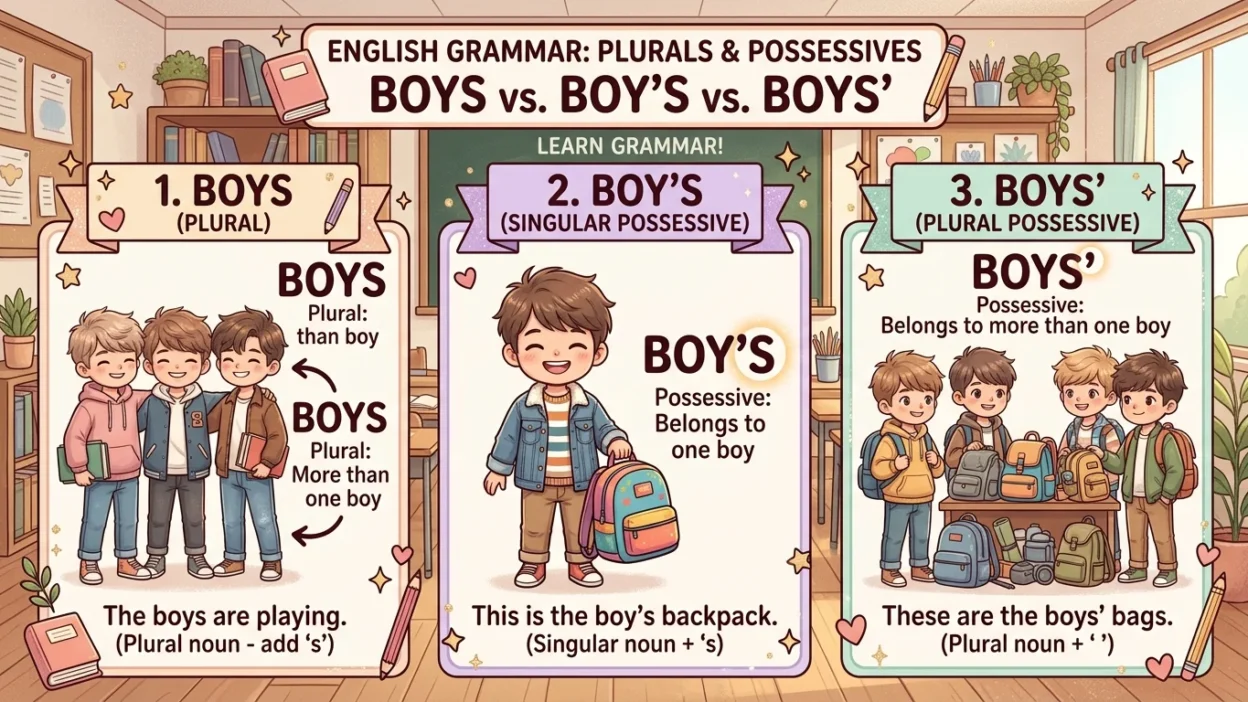
Have you ever wondered whether you should write boys or boy’s? These two forms look almost identical, but they have different meanings and grammatical uses. Boys is the plural form of boy, while boy’s is the singular possessive form, showing that something belongs to one boy.
There is also a third form you should know: boys’. This is the plural possessive form and shows that something belongs to two or more boys.
Understanding boys or boy’s can help you avoid common apostrophe mistakes in English. In this complete guide, you’ll learn the meanings, differences, examples, possessive rules, common mistakes, pronunciation, American and British English usage, FAQs, and an easy memory trick.
Quick Answer
The basic difference is simple:
- Boys ✅ = plural of boy, meaning more than one boy.
- Boy’s ✅ = something belongs to one boy.
- Boys’ ✅ = something belongs to multiple boys.
Examples:
- The boys are playing football. ✅
- The boy’s bag is blue. ✅
- The boys’ bags are blue. ✅
Think of the three forms this way:
Boy = one boy
Boys = more than one boy
Boy’s = belonging to one boy
Boys’ = belonging to multiple boys
What Does Boys Mean?
Boys is the plural form of the noun boy.
Use boys when you are talking about two or more boys.
Examples:
- The boys are playing outside.
- Three boys joined the team.
- The boys went to school together.
- Those boys are my neighbors.
- The boys are watching a movie.
There is no apostrophe in boys when you simply mean more than one boy.
For example:
- The boys are happy. ✅
- The boy’s are happy. ❌
The apostrophe changes the grammatical meaning.
What Does Boy’s Mean?
Boy’s is the singular possessive form of boy.
It usually means that something belongs to, is associated with, or is connected to one boy.
Examples:
- The boy’s bicycle is outside.
- The boy’s name is Daniel.
- I found the boy’s jacket.
- The boy’s mother called.
- The boy’s room is upstairs.
In each sentence, the apostrophe before the s shows possession.
For example:
The boy’s bicycle
means:
The bicycle belongs to one boy.
What Does Boys’ Mean?
Boys’ is the plural possessive form of boys.
Use boys’ when something belongs to two or more boys.
Examples:
- The boys’ classroom is upstairs.
- The boys’ bags are on the floor.
- The boys’ football team won the match.
- The boys’ parents attended the meeting.
- The boys’ shoes were outside.
Notice where the apostrophe goes:
One boy → boy’s
Several boys → boys’
The apostrophe moves after the s because boys is already plural.
Boys or Boy’s Comparison Table
| Form | Meaning | Grammar | Example |
|---|---|---|---|
| Boy | One male child | Singular noun | The boy is reading. |
| Boys | More than one male child | Plural noun | The boys are reading. |
| Boy’s | Belonging to one boy | Singular possessive | The boy’s book is here. |
| Boys’ | Belonging to multiple boys | Plural possessive | The boys’ books are here. |
The most important distinction is:
Boys = plural
Boy’s = singular possessive
Boys’ = plural possessive
Boys in Sentences
Use boys when you are simply talking about multiple boys.
Examples:
- The boys are playing basketball.
- Five boys entered the competition.
- The boys walked home together.
- Those boys attend the same school.
- The boys are laughing.
- Several boys were waiting outside.
- The boys enjoyed the trip.
Notice that none of these sentences needs an apostrophe.
Correct
- The boys are playing. ✅
- Two boys are running. ✅
- The boys won the game. ✅
Incorrect
- The boy’s are playing. ❌
- Two boy’s are running. ❌
- The boy’s won the game. ❌
If you mean more than one boy, use boys without an apostrophe.
Boy’s in Sentences
Use boy’s when something belongs to or relates to one boy.
Examples:
- The boy’s bicycle is new.
- The boy’s shoes are dirty.
- The boy’s father is a teacher.
- The boy’s handwriting is beautiful.
- The boy’s phone is ringing.
- The boy’s backpack is heavy.
- The boy’s favorite color is blue.
In each example, there is one boy.
For example:
The boy’s backpack is heavy.
This means:
The backpack belongs to one boy.
Boys’ in Sentences
Use boys’ when something belongs to multiple boys.
Examples:
- The boys’ shoes are outside.
- The boys’ classroom is clean.
- The boys’ team won the championship.
- The boys’ parents arrived early.
- The boys’ bicycles were parked outside.
- The boys’ uniforms were ready.
- The boys’ lockers were checked.
Here, the possession belongs to more than one boy.
Compare:
The boy’s shoes = one boy’s shoes.
The boys’ shoes = shoes belonging to multiple boys.
Boys vs Boy’s vs Boys’ Main Difference
The difference becomes much easier when you focus on number and possession.
Boys
Boys simply means more than one boy.
Example:
- The boys are playing football.
There is no possession.
Boy’s
Boy’s means something belongs to one boy.
Example:
- The boy’s football is new.
There is one boy and one possessive relationship.
Boys’
Boys’ means something belongs to multiple boys.
Example:
- The boys’ football team is practicing.
There are multiple boys connected to the noun that follows.
Therefore:
Boys = multiple boys
Boy’s = one boy owns or has something
Boys’ = multiple boys own or have something
Why Are Boys and Boy’s Confused?
The main reason is the apostrophe.
English uses apostrophes to show possession, but many writers mistakenly add them when they simply want to make a noun plural.
This creates mistakes such as:
- ❌ boy’s
- ❌ girl’s
- ❌ student’s
- ❌ teacher’s
when the writer actually means:
- boys
- girls
- students
- teachers
Remember that apostrophes do not normally make nouns plural.
For example:
- One boy → boy
- Two boys → boys
Not:
- ❌ boy’s
The apostrophe has a different job.
Common Mistakes People Make
Mistake 1: Using Boy’s for the Plural
Incorrect:
- ❌ There are three boy’s in the room.
Correct:
- ✅ There are three boys in the room.
You need boys because you are talking about more than one boy.
Mistake 2: Forgetting the Apostrophe for Possession
Incorrect:
- ❌ The boys bicycle is broken.
Correct:
- ✅ The boy’s bicycle is broken.
If the bicycle belongs to one boy, use boy’s.
Mistake 3: Using Boy’s for Multiple Boys
Incorrect:
- ❌ The boy’s uniforms are ready.
If the uniforms belong to several boys, write:
- ✅ The boys’ uniforms are ready.
The apostrophe comes after the s because boys is plural.
Mistake 4: Using Boys’ When You Mean Multiple Boys
Incorrect:
- ❌ The boys’ are playing outside.
Correct:
- ✅ The boys are playing outside.
Boys’ requires a possessive meaning. It cannot simply replace the plural form boys.
Simple Memory Trick
💡 Memory Trick
Spelling Box
👦 BOY = one
👦👦 BOYS = more than one
🎒 BOY’S = belonging to one boy
🎒🎒 BOYS’ = belonging to multiple boys
Remember:
No apostrophe = plural
’s = one boy owns or has something
s’ = multiple boys own or have something
Think:
Boys = many
Boy’s = one owner
Boys’ = many owners
Boys vs Boy’s Grammar Rule
The easiest way to choose the correct form is to ask two questions:
Question 1: Am I talking about more than one boy?
If yes, use:
Boys
Example:
- The boys are playing outside.
Question 2: Am I showing possession?
If yes, determine whether you mean one boy or multiple boys.
One boy:
Boy’s
Example:
- The boy’s bicycle is red.
Multiple boys:
Boys’
Example:
- The boys’ bicycles are red.
This simple two-step method can prevent most apostrophe mistakes.
Singular Possessive: Boy’s
For a singular noun such as boy, add ’s to show possession.
Pattern:
Singular noun + ’s + object
Examples:
- The boy’s book
- The boy’s bicycle
- The boy’s room
- The boy’s jacket
- The boy’s phone
Sentence examples:
- The boy’s book is on the table.
- I found the boy’s jacket.
- The boy’s bicycle needs repair.
The apostrophe comes before the s.
Plural Possessive: Boys’
For the regular plural noun boys, which already ends in s, add only an apostrophe to show possession.
Pattern:
Plural noun ending in s + ’ + object
Examples:
- The boys’ books
- The boys’ bicycles
- The boys’ classroom
- The boys’ uniforms
- The boys’ team
Sentence examples:
- The boys’ books are on the table.
- The boys’ bicycles are outside.
- The boys’ classroom is upstairs.
The apostrophe comes after the s.
Boys or Boy’s in Questions
The same rules apply in questions.
Examples:
- Are the boys ready?
- Where are the boys going?
- Is this the boy’s backpack?
- Did you see the boys’ classroom?
- Where is the boy’s bicycle?
- Are these the boys’ uniforms?
Ask yourself whether you’re talking about number or possession.
Boys or Boy’s in Negative Sentences
Examples with boys:
- The boys are not outside.
- The boys didn’t finish the project.
- The boys aren’t ready yet.
Examples with boy’s:
- The boy’s bicycle isn’t here.
- The boy’s parents haven’t arrived.
Examples with boys’:
- The boys’ uniforms aren’t ready.
- The boys’ classroom isn’t open.
The apostrophe does not change because the sentence becomes negative.
Boys or Boy’s With “Is” and “Are”
Verb agreement can also help you identify the correct form.
Use boys with plural verbs such as are.
- The boys are playing. ✅
- The boys are happy. ✅
Use boy with singular verbs.
- The boy is playing. ✅
- The boy is happy. ✅
For possession:
- The boy’s bag is heavy. ✅
- The boys’ bags are heavy. ✅
Notice:
Boy’s bag is = one boy, one possessive noun.
Boys’ bags are = multiple boys, plural possessive noun and plural object.
Boys or Boy’s in American English
American English follows the same basic rules:
- Boys = plural
- Boy’s = singular possessive
- Boys’ = plural possessive
Examples:
- The boys are outside.
- The boy’s jacket is blue.
- The boys’ jackets are blue.
There is no major American English spelling difference in these forms.
Boys or Boy’s in British English
British English also follows the same apostrophe rules.
Examples:
- The boys are playing football.
- The boy’s bicycle is outside.
- The boys’ bicycles are outside.
Therefore, whether you’re writing in American or British English, the distinction remains the same.
Boys or Boy’s Pronunciation
Pronunciation can help, but spelling and context are more important.
Boy
Boy has one syllable.
Example:
- The boy is running.
Boys
Boys is also generally pronounced as one syllable.
Example:
- The boys are running.
The final s produces a /z/ sound.
Boy’s
Boy’s is pronounced like boyz.
Example:
- The boy’s bag is blue.
Boys’
Boys’ is pronounced the same as boys.
This is important:
Boys and boys’ are pronounced alike.
The apostrophe changes the grammar and meaning, not the pronunciation.
For example:
- The boys are playing.
- The boys’ bags are outside.
They sound the same, but their grammatical functions differ.
Boys vs Boy’s vs Boys’ Examples
Correct Uses of Boys
- The boys are playing football. ✅
- Several boys joined the club. ✅
- The boys went home. ✅
- Those boys are my friends. ✅
Correct Uses of Boy’s
- The boy’s bag is missing. ✅
- The boy’s bicycle is new. ✅
- I found the boy’s jacket. ✅
- The boy’s mother called. ✅
Correct Uses of Boys’
- The boys’ bags are missing. ✅
- The boys’ bicycles are new. ✅
- I found the boys’ jackets. ✅
- The boys’ parents arrived. ✅
Incorrect Uses
- ❌ The boy’s are playing.
- ❌ The boys bag is missing.
- ❌ The boy’s bags are outside. (if multiple boys own them)
- ❌ The boys’ are playing.
Correct versions:
- ✅ The boys are playing.
- ✅ The boy’s bag is missing.
- ✅ The boys’ bags are outside.
- ✅ The boys are playing.
Boys or Boy’s: How to Choose Quickly
Use this quick method:
If you mean “more than one boy”
Use:
Boys
Example:
- The boys are laughing.
If you mean “belonging to one boy”
Use:
Boy’s
Example:
- The boy’s shoes are dirty.
If you mean “belonging to multiple boys”
Use:
Boys’
Example:
- The boys’ shoes are dirty.
So:
More than one → boys
One owner → boy’s
Multiple owners → boys’
When Should You Use Boys?
Use boys when:
- You mean two or more boys.
- You are using the plural noun.
- You are not showing possession.
Examples:
- The boys are outside.
- Five boys entered the room.
- The boys won the match.
- Those boys attend our school.
When Should You Use Boy’s?
Use boy’s when:
- You mean something belongs to one boy.
- You are describing something associated with one boy.
- You need the singular possessive form.
Examples:
- The boy’s bag is heavy.
- The boy’s name is Adam.
- The boy’s bicycle is red.
- The boy’s shoes are wet.
When Should You Use Boys’?
Use boys’ when:
- Something belongs to multiple boys.
- You are using the plural possessive form.
- The noun boys already ends in s.
Examples:
- The boys’ bags are outside.
- The boys’ team won.
- The boys’ parents arrived.
- The boys’ classroom is upstairs.
Related Words and LSI Keywords
- boys or boy’s
- boys vs boy’s
- boy’s vs boys
- boys vs boys’
- boy’s meaning
- boys meaning
- boys’ meaning
- boys apostrophe
- boy possessive
- singular possessive
- plural possessive
- boys plural
- boy’s possessive
- boys’ possessive
- when to use boys
- when to use boy’s
- when to use boys’
- boys grammar
- boy’s grammar
- boys’ grammar
- apostrophe rules
- apostrophe after s
- plural apostrophe
- English grammar
- English spelling
- commonly confused words
- possessive nouns
- plural nouns
- grammar mistakes
- English language learning
- correct English usage
- grammar guide
Tips for Remembering the Difference
- Boy means one.
- Boys means more than one.
- Boy’s means belonging to one boy.
- Boys’ means belonging to multiple boys.
- Do not use an apostrophe just to make boy plural.
- Use boys when you simply mean several boys.
- Use boy’s when one boy owns or has something.
- Use boys’ when several boys own or have something.
- Remember that boys and boys’ sound the same.
- Look at the context instead of relying only on pronunciation.
- Ask yourself: How many boys?
- Then ask: Is possession involved?
Frequently Asked Questions
What is the difference between boys and boy’s?
Boys is the plural form of boy, while boy’s is the singular possessive form. Boys means more than one boy, while boy’s means something belongs to one boy.
Is it boys or boy’s for more than one?
Use boys.
Example:
- The boys are playing outside.
Do not use boy’s to make the noun plural.
Is boy’s correct?
Yes. Boy’s is correct when you are showing possession by one boy.
Example:
- The boy’s backpack is blue.
What does boys mean?
Boys is the plural of boy and refers to two or more boys.
Example:
- The boys are playing football.
What does boy’s mean?
Boy’s is the singular possessive form of boy.
Example:
- The boy’s bicycle is new.
This means the bicycle belongs to one boy.
What is the difference between boys and boys’?
Boys is simply the plural form of boy.
Boys’ is the plural possessive form.
Examples:
- The boys are playing.
- The boys’ bags are outside.
What is the difference between boy’s and boys’?
Boy’s means belonging to one boy.
Boys’ means belonging to multiple boys.
Examples:
- The boy’s book = one boy’s book.
- The boys’ books = books belonging to multiple boys.
Is “The boy’s are playing” correct?
No.
The correct sentence is:
- The boys are playing.
You need boys because you’re talking about more than one boy.
Is “The boys bag” correct?
Not if the bag belongs to the boys.
Correct:
- The boy’s bag = one boy.
- The boys’ bag = multiple boys.
Is “The boys’ are playing” correct?
No.
The correct sentence is:
- The boys are playing.
The possessive form boys’ must show possession and cannot simply replace boys.
Is boys’ singular or plural?
Boys’ is based on the plural noun boys, so it is plural possessive.
Example:
- The boys’ classroom.
It means the classroom belongs to or is associated with multiple boys.
Are boys and boys’ pronounced the same?
Yes. In normal speech, boys and boys’ are pronounced the same.
The apostrophe changes the grammatical function, not the pronunciation.
Should I use an apostrophe in boys?
Not when you simply mean more than one boy.
Correct:
- The boys are outside.
Use an apostrophe only when showing possession:
- The boys’ bags are outside.
Is “boys” a plural noun?
Yes. Boys is the regular plural form of boy.
Example:
- One boy
- Two boys
Is “boy’s” a plural?
No. Boy’s is singular possessive.
Example:
- The boy’s toy.
It refers to one boy.
How do I remember boys vs boy’s?
Remember:
Boys = many boys
Boy’s = one boy owns something
Boys’ = many boys own something
The apostrophe tells you that possession is involved.
Which is correct: “The boys are” or “The boy’s are”?
The boys are is correct when referring to multiple boys.
Example:
- The boys are playing outside.
Which is correct: “boys shoes” or “boys’ shoes”?
If the shoes belong to multiple boys, use:
- boys’ shoes
If the shoes belong to one boy, use:
- boy’s shoes
Is boys’ the same as boys?
No. They are pronounced the same, but their grammatical functions differ.
Boys = plural noun.
Boys’ = plural possessive.
Examples:
- The boys are here.
- The boys’ bags are here.
Summary
The difference between boys or boy’s becomes simple once you understand plural and possessive forms. Boys means more than one boy and does not need an apostrophe. Boy’s means something belongs to one boy, so the apostrophe comes before the s. There is also boys’, which means something belongs to multiple boys, with the apostrophe placed after the s.
Remember the easy rule: boys = many, boy’s = one owner, boys’ = many owners. Never add an apostrophe simply to make boy plural. Once you understand what the apostrophe means, choosing between these three forms becomes quick and easy.

Rowan Blythecroft crafts atmospheric fiction filled with mystery and folklore.
Her stories often blur the line between reality and imagination.
She spends most of her days wandering forests and writing by candlelight.