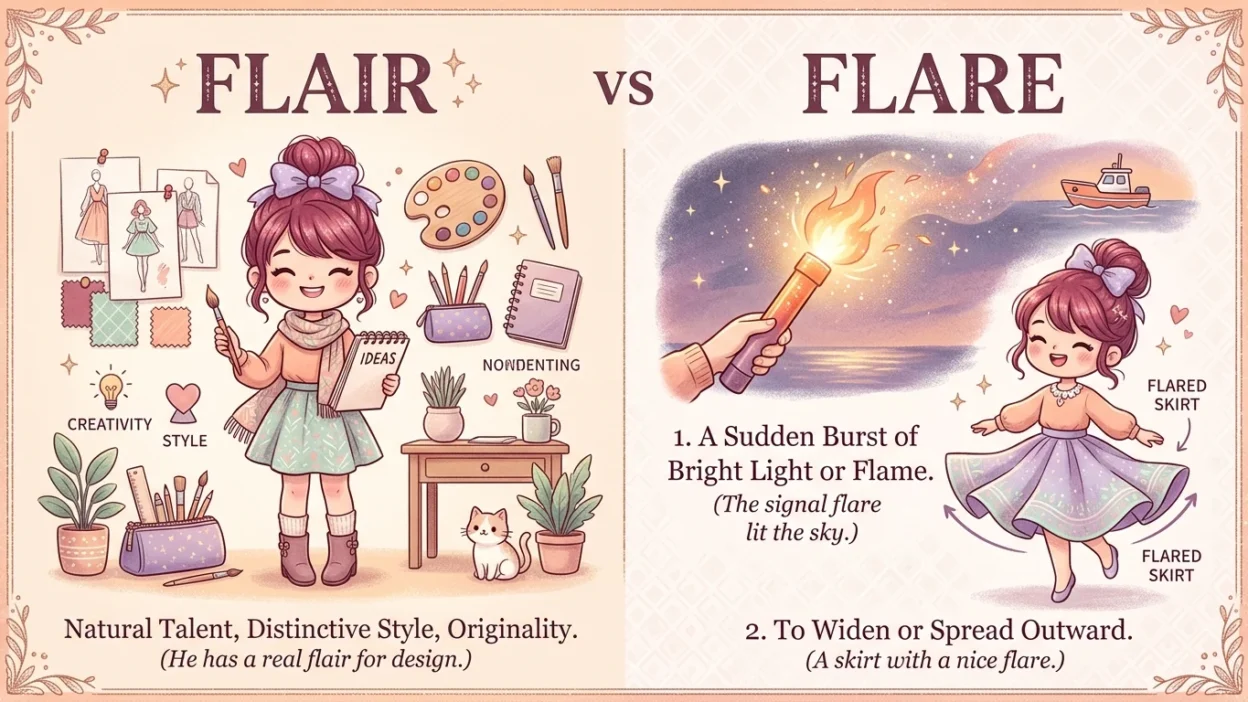
Have you ever wondered whether you should write flair vs flare when using these commonly confused words? Although flair and flare sound exactly alike in many accents, they have completely different meanings. One describes a natural talent or distinctive style, while the other can describe a sudden burst of light, fire, or a widening shape.
Understanding flair vs flare is important because using the wrong spelling can completely change the meaning of your sentence. In this guide, you’ll learn the meanings, differences, examples, common mistakes, pronunciation, usage rules, and easy ways to remember which word to use.
Quick Answer
The difference is simple:
- Flair ✅ = a natural talent, ability, or distinctive style.
- Flare ✅ = a sudden burst of light, fire, or emotion, or something that becomes wider.
Examples:
- She has a flair for fashion.
- The fire began to flare up.
- He has a flair for writing.
- The warning light began to flare brightly.
Easy Rule
Flair = talent or style
Flare = burst, spread, or widen
Both words are correct, but you use them in completely different situations.
What Does Flair Mean?
Flair is a noun that describes a natural ability, talent, or special quality that makes someone stand out.
It can also describe a distinctive and attractive style.
Examples:
- She has a flair for design.
- He has a natural flair for storytelling.
- The chef prepares every dish with flair.
- She decorated the room with creative flair.
When you say someone has a flair for something, you mean they seem naturally good at it or have a special talent for it.
Flair for Something
One of the most common structures is:
flair for + noun/gerund
Examples:
- She has a flair for photography.
- He has a flair for languages.
- My sister has a flair for cooking.
- The designer has a flair for modern fashion.
This expression often suggests both talent and creativity.
What Does Flare Mean?
Flare can be used as both a noun and a verb.
As a noun, it can mean a sudden burst of light, fire, or brightness.
Examples:
- The fire produced a bright flare.
- A red flare appeared in the sky.
- The emergency team used a flare for signaling.
As a verb, flare means to burn or shine suddenly and brightly, or to become wider.
Examples:
- The flames flared suddenly.
- The fire flared up.
- Her anger flared.
- The road flares out near the entrance.
Flare Up Meaning
The phrasal verb flare up is especially common.
It means something suddenly becomes more intense or serious.
It can describe:
- Anger
- Conflict
- Violence
- Problems
- Symptoms
- Fire
Examples:
- His temper flared up during the argument.
- The conflict flared up again.
- The flames flared up when the wind increased.
- Tensions flared up between the two groups.
The spelling is always flare, not flair, when you mean something suddenly becomes more intense.
Flare as a Widening Shape
Flare can also mean to become wider toward the bottom or end.
Examples:
- The skirt flares at the bottom.
- The trousers flare slightly below the knee.
- The road flares out near the bridge.
- The pipe flares outward at the end.
This meaning appears frequently in descriptions of:
- Clothing
- Roads
- Pipes
- Shapes
- Structures
Flair vs Flare Comparison Table
| Word | Part of Speech | Main Meaning | Example |
|---|---|---|---|
| Flair | Noun | Natural talent or special ability | She has a flair for art. |
| Flair | Noun | Distinctive style | He writes with flair. |
| Flare | Noun | Sudden burst of light or fire | The signal flare was bright. |
| Flare | Verb | Burn or shine suddenly | The flames flare up. |
| Flare | Verb | Become wider | The dress flares at the bottom. |
| Flare | Verb | Become suddenly more intense | His anger flared. |
The simplest distinction is:
Flair → talent and style
Flare → fire, brightness, intensity, or widening
Flair in Sentences
Here are some examples of flair:
- She has a flair for interior design.
- He has a natural flair for comedy.
- The writer brings flair to every article.
- She dresses with remarkable flair.
- His presentation showed creativity and flair.
- The chef prepared the meal with great flair.
- She has a flair for learning new languages.
In each example, flair refers to talent, creativity, style, or a distinctive quality.
Flare in Sentences
Here are some examples of flare:
- The flames began to flare.
- The signal flare lit up the night sky.
- Her anger began to flare.
- The fire flared up suddenly.
- The skirt flares at the bottom.
- The road flares out near the intersection.
- The bright light appeared as a sudden flare.
These examples show how flare relates to brightness, fire, sudden intensity, or widening.
Flair vs Flare: The Main Difference
The main difference is the concept each word represents.
Flair
Flair is about something special that a person possesses.
It can mean:
- Talent
- Creativity
- Natural ability
- Style
- A distinctive quality
Example:
She has a flair for painting.
This means she has a natural talent or special ability for painting.
Flare
Flare describes something that suddenly becomes:
- Brighter
- Hotter
- More intense
- Wider
Example:
The flames flared up.
This means the flames suddenly became stronger or brighter.
So remember:
Flair = what you have
Flare = what suddenly bursts, intensifies, or widens
Why Are Flair and Flare Confused?
The biggest reason is pronunciation.
Flair and flare are homophones in many varieties of English. This means they sound the same even though they have different spellings and meanings.
For example:
- Flair → talent
- Flare → burst or widen
When people hear the word rather than see it written, they may not know which spelling to choose.
The solution is to identify the meaning before choosing the spelling.
Ask yourself:
Am I talking about talent or style?
Use flair.
Am I talking about fire, brightness, intensity, or widening?
Use flare.
Common Mistakes People Make
Mistake 1: Using Flare for Talent
Incorrect:
- ❌ She has a flare for fashion.
Correct:
- ✅ She has a flair for fashion.
Here, you’re talking about talent or a natural ability.
Mistake 2: Using Flair for Fire
Incorrect:
- ❌ The flames flair up suddenly.
Correct:
- ✅ The flames flare up suddenly.
Here, you’re describing a sudden increase in the flames.
Mistake 3: Confusing Style With Shape
Incorrect:
- ❌ The dress flairs at the bottom.
Correct:
- ✅ The dress flares at the bottom.
A widening shape uses flare.
Mistake 4: Using Flare in “Flair for”
Incorrect:
- ❌ He has a flare for writing.
Correct:
- ✅ He has a flair for writing.
The standard expression is flair for.
Simple Memory Trick
💡 Memory Trick
✨ FLAIR = TALENT & STYLE
Think of flair as something special you have.
🔥 FLARE = FIRE & BURST
Think of a flame that flares up suddenly.
FLAIR = talent
FLARE = burst
If you’re talking about someone’s special ability or fashionable style, choose flair. If something burns, shines, intensifies, or widens, choose flare.
Flair vs Flare in Fashion
Both words can appear in fashion, but they mean different things.
Flair in Fashion
Flair refers to a person’s distinctive style.
Example:
- She dresses with flair.
This means she has a stylish or creative way of dressing.
Flare in Fashion
Flare describes clothing that becomes wider toward the bottom.
Examples:
- Flared jeans are popular.
- The skirt flares at the hem.
- She wore a flared dress.
So:
Fashion style → flair
Widening clothing → flare
Flair vs Flare in Writing
These words can also appear in writing and communication.
Flair
Use flair when describing someone’s creative or distinctive writing style.
Examples:
- She writes with flair.
- The author brings humor and flair to the story.
- His writing has a unique flair.
Flare
Use flare when describing something that suddenly becomes stronger or more noticeable.
Examples:
- Tensions flared during the debate.
- The argument flared up again.
- His emotions began to flare.
Flair vs Flare in Medicine
Flare is commonly used in medical contexts.
A flare-up describes a sudden worsening or increase in symptoms or a condition.
Examples:
- The condition can flare up unexpectedly.
- Stress may cause symptoms to flare.
- She experienced a sudden flare-up.
Do not use flair in this context.
Flair refers to talent or style, not worsening symptoms.
Flair vs Flare Pronunciation
In many English accents, flair and flare are pronounced the same.
They are generally pronounced approximately:
flair: /fler/
flare: /fler/
Because they are often homophones, pronunciation alone cannot tell you which spelling is correct.
Instead, focus on the meaning.
If the word means talent or style, spell it flair.
If it means burst, intensify, or widen, spell it flare.
American vs British English
There is no major spelling difference between American and British English for these words.
Both varieties use:
- Flair = talent, creativity, or distinctive style
- Flare = burst, sudden intensity, or widening
Examples:
- She has a flair for design.
- The fire began to flare up.
- His anger flared.
- The trousers flare at the bottom.
The spelling remains the same in both varieties.
When Should You Use Flair?
Use flair when discussing:
- Natural talent
- Creativity
- Personal style
- Distinctive qualities
- Artistic ability
- A special way of doing something
Common expressions include:
- Flair for writing
- Flair for design
- Flair for fashion
- Flair for cooking
- Flair for languages
- Flair for comedy
- Flair for creativity
Examples:
- She has a flair for photography.
- He performs with confidence and flair.
- The designer has a unique flair for color.
When Should You Use Flare?
Use flare when discussing:
- Fire
- Light
- Brightness
- Sudden intensity
- Anger
- Conflict
- Medical symptoms
- Widening shapes
- Signal devices
Examples:
- The fire began to flare.
- His anger flared.
- The conflict flared up.
- The skirt flares at the bottom.
- The emergency team launched a flare.
Flair vs Flare Examples
Correct Uses of Flair
- She has a flair for art. ✅
- He writes with flair. ✅
- The chef prepared the meal with flair. ✅
- She has a natural flair for fashion. ✅
Correct Uses of Flare
- The flames flared up. ✅
- His anger flared suddenly. ✅
- The skirt flares at the bottom. ✅
- The signal flare was visible from a distance. ✅
Incorrect Uses
- ❌ She has a flare for music.
- ❌ The flames flair up.
- ❌ His dress flairs at the bottom.
- ❌ The writer has great flare.
Correct versions:
- ✅ She has a flair for music.
- ✅ The flames flare up.
- ✅ His dress flares at the bottom.
- ✅ The writer has great flair.
Related Words and LSI Keywords
- flair vs flare
- flare vs flair
- flair meaning
- flare meaning
- flair definition
- flare definition
- flair for meaning
- flare up meaning
- flair for something
- natural flair
- creative flair
- personal flair
- flare up
- flared meaning
- flared clothing
- flare pronunciation
- flair pronunciation
- flair and flare homophones
- commonly confused words
- English spelling
- English grammar
- confusing English words
- correct English usage
- vocabulary mistakes
- English language learning
- spelling guide
- grammar guide
Tips for Remembering the Difference
- Flair = talent.
- Flair = style.
- Flare = fire.
- Flare = brightness.
- Flare = sudden intensity.
- Flare = widening shape.
- Remember the common phrase “flair for” when talking about talent.
- Remember “flare up” when something suddenly becomes more intense.
- If someone has a special ability, think flair.
- If something bursts, burns, intensifies, or widens, think flare.
- Although they often sound alike, their meanings are completely different.
Frequently Asked Questions
What is the difference between flair and flare?
Flair means natural talent, creativity, or distinctive style. Flare means a sudden burst of light or fire, a sudden increase in intensity, or a widening shape.
Is it flair or flare for talent?
Use flair.
Example:
- She has a flair for writing.
Is it flare or flair up?
Use flare up.
Example:
- His anger began to flare up.
What does flair mean?
Flair means a natural talent, creative ability, or distinctive style.
Example:
- He has a flair for storytelling.
What does flare mean?
Flare can mean a sudden burst of light or fire. As a verb, it can mean to burn brightly, become more intense, or widen.
Is “flair for” correct?
Yes. Flair for is the standard expression used when describing someone’s natural talent or ability.
Example:
- She has a flair for languages.
Is “flare for” correct?
No, not when you mean natural talent. The correct phrase is flair for.
Is it “flair up” or “flare up”?
The correct expression is flare up.
Example:
- The argument flared up again.
Are flair and flare homophones?
Yes. In many varieties of English, flair and flare are pronounced the same, although their spellings and meanings differ.
What does flare up mean?
Flare up means to suddenly become more intense, serious, angry, or active.
Example:
- The conflict flared up again.
What does creative flair mean?
Creative flair means a natural ability to produce original, attractive, or imaginative work.
Example:
- She has remarkable creative flair.
What does flare mean in fashion?
In fashion, flare describes clothing that becomes wider toward the bottom, such as flared trousers or a flared skirt.
What does flair mean in fashion?
In fashion, flair refers to someone’s distinctive, creative, or stylish way of dressing.
Do American and British English use flair and flare differently?
No major spelling difference exists. Both American and British English use flair for talent or style and flare for bursts, intensity, and widening shapes.
Summary
The difference between flair vs flare is easy once you connect each spelling with its meaning. Flair refers to natural talent, creativity, or distinctive style, as in “She has a flair for design.” Flare refers to a burst of fire or light, a sudden increase in intensity, or something that becomes wider, as in “The flames flared up.”
Although these words often sound identical, their meanings are completely different. Remember flair = talent or style and flare = burst, intensity, or widening. This simple distinction will help you choose the correct spelling in everyday, academic, and professional writing.

Rowan Blythecroft crafts atmospheric fiction filled with mystery and folklore.
Her stories often blur the line between reality and imagination.
She spends most of her days wandering forests and writing by candlelight.