Have you ever confused foreword vs forward? These two words sound almost identical, but they have completely different meanings and uses. Foreword is a short introduction written for a book, while forward can describe movement, direction, progress, or sending something onward.
In this guide, you’ll learn the difference between foreword and forward, their meanings, examples, common mistakes, grammar rules, American and British English usage, FAQs, and an easy memory trick.
Quick Answer
- Foreword ✅ = an introductory section at the beginning of a book, usually written by someone other than the author.
- Forward ✅ = toward the front, onward, ahead, or toward the future.
Examples:
- The professor wrote the foreword to the book. ✅
- We need to move forward with the project. ✅
The easiest rule is:
Foreword = book introduction
Forward = ahead or onward
What Does Foreword Mean?
A foreword is a short introductory section that appears at the beginning of a book.
It is usually written by someone other than the author. The person writing the foreword may be an expert, respected professional, friend, colleague, or another person connected to the subject or author.
A foreword often explains:
- Why the book is important
- Why the author is qualified
- How the writer knows the author
- Why readers should consider reading the book
- The significance of the book’s subject
Examples:
- The historian wrote the foreword to the new biography.
- The book includes a foreword by a famous author.
- I read the foreword before starting the first chapter.
What Does Forward Mean?
Forward has several meanings.
It can function as an adjective, adverb, verb, or noun, depending on the sentence.
Its most common meanings involve:
- Movement ahead
- Direction toward the front
- Progress
- The future
- Sending something onward
Examples:
- Take one step forward.
- We need to move forward.
- She looked forward to the trip.
- Please forward this email to the manager.
- He leaned forward in his chair.
Foreword vs Forward Comparison Table
| Word | Meaning | Common Use | Example |
|---|---|---|---|
| Foreword | Introduction to a book | Books and publications | The author invited her mentor to write the foreword. |
| Forward | Ahead, onward, or toward the front | Direction, movement, progress, email | We moved forward with the plan. |
Why Are Foreword and Forward Confused?
The main reason is pronunciation.
Foreword and forward sound extremely similar in many varieties of English. However, their meanings are completely different.
The word foreword contains fore, which means before or in front of.
A foreword comes before the main text of a book.
On the other hand, forward relates to moving ahead or progressing.
So think:
- Foreword → before the book begins
- Forward → ahead
Foreword in a Book
A foreword is part of the front matter of a book.
It usually comes before the main chapters and is commonly written by someone other than the main author.
For example:
A respected scientist writes a foreword explaining why a new science book is important.
The author’s own introductory section is often called a preface, although the exact structure of a book can vary.
Example
- The novel includes a foreword by a well-known literary critic.
- The foreword explains the historical importance of the book.
- I found the author’s story particularly interesting after reading the foreword.
Foreword vs Preface
These terms are related but not identical.
Foreword
A foreword is generally written by someone other than the book’s author.
It introduces the book and may discuss the author’s work, expertise, or importance.
Preface
A preface is generally written by the author.
It may explain:
- Why the author wrote the book
- How the book developed
- The author’s purpose
- Acknowledgments or background information
For example:
- Foreword → often written by another person
- Preface → usually written by the author
Forward as a Direction
Forward commonly describes movement toward the front or ahead.
Examples:
- Take two steps forward.
- He leaned forward.
- The car moved forward.
- She looked forward.
- The soldiers marched forward.
In these examples, forward relates to direction or movement.
Forward as Progress
Forward can also mean making progress.
Examples:
- We need to move forward.
- The company is moving forward with the plan.
- Let’s take the project forward.
- She wants to move forward after the difficult experience.
Here, forward means progressing toward a future goal.
Forward an Email
Forward can also be a verb meaning to send a message or document to another person.
Examples:
- Please forward the email to me.
- Could you forward this message to your manager?
- I forwarded the document to the team.
- She forwarded the invitation to her colleagues.
This use has nothing to do with foreword.
Look Forward To
One of the most common expressions using forward is:
look forward to
It means to feel excited about or anticipate something positively.
Examples:
- I look forward to seeing you.
- We look forward to your response.
- She looks forward to the weekend.
- They look forward to meeting the new team.
Remember that to in look forward to is a preposition, so a noun or -ing form can follow it.
Correct:
- I look forward to meeting you.
Incorrect:
- ❌ I look forward to meet you.
Common Mistakes People Make
Mistake 1: Writing Forward for a Book Introduction
Incorrect:
- ❌ The book begins with a forward by a famous historian.
Correct:
- ✅ The book begins with a foreword by a famous historian.
Mistake 2: Writing Foreword for Movement
Incorrect:
- ❌ We need to move foreword.
Correct:
- ✅ We need to move forward.
Mistake 3: Confusing Foreword With Forward
Incorrect:
- ❌ Please foreword this email to me.
Correct:
- ✅ Please forward this email to me.
Mistake 4: Writing Forward Instead of Foreword in Publishing
Incorrect:
- ❌ The author’s mentor contributed a forward.
Correct:
- ✅ The author’s mentor contributed a foreword.
Simple Memory Trick
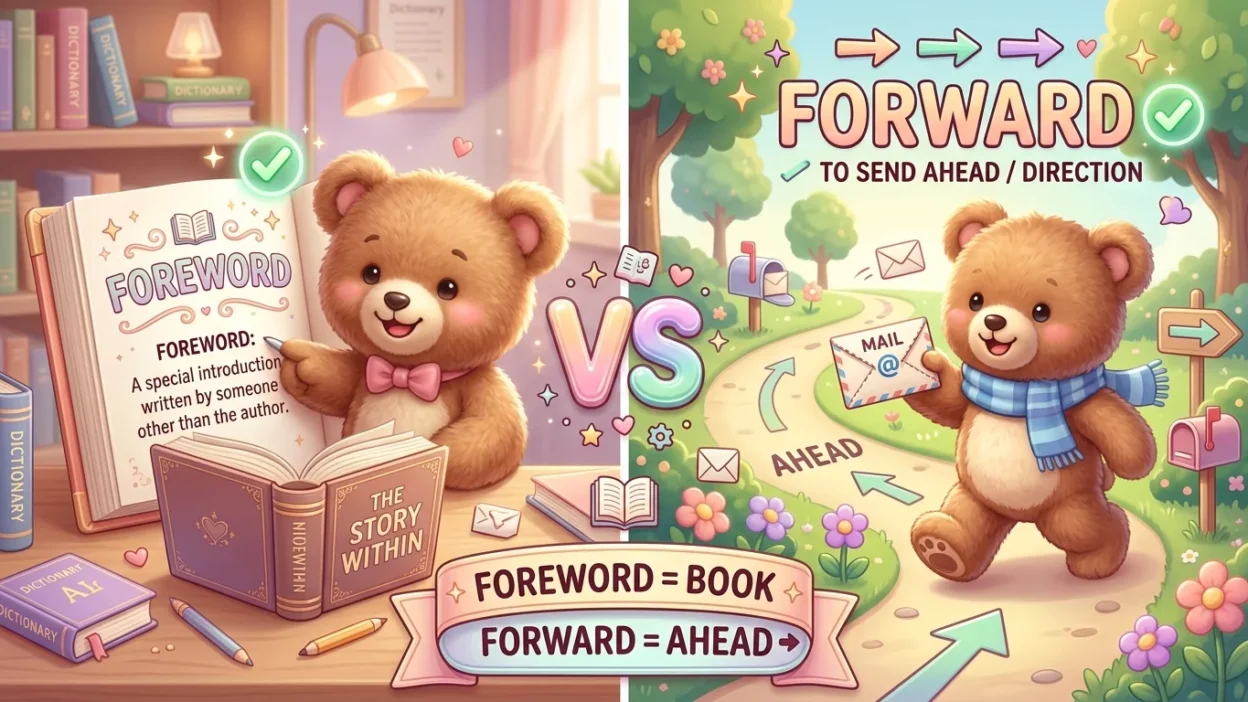
💡 Memory Trick
Spelling Box
📖 FOREWORD = BOOK
Think: FORE = BEFORE → a foreword comes before the main text.
➡️ FORWARD = AHEAD
Think: FORWARD = MOVE AHEAD
Remember:
Foreword = something you read before the book.
Forward = something that moves ahead.
Foreword Examples
Here are more examples using foreword correctly:
- The award-winning author wrote the foreword.
- The foreword provides useful background information.
- The book’s foreword was written by a professor.
- I enjoyed reading the foreword.
- The publisher asked a famous historian to contribute a foreword.
- Her mentor wrote a thoughtful foreword for the memoir.
Forward Examples
Here are more examples using forward:
- Move forward slowly.
- We must keep moving forward.
- He stepped forward to accept the award.
- Please forward the message.
- She is looking forward to the holiday.
- The project is moving forward.
- He leaned forward to hear the speaker.
- They decided to move forward with the proposal.
Foreword vs Introduction
A foreword is a specific type of introductory material, usually written by someone other than the author.
An introduction can be written by the author or another person and may introduce the subject or content of the book.
For example:
- Foreword → often explains why the book or author matters
- Introduction → introduces the subject or prepares readers for the content
The exact structure varies from book to book.
Foreword vs Forward in Professional Writing
Both words are correct, but they belong in completely different contexts.
Use foreword when discussing:
- Books
- Memoirs
- Biographies
- Academic publications
- Anthologies
- Other published works
Use forward when discussing:
- Direction
- Movement
- Progress
- Future plans
- Email forwarding
- Sending documents
Examples:
- The professor wrote the foreword.
- The team moved forward with the project.
American vs British English
There is no significant spelling difference between American and British English for these words.
Both varieties use:
- foreword = book introduction
- forward = ahead, onward, or send onward
The distinction remains the same.
When Should You Use Foreword?
Use foreword when you’re talking about an introductory section of a book, especially one written by someone other than the author.
Examples:
- The book has a foreword by a famous historian.
- I read the foreword before beginning the first chapter.
- Her professor contributed a foreword to the textbook.
Ask yourself:
“Am I talking about a section at the beginning of a book?”
If yes, use foreword.
When Should You Use Forward?
Use forward when you mean:
- Ahead
- Toward the front
- Onward
- Progressing
- Sending something onward
- Looking toward the future
Examples:
- Move forward.
- Step forward.
- Forward the email.
- Look forward to the event.
- Move forward with the plan.
Ask yourself:
“Am I talking about movement, progress, direction, or sending something?”
If yes, use forward.
Related Words and LSI Keywords
- foreword meaning
- forward meaning
- foreword vs forward
- forward vs foreword
- foreword definition
- forward definition
- foreword in a book
- what is a foreword
- foreword vs preface
- book introduction
- forward an email
- look forward to
- move forward
- step forward
- commonly confused words
- common spelling mistakes
- English grammar
- English vocabulary
- correct English usage
- publishing terms
- book terminology
Tips for Remembering the Difference
- Foreword = a book’s introductory section.
- Forward = ahead or onward.
- Think fore = before.
- Think forward = ahead.
- A foreword comes before the main text.
- You move forward toward the future.
- You forward an email.
- You look forward to something.
- Don’t write forward when you mean a book’s foreword.
Frequently Asked Questions
What is the difference between foreword and forward?
Foreword is an introductory section of a book, usually written by someone other than the author. Forward means ahead, onward, toward the front, or to send something onward.
Is it foreword or forward in a book?
The correct word is foreword when referring to an introductory section of a book.
Is “forward of the book” correct?
No. If you mean the introductory section, use foreword.
Is foreword written by the author?
Usually, a foreword is written by someone other than the author. The author’s own introductory comments are more commonly called a preface.
Is a foreword the same as a preface?
Not usually. A foreword is generally written by someone other than the author, while a preface is generally written by the author.
What does forward mean?
Forward can mean ahead, toward the front, onward, or toward future progress. It can also mean to send something to another person.
Is it “move foreword” or “move forward”?
The correct phrase is move forward.
Is it “forward an email” or “foreword an email”?
The correct phrase is forward an email.
Is “look foreword to” correct?
No. The correct expression is look forward to.
Example:
- I look forward to hearing from you.
Is foreword used in American English?
Yes. Foreword is standard in American English.
Is foreword used in British English?
Yes. Foreword is also standard in British English.
How do you remember foreword vs forward?
Remember FOREWORD = BOOK and FORWARD = AHEAD. A foreword comes before the main text, while forward means moving or progressing ahead.
Can foreword and forward be used in the same sentence?
Yes.
Example:
- After reading the book’s foreword, we moved forward with our research.
Summary
The difference between foreword vs forward is easy once you connect each word with its purpose. Foreword is a short introductory section at the beginning of a book, usually written by someone other than the author. Forward means ahead, onward, toward the front, or to send something onward.
Remember the simple trick: FOREWORD = BOOK and FORWARD = AHEAD. If you’re talking about a book’s introductory section, choose foreword. If you’re talking about movement, progress, email, or the future, choose forward.