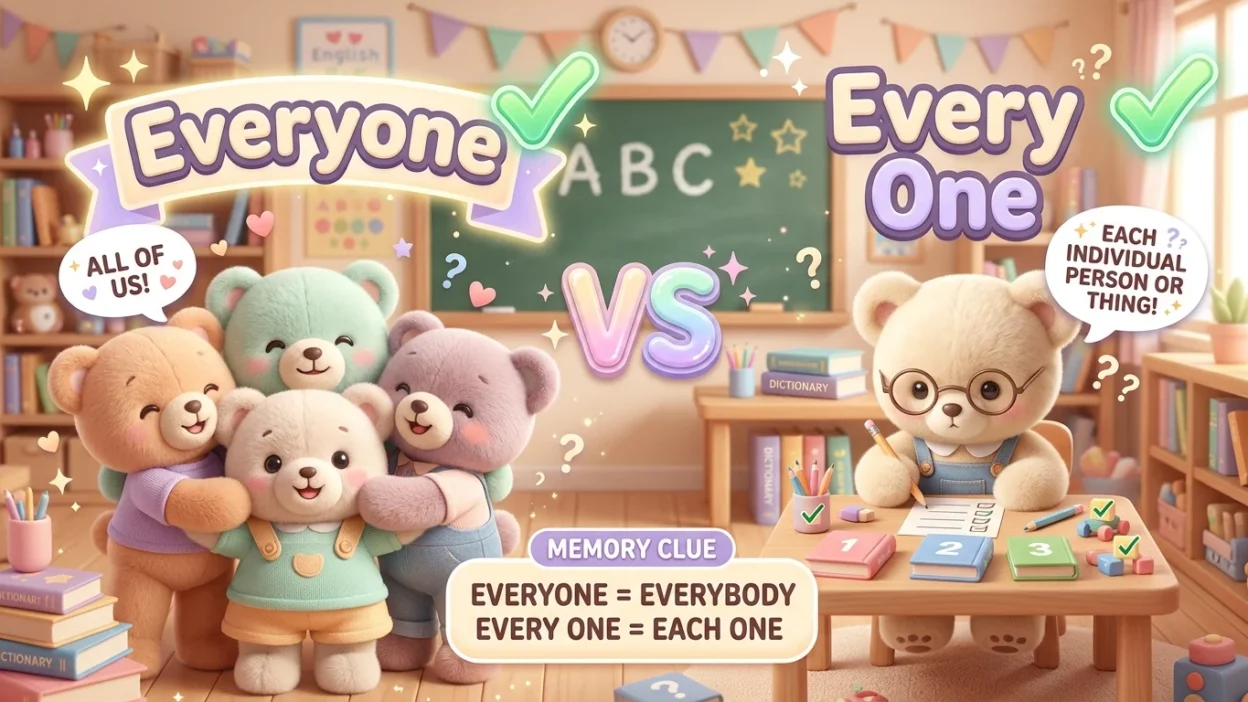
Have you ever wondered about everyone vs every one? These two expressions look almost identical, but they have different meanings and uses. Everyone is a pronoun that means “all people,” while every one refers to each individual person or thing in a group.
In this guide, you’ll learn the difference between everyone and every one, their meanings, examples, common mistakes, grammar rules, American and British English usage, FAQs, and an easy memory trick.
Quick Answer
- Everyone ✅ = all people or everybody.
- Every one ✅ = each individual person or thing.
Examples:
- Everyone enjoyed the party. ✅
- I checked every one of the documents. ✅
The easiest rule is:
Everyone = everybody
Every one = each individual one
What Does Everyone Mean?
Everyone is an indefinite pronoun that means all people in a particular group or situation.
It refers only to people.
Examples:
- Everyone is ready.
- Everyone enjoyed the meal.
- Everyone needs a break sometimes.
- Everyone in the class passed the test.
- Everyone was excited about the trip.
You can usually replace everyone with everybody without changing the basic meaning.
For example:
- Everyone was happy.
- Everybody was happy.
Both sentences mean essentially the same thing.
What Does Every One Mean?
Every one is a two-word phrase meaning each individual person or thing in a group.
Unlike everyone, every one can refer to both people and things.
Examples:
- I read every one of the books.
- She answered every one of the questions.
- We inspected every one of the rooms.
- He thanked every one of his supporters.
- I carefully checked every one of the files.
The word one emphasizes individual items.
Everyone vs Every One Comparison Table
| Expression | Meaning | Refers To | Example |
|---|---|---|---|
| Everyone | All people | People only | Everyone enjoyed the show. |
| Every one | Each individual one | People or things | I checked every one of the files. |
Why Are Everyone and Every One Confused?
The confusion happens because the two expressions sound almost identical.
However, the space changes the meaning.
Everyone
Everyone is one word.
It means:
all people
Example:
- Everyone arrived on time.
Every One
Every one is two words.
It means:
each individual person or thing
Example:
- Every one of the students arrived on time.
The phrase of the students makes the individual group especially clear.
Everyone Examples in Sentences
Use everyone when you’re referring to people generally or to all the people in a group.
- Everyone loves a good story.
- Everyone was invited to the wedding.
- Everyone needs support sometimes.
- Everyone in the office received an email.
- Everyone agreed with the decision.
- Everyone looked surprised.
- Everyone should bring their identification.
- Everyone deserves respect.
In each sentence, everyone means all people.
Every One Examples in Sentences
Use every one when you want to emphasize each individual member or item.
- I opened every one of the boxes.
- She answered every one of the questions.
- He examined every one of the paintings.
- We watched every one of the episodes.
- They inspected every one of the vehicles.
- I remember every one of those moments.
- She thanked every one of her guests.
- The teacher reviewed every one of the assignments.
Everyone vs Every One of
This is one of the easiest ways to recognize the difference.
When you see every one of, the two-word form is normally required.
Examples:
- Every one of the students passed.
- Every one of the books was expensive.
- Every one of these answers is correct.
- Every one of them received a certificate.
You would not normally write:
- ❌ Everyone of the students passed.
Correct:
- ✅ Every one of the students passed.
Everyone vs Every One of Them
The correct expression is:
every one of them
Examples:
- I spoke to every one of them.
- She thanked every one of them.
- We interviewed every one of them.
- He remembered every one of them.
Here, one refers to each individual person.
Everyone Can Refer Only to People
A useful grammar rule is that everyone refers to people.
Correct:
- Everyone in the room was quiet.
- Everyone at the party had fun.
For objects, use every one:
- I checked every one of the machines.
- She inspected every one of the boxes.
Incorrect:
- ❌ Everyone of the boxes was damaged.
Correct:
- ✅ Every one of the boxes was damaged.
Every One Can Refer to People
Every one can also refer to people.
For example:
- I thanked every one of the volunteers.
- She interviewed every one of the candidates.
- He remembered every one of his teachers.
The important difference is that every one emphasizes individuals.
Everyone vs Every Person
Everyone and every person can have the same basic meaning.
Examples:
- Everyone agreed.
- Every person agreed.
However, everyone is more natural and concise in many situations.
Everyone vs Everybody
Everyone and everybody are usually interchangeable.
Examples:
- Everyone was excited.
- Everybody was excited.
Both mean all people.
However, neither should automatically replace every one.
Compare:
- Everyone was invited. → all people
- Every one of the invitations was sent. → each individual invitation
Common Mistakes People Make
Mistake 1: Writing Everyone of
Incorrect:
- ❌ Everyone of the students passed.
Correct:
- ✅ Every one of the students passed.
Mistake 2: Using Everyone for Objects
Incorrect:
- ❌ I checked everyone of the documents.
Correct:
- ✅ I checked every one of the documents.
Mistake 3: Using Every One When Everyone Is Needed
Incorrect:
- ❌ Every one deserves respect.
Correct:
- ✅ Everyone deserves respect.
Here, you’re referring generally to all people.
Mistake 4: Forgetting the Meaning of “One”
When one means an individual person or thing, write the phrase as two words:
every one
Simple Memory Trick
💡 Memory Trick
Spelling Box
👥 EVERYONE = EVERYBODY
📦 EVERY ONE = EACH INDIVIDUAL ONE
Think:
Everyone = all people
Every one = each one
If you can replace it with everybody, use everyone.
If you can replace it with each one, use every one.
Everyone vs Every One With “Of”
This is an especially useful grammar test.
If you have:
every one + of + group
use two words.
Examples:
- Every one of the students
- Every one of the books
- Every one of the answers
- Every one of my friends
- Every one of them
The phrase every one of clearly means each individual member or item.
Everyone and Subject-Verb Agreement
Everyone is grammatically singular.
Therefore, it takes a singular verb.
Correct:
- Everyone is ready.
- Everyone has arrived.
- Everyone wants to help.
- Everyone was excited.
Incorrect:
- ❌ Everyone are ready.
- ❌ Everyone have arrived.
Even though everyone refers to multiple people, grammatically it behaves as a singular pronoun.
Every One and Subject-Verb Agreement
Every one is also treated as singular when it functions as the subject.
Examples:
- Every one of the students is ready.
- Every one of the books was damaged.
- Every one of them has received a message.
The verb agrees with one, not with the plural noun after of.
Everyone in Formal Writing
Everyone is standard and appropriate in:
- Academic writing
- Business writing
- Emails
- Essays
- Articles
- Everyday communication
Examples:
- Everyone should follow the instructions.
- Everyone in the department received the announcement.
Every One in Formal Writing
Every one is also standard.
Use it when emphasizing each individual member or item.
Examples:
- The committee reviewed every one of the proposals.
- The researcher examined every one of the samples.
- The manager contacted every one of the applicants.
American vs British English
There is no significant difference between American and British English in the spelling or basic meaning of these expressions.
Both use:
- everyone = all people
- every one = each individual person or thing
The same grammar rules apply in both varieties.
When Should You Use Everyone?
Use everyone when you mean:
- All people
- Everybody
- All members of a group
Examples:
- Everyone is welcome.
- Everyone enjoyed the event.
- Everyone knows the answer.
- Everyone in the room was quiet.
Ask yourself:
“Can I replace this with everybody?”
If yes, use everyone.
When Should You Use Every One?
Use every one when you mean:
- Each individual person
- Each individual thing
- Each member or item in a group
Examples:
- Every one of the students
- Every one of the books
- Every one of the questions
- Every one of them
Ask yourself:
“Can I replace this with each one?”
If yes, use every one.
Related Words and LSI Keywords
- everyone meaning
- every one meaning
- everyone vs every one
- every one vs everyone
- everyone of vs every one of
- everyone definition
- every one definition
- everyone or every one
- everyone vs everybody
- each one vs everyone
- every one of them
- everyone is or are
- English grammar
- English spelling
- commonly confused words
- common grammar mistakes
- correct English usage
- pronouns
- indefinite pronouns
- grammar guide
- vocabulary
Tips for Remembering the Difference
- Everyone = everybody.
- Every one = each one.
- Everyone refers to people.
- Every one can refer to people or things.
- Use every one of when followed by a group.
- Everyone is correct because everyone is grammatically singular.
- Every one of the books is correct.
- Think everyone = all, while every one = each.
Frequently Asked Questions
What is the difference between everyone and every one?
Everyone means all people, while every one means each individual person or thing.
Is everyone one word?
Yes. Everyone is one word when it means everybody.
Is every one two words?
Yes. Every one is two words when one refers to each individual person or thing.
Is “everyone of them” correct?
No. The standard form is:
- ✅ Every one of them
Is it everyone or every one of the students?
The correct phrase is:
- ✅ Every one of the students
Can everyone refer to things?
No. Everyone normally refers to people. Use every one for individual things.
Example:
- Every one of the books was expensive.
Is everyone singular or plural?
Everyone is grammatically singular.
Correct:
- Everyone is ready.
Is “everyone are” correct?
No. Use a singular verb:
- ✅ Everyone is ready.
Is every one singular?
Yes. Every one is treated as singular when referring to each individual person or thing.
Example:
- Every one of the students is prepared.
Are everyone and everybody the same?
They are generally interchangeable. Both mean all people.
What is an easy way to remember everyone vs every one?
Remember EVERYONE = EVERYBODY and EVERY ONE = EACH ONE. If you’re talking about all people, use everyone. If you’re emphasizing individual people or things, use every one.
Can everyone and every one be used in the same sentence?
Yes.
Example:
- Everyone received a gift, and every one of the gifts was beautifully wrapped.
Summary
The difference between everyone vs every one is simple once you focus on the meaning. Everyone is one word and means all people, while every one is two words and means each individual person or thing.
Remember the easiest test: if you can replace the word with everybody, use everyone. If you can replace it with each one, use every one. So write “Everyone is welcome” but “Every one of the guests received a gift.”

Alistair Fenwicke is a quiet observer of rural life and forgotten histories.
His novels explore memory, solitude, and the passing of time.
He writes from a small countryside cottage surrounded by fields.