
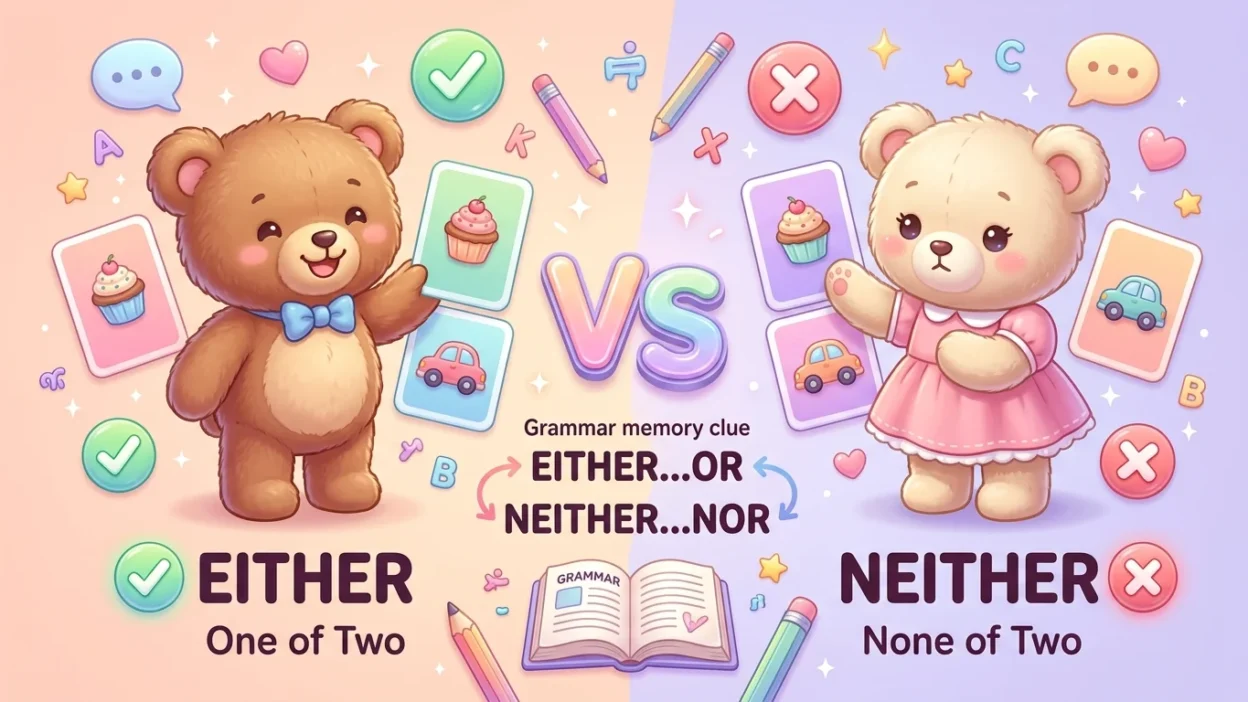
Have you ever wondered about the difference between either vs neither? These two words are closely related, but they express opposite ideas. Either generally refers to one of two choices, both possibilities in a negative construction, or any one of two options, while neither means not one and not the other.
In this guide, you’ll learn the difference between either and neither, including their meanings, grammar rules, examples, common mistakes, sentence patterns, and an easy memory trick. Once you understand the basic contrast, choosing between them becomes much easier.
Quick Answer
- Either ✅ — Refers to one of two choices or can express agreement with a negative statement.
- Neither ✅ — Means not one and not the other.
Examples:
- You can choose either option. ✅
- Neither option is available. ✅
The easiest rule is:
Either = one or the other
Neither = not one and not the other
What Does Either Mean?
Either is commonly used when talking about two choices or possibilities.
It can mean one or the other of two.
Examples:
- You can choose either dress.
- Either answer could be correct.
- I can meet you on either day.
- Either option will work.
It can also appear in the structure:
either…or
Examples:
- You can either call me or send me a message.
- Either Sarah or Emily will attend.
- We can either stay home or go outside.
What Does Neither Mean?
Neither means not one and not the other of two choices.
Examples:
- Neither answer is correct.
- Neither candidate won.
- Neither option works for me.
- Neither restaurant is open.
It commonly appears in the structure:
neither…nor
Examples:
- Neither John nor Mark attended.
- She likes neither tea nor coffee.
- Neither option is suitable.
Either vs Neither Comparison Table
| Feature | Either | Neither |
|---|---|---|
| Basic meaning | One or the other | Not one and not the other |
| Number of choices | Two | Two |
| Positive choice | ✅ Yes | ❌ No |
| Negative meaning | Sometimes, with negative statements | ✅ Yes |
| Common pair | Either…or | Neither…nor |
| Example | Either answer is acceptable. | Neither answer is acceptable. |
Why Are Either and Neither Confused?
Either and neither are confusing because both usually refer to two people or things.
The main difference is their meaning.
Compare:
- Either answer is correct. → One of the two answers is acceptable.
- Neither answer is correct. → Both answers are incorrect.
Think of them as opposites:
Either → one of two
Neither → zero of two
Examples of Either in Sentences
- You can choose either color.
- Either answer could be right.
- We can take either road.
- Either restaurant would be fine.
- I can meet you on either day.
- Either option is acceptable.
- You can sit on either side.
- Either candidate could win.
Examples of Neither in Sentences
- Neither answer is correct.
- Neither option is available.
- Neither student knew the answer.
- Neither restaurant serves breakfast.
- Neither candidate received enough votes.
- Neither road leads to the city.
- Neither explanation makes sense.
- Neither team scored.
Either…Or
The structure either…or presents two alternatives.
Examples:
- You can either stay or leave.
- We can either walk or take a taxi.
- Either John or James will help.
- She will either call or email you.
- You can choose either tea or coffee.
The basic pattern is:
Either + option A + or + option B
Neither…Nor
The structure neither…nor rejects both alternatives.
Examples:
- Neither John nor James came.
- Neither tea nor coffee is available.
- She likes neither cats nor dogs.
- Neither answer nor explanation was convincing.
The basic pattern is:
Neither + option A + nor + option B
Either vs Neither With Two Choices
Imagine that you have two restaurants.
If both are acceptable:
- You can eat at either restaurant.
If neither is acceptable:
- You can eat at neither restaurant.
Another example:
Two shirts are available.
- You can wear either shirt. → One of the two is okay.
- You can wear neither shirt. → Both are unsuitable.
Either Means One of Two
One of the easiest ways to understand either is to think:
Either = one or the other
For example:
- Either road will take you there.
This means that Road A or Road B can take you there.
It doesn’t necessarily mean both roads will be chosen. It means either individual option is acceptable.
Neither Means Zero of Two
Think of neither as:
Neither = not this one + not that one
For example:
- Neither road goes to the village.
This means:
- Road A doesn’t go there.
- Road B doesn’t go there.
So, neither option works.
Either as a Determiner
Either can come before a singular noun when referring to one of two things.
Examples:
- Either answer is acceptable.
- Either option will work.
- Either side is fine.
- Either candidate could win.
Notice that the noun is normally singular:
- Either answer ✅
- Either answers ❌
Neither as a Determiner
Neither can also come before a singular noun when referring to two things.
Examples:
- Neither answer is correct.
- Neither option works.
- Neither candidate won.
- Neither side agreed.
Again, the noun is generally singular:
- Neither answer ✅
- Neither answers ❌
Either as a Pronoun
Either can stand alone when the noun is already understood.
Examples:
- Which dress do you want? Either is fine.
- Which road should we take? Either will work.
- Which one can I choose? Either is acceptable.
Here, either means one of the two options.
Neither as a Pronoun
Neither can also stand alone.
Examples:
- Which shirt do you want? Neither.
- Which answer is correct? Neither.
- Which restaurant do you prefer? Neither is open.
Here, neither means not one and not the other.
Either as an Adverb
Either can also appear at the end of a negative sentence to mean also.
Examples:
- I don’t like coffee either.
- She doesn’t understand it either.
- He isn’t coming either.
- I can’t swim either.
This is a very common use of either.
Neither for Agreement With Negative Statements
Neither can be used to agree with a negative statement.
For example:
- “I don’t like coffee.”
- “Neither do I.”
Another example:
- “I can’t swim.”
- “Neither can I.”
You can also use:
- Neither am I.
- Neither have I.
- Neither did I.
- Neither will I.
The auxiliary verb changes according to the original sentence.
Either vs Neither for Agreement
Compare these patterns:
Negative Agreement With Either
- I don’t like tea either.
- She doesn’t like it either.
Negative Agreement With Neither
- “I don’t like tea.”
- “Neither do I.”
Both can express agreement with a negative idea, but their grammatical structures are different.
Common Mistakes People Make
Mistake 1: Using Either Instead of Neither
Incorrect:
- ❌ Either answer is correct.
(If you mean both answers are wrong.)
Correct:
- ✅ Neither answer is correct.
Mistake 2: Using Neither When One Option Works
Incorrect:
- ❌ Neither dress looks good.
(If one dress actually looks good.)
Correct:
- ✅ Either dress looks good.
Mistake 3: Using “Either…Nor”
Standard paired constructions are:
- either…or ✅
- neither…nor ✅
Not:
- ❌ either…nor
- ❌ neither…or
Examples:
- ✅ Either call me or text me.
- ✅ Neither John nor Sarah came.
Simple Memory Trick
💡 Memory Trick
Spelling Box
Remember:
EITHER = ONE OF TWO
NEITHER = NONE OF TWO
Think:
Either = one
Neither = zero
And remember the pairs:
Either…or ✅
Neither…nor ✅
Either vs Neither With “Of”
Both words can be followed by of before a plural noun or pronoun.
Either of
- Either of the answers is acceptable.
- Either of them can help.
- Either of these options will work.
Neither of
- Neither of the answers is correct.
- Neither of them came.
- Neither of these options works.
The meanings remain opposite:
Either of = one of the two
Neither of = not one of the two
Either of Them vs Neither of Them
These expressions are particularly common.
Either of Them
Means one of the two people or things.
Example:
- Either of them can help you.
This means either individual is capable of helping.
Neither of Them
Means not one and not the other.
Example:
- Neither of them can help you.
This means both are unable to help.
Either vs Neither With Singular and Plural Nouns
After either and neither, a singular noun is usually used.
Examples:
- Either option is fine.
- Neither option is suitable.
- Either answer could work.
- Neither answer is correct.
However, when you use either of or neither of, the following noun or pronoun is plural:
- Either of the options
- Neither of the options
- Either of them
- Neither of them
Subject-Verb Agreement
In formal standard English, either and neither used directly with a singular noun generally take a singular verb.
Examples:
- Either option is acceptable.
- Neither option is available.
- Either answer works.
- Neither answer works.
With either of and neither of, usage can vary in informal speech, but singular agreement is a safe choice in formal writing.
Examples:
- Neither of the options is suitable.
- Either of the candidates is qualified.
Either vs Neither in Questions
Both can appear in questions.
Examples:
- Do you want either option?
- Can either candidate help us?
- Is either restaurant open?
- Is neither option available?
However, the exact meaning depends on the sentence.
Either vs Neither in Negative Sentences
Be careful not to create a double negative.
Incorrect:
- ❌ I don’t like neither option.
Standard alternatives:
- ✅ I don’t like either option.
- ✅ I like neither option.
Why?
Neither already contains a negative meaning.
Therefore:
I don’t like either option. ✅
or
I like neither option. ✅
Either vs Neither in Formal Writing
Both either and neither are completely standard in formal English.
Examples:
- Either proposal could be accepted.
- Neither proposal meets the requirements.
- Either candidate may apply.
- Neither candidate has sufficient experience.
They work well in:
- Academic writing
- Business writing
- Professional emails
- Reports
- Essays
- Everyday communication
American vs British English
There is no major difference between American and British English regarding the basic meanings of either and neither.
Both varieties use:
- either…or
- neither…nor
- either of
- neither of
Pronunciation can vary between American and British English, but the grammar and meanings remain essentially the same.
When Should You Use Either?
Use either when:
- You mean one of two choices.
- Both options are possible or acceptable.
- You present two alternatives.
- You agree with a negative statement at the end of a sentence.
Examples:
- Either answer is acceptable.
- You can choose either one.
- Either John or Mark will come.
- I don’t like it either.
When Should You Use Neither?
Use neither when:
- You mean not one of two.
- Both options are rejected.
- Both people or things are excluded.
- You want to form a negative pair with nor.
Examples:
- Neither answer is correct.
- Neither option works.
- Neither John nor Mark came.
- Neither of them agreed.
Related Words and LSI Keywords
- either meaning
- neither meaning
- either vs neither
- either definition
- neither definition
- either or
- neither nor
- either of them
- neither of them
- either one
- neither one
- either choice
- neither choice
- English grammar
- English usage
- commonly confused words
- grammar rules
- common grammar mistakes
- correct English usage
- English language learning
Tips for Remembering the Difference
- Either = one of two.
- Neither = not one and not the other.
- Either…or presents alternatives.
- Neither…nor rejects both alternatives.
- Either of them = one of the two.
- Neither of them = zero of the two.
- Either can appear at the end of a negative sentence.
- Remember: Either = one; neither = none.
Frequently Asked Questions
What is the difference between either and neither?
Either generally refers to one of two choices, while neither means not one and not the other.
Is either positive or negative?
Either is generally neutral or positive when referring to a choice. For example, either option means one of the two options is acceptable. However, either can also appear in negative sentences, such as “I don’t like it either.”
Is neither always negative?
Neither has a negative meaning because it means not one and not the other.
What is the difference between either…or and neither…nor?
Either…or gives two alternatives:
- Either call me or text me.
Neither…nor rejects both:
- Neither John nor Mark called.
Can I say either of them?
Yes. Either of them means one of two people or things.
Example: Either of them can help you.
Can I say neither of them?
Yes. Neither of them means not one and not the other.
Example: Neither of them knows the answer.
Is it “either is” or “either are”?
When either directly modifies a singular noun, use a singular verb:
- Either option is acceptable.
Is it “neither is” or “neither are”?
When neither directly modifies a singular noun, use a singular verb:
- Neither option is available.
Can either mean both?
Usually, either means one or the other of two, not both simultaneously. However, in some contexts, either can describe each of two individually, so context matters.
What is an easy way to remember either vs neither?
Remember: Either = one of two. Neither = none of two. Also remember the pairs either…or and neither…nor.
Summary
The difference between either vs neither becomes easy once you focus on the number of choices being accepted or rejected. Either generally means one of two, while neither means not one and not the other. For example, “Either answer is acceptable” means one of the two answers can work, while “Neither answer is acceptable” means both answers are wrong.
Remember the common structures either…or and neither…nor. Also, avoid double negatives such as “I don’t like neither.” Instead, say “I don’t like either” or “I like neither.” With these simple rules, you’ll be able to use both words confidently.

Cedric Halewood is known for his intricate historical narratives.
His work reflects a deep fascination with lost civilizations.
He lives near the coast, where he finds inspiration in the sea.