Have you ever wondered about yea vs nay and when to use each word? Although both words express a response or opinion, they have different meanings and uses. Yea generally means yes, approval, or an affirmative vote, while nay means no, rejection, or a negative vote.
In this guide, you’ll learn the difference between yea and nay, their meanings, origins, examples, voting usage, common mistakes, and an easy memory trick. You’ll also learn how yea differs from yeah, yes, and nay differs from no.
Quick Answer
- Yea ✅ = Yes / approval / affirmative vote
- Nay ✅ = No / rejection / negative vote
Examples:
- The proposal passed with yea votes. ✅
- The proposal received several nay votes. ✅
The simplest rule is:
Yea = yes
Nay = no
However, both words can sound formal, old-fashioned, or ceremonial outside specific contexts.
What Does Yea Mean?
Yea is an English word that traditionally means yes, approval, or an affirmative vote.
It is especially common in formal voting contexts, parliamentary language, and traditional expressions.
Examples:
- The motion passed with 30 yea votes.
- The members voted yea on the proposal.
- There were 80 yeas and 20 nays.
- She cast her yea vote.
In ordinary conversation, people usually say yes instead of yea.
What Does Nay Mean?
Nay means no, rejection, or a negative vote.
It is commonly used as the opposite of yea in voting contexts.
Examples:
- The motion received ten nay votes.
- The committee voted nay on the proposal.
- There were more nays than yeas.
- He cast a nay vote.
Like yea, nay can sound formal or old-fashioned in everyday conversation.
Yea vs Nay Comparison Table
| Feature | Yea | Nay |
|---|---|---|
| Basic meaning | Yes / approval | No / rejection |
| Voting meaning | Affirmative vote | Negative vote |
| Opposite | Nay | Yea |
| Common context | Formal voting | Formal voting |
| Everyday usage | Uncommon | Uncommon |
| Example | Vote yea | Vote nay |
Why Are Yea and Nay Confused?
The words yea and nay are often learned together because they form a traditional pair.
When a group votes:
- Yea = approve
- Nay = reject
The confusion usually comes from the fact that yea looks and sounds similar to yeah, while nay is less common in everyday modern English.
Remember that:
Yea ≠ Yeah
Although they can sound similar, they have different uses.
Examples of Yea in Sentences
Here are some correct examples of yea:
- The council voted yea on the proposal.
- The motion passed with 45 yea votes.
- She gave a yea to the new policy.
- The members cast their yea votes.
- The final count was 60 yeas and 15 nays.
- He voted yea when the proposal was presented.
Examples of Nay in Sentences
Here are some correct examples of nay:
- The committee voted nay on the proposal.
- The motion received several nay votes.
- There were 25 nays and 40 yeas.
- She cast a nay vote.
- The members voted nay against the amendment.
- The final result included more nays than yeas.
Yea and Nay in Voting
One of the most important uses of yea and nay is voting.
When a person votes yea, they approve of a proposal.
When a person votes nay, they reject it.
For example:
Question: Should the organization adopt the new rule?
Response:
- Yea → Yes, approve the rule.
- Nay → No, reject the rule.
This usage is especially associated with formal legislative and parliamentary voting.
What Does Yea Vote Mean?
A yea vote is an affirmative vote in favor of a proposal, motion, bill, or decision.
Example:
- The senator cast a yea vote on the bill.
This means the senator voted in favor of the bill.
You may also see the plural form:
- yeas = affirmative votes.
Example:
- The bill passed with 70 yeas and 30 nays.
What Does Nay Vote Mean?
A nay vote is a negative vote against a proposal, motion, bill, or decision.
Example:
- The representative cast a nay vote on the measure.
This means the representative voted against it.
The plural is:
- nays = negative votes.
Yea vs Yes
Although yea and yes can both express agreement, they aren’t used in exactly the same way.
Yes
Yes is the ordinary modern English word for agreement or affirmation.
Examples:
- Yes, I agree.
- Yes, I’ll come.
- Yes, that’s correct.
Yea
Yea is more formal, traditional, or associated with voting.
Examples:
- The members voted yea.
- The motion received 50 yeas.
So:
Yes = everyday agreement
Yea = formal/traditional approval or voting
Yea vs Yeah
This distinction is especially important.
Yea
Means yes, particularly in formal voting or traditional contexts.
- The committee voted yea.
Yeah
Is an informal form of yes.
- Yeah, I’ll help you.
Therefore:
- Yea = affirmative vote / traditional yes
- Yeah = informal yes
Don’t use yea simply because you want to spell yeah differently.
Nay vs No
Nay and no can both express rejection, but their usage differs.
No
No is the standard everyday word.
- No, I don’t want it.
- No, that’s incorrect.
Nay
Nay is more formal, traditional, or associated with voting.
- The committee voted nay.
- The proposal was defeated by the nays.
Therefore:
No = everyday negative response
Nay = formal/traditional negative response or vote
Yea and Nay in Formal Language
You may encounter yea and nay in:
- Legislative voting
- Parliamentary proceedings
- Formal resolutions
- Historical documents
- Ceremonial language
- Traditional expressions
- Religious or archaic writing
For example:
- The members voted yea.
- The motion was defeated by the nays.
In casual conversation, yes and no are much more natural.
Yea and Nay in Modern English
Although yea and nay remain valid English words, they are not equally common in everyday speech.
Most people would say:
- Yes
- No
rather than:
- Yea
- Nay
However, yea and nay remain useful when discussing formal votes.
Yea as a Noun
Yea can function as a noun when referring to an affirmative vote.
Example:
- The motion passed by a vote of 40 yeas to 10 nays.
Here:
- yeas = people or votes in favor
- nays = people or votes against
Nay as a Noun
Nay can also function as a noun.
Examples:
- The vote was 30 yeas and 20 nays.
- The nays opposed the proposal.
- There were only five nays.
In these contexts, nay refers to a negative vote.
“Yea or Nay” Meaning
The phrase yea or nay means yes or no, especially when asking for a decision, approval, or vote.
Example:
- The committee must decide yea or nay.
- Give me a yea or nay before Friday.
- The proposal requires a yea or nay from the board.
In modern everyday English, you could simply say:
- Give me a yes or no.
“Yea or Nay” in Everyday Use
Although yea or nay is understandable, it can sound formal, playful, dramatic, or old-fashioned.
For example:
Is the plan a yea or nay?
This might sound more ceremonial than:
Is the plan a yes or no?
So, choose the expression based on your audience and context.
“Yea, Nay” and “Yea, Nay” as an Emphasis
You may occasionally encounter nay in older expressions where it means something like “indeed” or “more than that.”
For example:
- “It was difficult, nay, almost impossible.”
This is a literary or old-fashioned use and is different from nay = no.
In this construction, nay corrects or strengthens the statement that came before it.
Common Mistakes People Make
Mistake 1: Using Yea Instead of Yeah
Incorrect if you mean informal “yeah”:
- ❌ Yea, I’ll come with you.
More natural:
- ✅ Yeah, I’ll come with you.
Or, in formal English:
- ✅ Yes, I’ll come with you.
Mistake 2: Using Nay in Casual Conversation
You can use nay, but it may sound unusually formal or old-fashioned.
Instead of:
- “Nay, I don’t want coffee.”
Most modern speakers would say:
- “No, I don’t want coffee.”
Mistake 3: Confusing Yea With Nay
Remember:
- Yea = yes
- Nay = no
They are opposites.
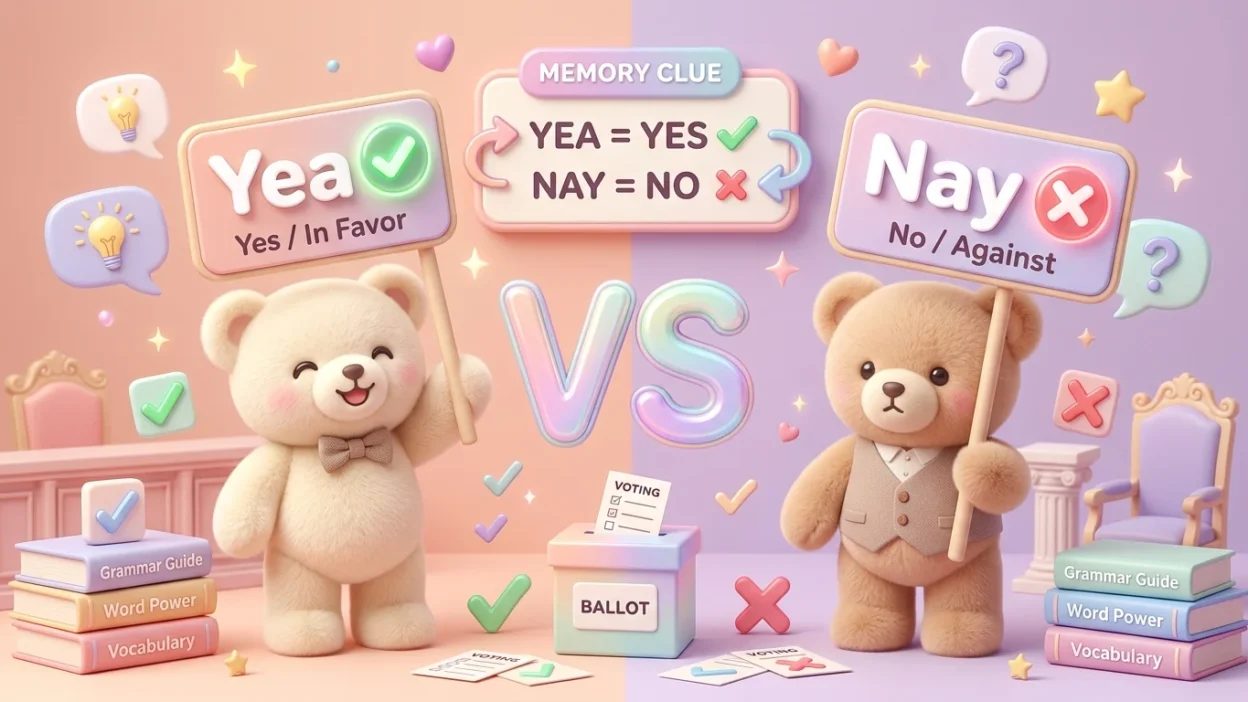
Simple Memory Trick
💡 Memory Trick
Spelling Box
Remember:
YEA = YES ✔
NAY = NO ✖
Think:
Yea = You approve
Nay = No
And remember:
Yea ↔ Nay
Yes ↔ No
Yea vs Nay in a Vote
Imagine a committee has to decide whether to approve a new project.
If you support it:
Yea! ✅
If you oppose it:
Nay! ❌
For example:
Chairperson: All in favor?
Members: Yea!
Or:
Chairperson: All opposed?
Members: Nay!
This makes the distinction easy:
Yea = in favor
Nay = against
Yea vs Nay in Parliamentary Language
In formal legislative contexts, yea and nay can identify votes for and against a measure.
You might see:
- Yeas: 75
- Nays: 25
This means:
- 75 votes supported the measure.
- 25 votes opposed it.
The exact procedures and terminology can vary by legislative body, but the basic meaning remains the same.
American vs British English
Both American and British English recognize yea and nay.
However, their everyday use is limited compared with yes and no.
In both varieties:
- Yea = affirmative / yes
- Nay = negative / no
The words are particularly familiar in formal or historical voting language.
When Should You Use Yea?
Use yea when:
- Casting or describing a formal vote.
- Talking about an affirmative vote.
- Writing in a traditional or ceremonial style.
- Referring to yeas and nays.
Examples:
- The committee voted yea.
- The bill passed with 60 yeas.
- The members cast their yea votes.
For everyday conversation, use yes or yeah instead.
When Should You Use Nay?
Use nay when:
- Casting or describing a formal negative vote.
- Talking about opposition to a proposal.
- Writing in a traditional or ceremonial style.
- Referring to yeas and nays.
Examples:
- The committee voted nay.
- The motion received 30 nays.
- The members cast their nay votes.
For everyday conversation, no is generally more natural.
Related Words and LSI Keywords
- yea meaning
- nay meaning
- yea vs nay
- yea definition
- nay definition
- yea or nay
- yea vote
- nay vote
- yeas and nays
- yea or nay meaning
- yes or no
- yea vs yeah
- nay vs no
- affirmative vote
- negative vote
- voting terminology
- parliamentary language
- formal English
- old-fashioned English
- English vocabulary
- commonly confused words
Tips for Remembering the Difference
- Yea = yes.
- Nay = no.
- Yea = approval.
- Nay = rejection.
- Yea vote = vote in favor.
- Nay vote = vote against.
- Yeas and nays = votes for and against.
- Yea is not simply another spelling of informal yeah.
- In everyday conversation, yes/no usually sound more natural.
Frequently Asked Questions
What is the difference between yea and nay?
Yea means yes, approval, or an affirmative vote, while nay means no, rejection, or a negative vote.
Does yea mean yes?
Yes. Yea can mean yes, especially in formal voting or traditional language.
Does nay mean no?
Yes. Nay can mean no, particularly in formal, traditional, or voting contexts.
Is yea the same as yeah?
No. Yea is associated with affirmative votes and traditional/formal usage, while yeah is an informal form of yes.
Is nay still used today?
Yes. Nay is still used, especially in formal voting terminology such as yeas and nays. It is less common in ordinary conversation.
What does yea or nay mean?
Yea or nay means yes or no, especially when asking someone for a decision or vote.
What does a yea vote mean?
A yea vote means a vote in favor of a proposal, motion, bill, or decision.
What does a nay vote mean?
A nay vote means a vote against a proposal, motion, bill, or decision.
What are yeas and nays?
Yeas and nays are affirmative and negative votes. Yeas support a measure, while nays oppose it.
Is yea formal or informal?
Yea is generally formal, traditional, ceremonial, or associated with voting. Yes is much more common in ordinary conversation.
Is nay formal or informal?
Nay is generally formal, traditional, literary, or associated with voting. No is more natural in everyday speech.
What is an easy way to remember yea vs nay?
Remember: YEA = YES and NAY = NO. In voting, yea means in favor, while nay means against.
Summary
The difference between yea vs nay is simple: yea means yes or approval, while nay means no or rejection. These words are especially common when discussing formal votes, where yeas represent votes in favor and nays represent votes against. The familiar phrase “yea or nay” simply means “yes or no.”
Although both words remain correct English, they can sound formal, traditional, or old-fashioned in everyday conversation. In most casual situations, use yes or yeah instead of yea, and no instead of nay. For voting terminology, however, yea and nay remain useful and clear.

Alistair Fenwicke is a quiet observer of rural life and forgotten histories.
His novels explore memory, solitude, and the passing of time.
He writes from a small countryside cottage surrounded by fields.