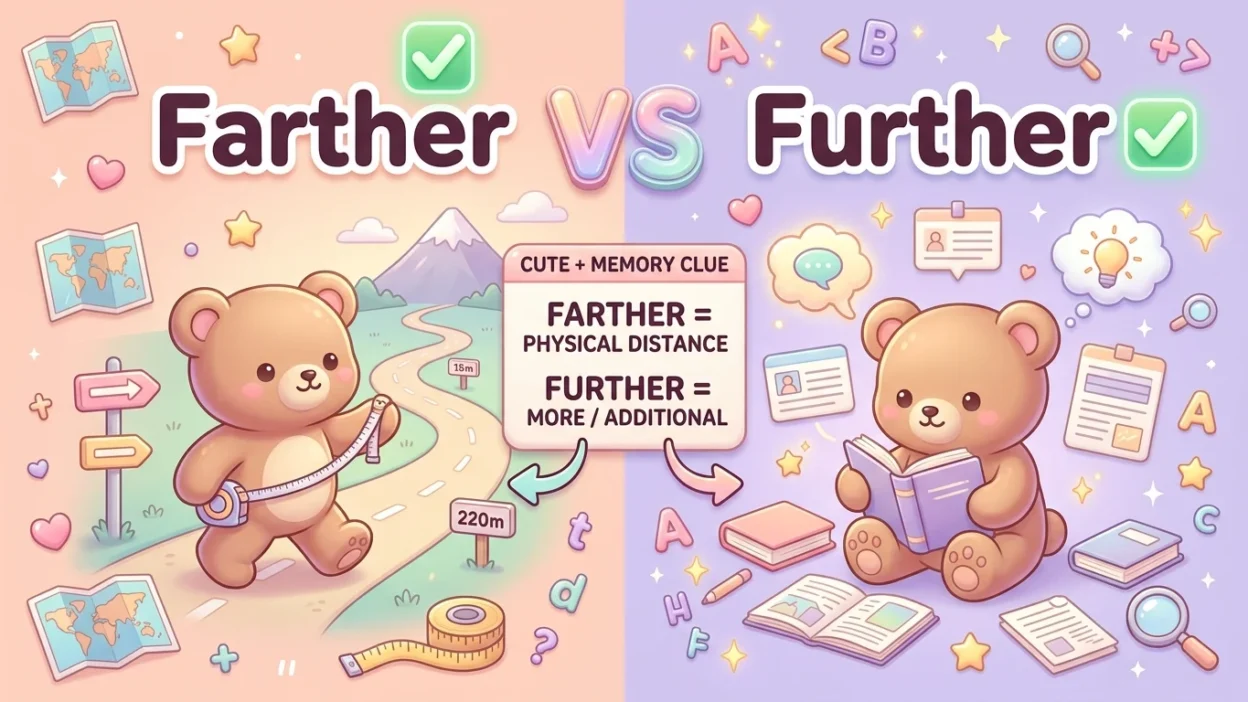
Have you ever wondered whether farther or further is the correct word? You’re not alone. These two words have very similar meanings, and many English speakers use them interchangeably. However, there is a useful distinction: farther traditionally refers to physical distance, while further often refers to figurative distance, additional information, or something beyond a certain point.
In this guide, you’ll learn the difference between farther vs further, their meanings, correct usage, examples, common mistakes, American and British English usage, and an easy memory trick. By the end, you’ll know when to choose farther and when further is the better option.
Quick Answer
- Farther ✅ — Traditionally used for physical or measurable distance.
- Further ✅ — Commonly used for figurative distance, additional information, or something more.
Examples:
- We walked farther than we expected. ✅
- We need to discuss this further. ✅
A simple rule is:
Physical distance = farther
Additional or figurative meaning = further
However, modern English sometimes uses further for physical distance too, so the distinction isn’t always absolute.
What Does Farther Mean?
Farther traditionally refers to physical distance. It describes something that is located at or moves to a greater measurable distance.
Examples:
- The school is farther from my house than I thought.
- We walked farther than the other group.
- How much farther is the airport?
- The mountain looked farther away than it really was.
- She ran farther than she had ever run before.
In these examples, you can imagine measuring the distance in miles, kilometers, meters, or another physical unit.
What Does Further Mean?
Further commonly means additional, more, or to a greater degree.
It is often used for abstract or figurative ideas rather than physical distance.
Examples:
- We need to investigate the matter further.
- Please provide further information.
- I don’t want to discuss this further.
- The issue requires further consideration.
- She wants to further her education.
Here, further does not describe physical distance. Instead, it expresses the idea of going deeper, continuing, or adding something.
Farther vs Further Comparison Table
| Feature | Farther | Further |
|---|---|---|
| Main meaning | Greater physical distance | Additional, more, or greater degree |
| Physical distance | ✅ Traditionally preferred | ✅ Also used in modern English |
| Figurative meaning | Less common | ✅ Common |
| Additional information | ❌ Usually not used | ✅ Common |
| Example | We walked farther. | We discussed it further. |
| Memory clue | Physical distance | More/additional |
Why Are Farther and Further Confused?
The words farther and further both come from far, which naturally creates confusion.
They also sound similar and can sometimes be used in similar contexts.
For example:
- How much farther do we have to walk?
- How much further do we have to go?
Both can be heard in modern English, especially when referring to distance.
The clearest traditional distinction is:
Farther = physical distance
Further = figurative or additional meaning
Examples of Farther in Sentences
Use farther when talking about physical distance.
- The store is farther away than I expected.
- We drove farther than planned.
- She walked farther down the road.
- The house is farther from the station.
- How much farther is the beach?
- He can throw the ball farther than I can.
- We traveled farther north than last year.
- The second village is farther away.
Examples of Further in Sentences
Use further when you mean more, additional, or to a greater degree.
- We need further information.
- Let’s discuss this further.
- The issue requires further investigation.
- Please don’t take this any further.
- She wants to further her career.
- We need to examine the evidence further.
- No further action is required.
- The company provided further details.
Common Mistakes People Make
One common mistake is using farther for abstract ideas.
Incorrect:
- ❌ We need to discuss this farther.
Correct:
- ✅ We need to discuss this further.
Another mistake is using further when traditional grammar would favor farther for measurable physical distance.
Less preferred in traditional usage:
- ⚠️ We walked further than five miles.
Traditional preference:
- ✅ We walked farther than five miles.
However, modern English commonly accepts further for physical distance too, so this isn’t always considered an error.
Simple Memory Trick
💡 Memory Trick
Spelling Box
Remember:
FARTHER = FARTHER AWAY
Think of farther when you can physically measure the distance.
FURTHER = FURTHER INFORMATION
Think of further when you mean more, additional, or deeper.
Rule: Physical distance → farther. Additional/figurative meaning → further.
Farther for Physical Distance
Farther is traditionally the preferred choice when discussing measurable physical distance.
Examples:
- The next town is farther away.
- We traveled farther than expected.
- She ran farther than her brother.
- The restaurant is farther down the road.
You can often replace farther with more distant.
For example:
The house is farther away.
means:
The house is more distant.
Further for Figurative Distance
Further is commonly used when distance is not physical.
Examples:
- We need to investigate the issue further.
- The discussion went further than expected.
- I don’t want to take the argument any further.
- The research could go further.
- Let’s explore this idea further.
Here, the “distance” is conceptual rather than physical.
Further Meaning Additional
One of the most common uses of further is to mean additional.
Examples:
- Please contact us for further information.
- No further questions were asked.
- We need further evidence.
- The company released further details.
- Further instructions will follow.
You wouldn’t normally replace further with farther in these sentences.
Incorrect:
- ❌ Please provide farther information.
Correct:
- ✅ Please provide further information.
Further as a Verb
Further can also function as a verb.
As a verb, further means to promote, advance, or help develop something.
Examples:
- She worked hard to further her career.
- The program aims to further scientific research.
- He joined the organization to further his goals.
- The project will further our understanding of the subject.
In this use, farther would not be appropriate.
Further as an Adjective
Further can describe something additional or extra.
Examples:
- We need further information.
- No further action is required.
- The matter needs further review.
- Further details are available upon request.
This is extremely common in professional and formal writing.
Further as an Adverb
Further can describe the idea of going deeper or continuing.
Examples:
- Let’s examine the problem further.
- She didn’t want to discuss it further.
- The research needs to go further.
- We should investigate the claim further.
Farther vs Further in Questions
Both words can appear in questions, but the meaning matters.
Physical Distance
- How much farther do we have to walk?
- How much farther is the station?
Additional or Figurative Meaning
- Can you explain this further?
- Should we investigate this further?
- Would you like to discuss the matter further?
The distinction becomes easy when you identify what kind of “distance” you mean.
Farther vs Further With “Than”
Both can appear with than, depending on meaning.
Physical Distance
- We walked farther than we planned.
- She ran farther than her friend.
Figurative Meaning
- The discussion went further than expected.
- The project has progressed further than anticipated.
Again, the context determines which word is more appropriate.
Farther vs Further in Formal Writing
In formal writing, choosing between the two can improve clarity.
Use farther for physical distance:
- The second facility is farther from the city center.
Use further for additional information or abstract concepts:
- The study requires further analysis.
Common formal expressions include:
- Further information
- Further research
- Further investigation
- Further discussion
- Further consideration
- Further action
Farther vs Further in Business English
Further is particularly common in professional and business communication.
Examples:
- Please contact us for further information.
- No further action is required.
- We need further clarification.
- The issue requires further discussion.
- We will provide further details soon.
Use farther when you’re specifically discussing physical distance.
Example:
- Our new office is farther from the city center.
Farther vs Further in Academic Writing
Further appears frequently in academic writing because researchers often discuss additional investigation, evidence, or analysis.
Examples:
- Further research is needed.
- The results require further analysis.
- This topic deserves further investigation.
- The findings may provide further evidence.
Use farther when discussing actual geographical or physical distance.
Example:
- The second research site was located farther from the university.
American vs British English
Both American and British English use farther and further, but actual usage can vary.
Traditionally, both varieties distinguish them like this:
- Farther → physical distance
- Further → figurative distance or additional meaning
However, further is widely used for physical distance in modern English, particularly in British English and in informal usage.
For example:
- We walked farther down the road.
- We walked further down the road.
Both can be acceptable, depending on style and context.
If you want to follow the clearest traditional distinction, use farther for physical distance and further for abstract or additional meanings.
When Should You Use Farther?
Use farther when talking about:
- Physical distance
- Measurable distance
- Geographic distance
- Travel distance
- How far something is
Examples:
- The airport is farther away.
- We drove farther than expected.
- She ran farther than me.
- How much farther do we need to go?
When Should You Use Further?
Use further when talking about:
- Additional information
- More details
- Deeper investigation
- Further discussion
- Figurative progress
- Career advancement
- Additional action
Examples:
- We need further information.
- Let’s discuss it further.
- The issue needs further investigation.
- She wants to further her career.
When Can Further Mean Physical Distance?
This is where modern English gets interesting.
Further can also refer to physical distance, especially when the distance is not being precisely measured.
For example:
- Don’t go any further.
- We walked further down the road.
- How much further is it?
These forms are common and widely understood.
Therefore, it would be too strict to say that further can never refer to physical distance.
A better rule is:
Farther is the traditional choice for measurable physical distance, while further is broader and can also refer to physical distance.
Farther vs Further in Everyday English
In casual speech, many native speakers use further for both physical and figurative distance.
For example:
- Let’s walk further.
- We need to go further.
- Let’s discuss it further.
However, farther remains useful when you want to clearly emphasize physical distance.
Related Words and LSI Keywords
- farther meaning
- further meaning
- farther vs further
- farther definition
- further definition
- farther away
- further information
- further details
- further discussion
- further research
- further investigation
- physical distance
- figurative distance
- additional meaning
- farther or further
- English grammar
- English usage
- commonly confused words
- common grammar mistakes
- correct English usage
Tips for Remembering the Difference
- Farther traditionally refers to physical distance.
- Further often means additional or more.
- Further information is correct.
- Further research is correct.
- Farther away is a useful physical-distance example.
- Further can also describe physical distance in modern English.
- Remember: Farther = physical distance; further = additional or figurative meaning.
Frequently Asked Questions
Is it farther or further?
Both are correct words, but they have traditionally different uses. Farther is associated with physical distance, while further commonly means additional, more, or figurative distance.
What is the difference between farther and further?
Farther traditionally refers to physical distance, while further usually refers to additional information, greater degree, or figurative progress.
Is “further away” correct?
Yes. Further away is common and acceptable, especially in modern English. Farther away is also correct when referring to physical distance.
Is it further information or farther information?
The correct phrase is further information.
Example: Please contact us for further information.
Is it farther down the road or further down the road?
Both can be used. Farther down the road emphasizes physical distance, while further down the road is also very common in modern English.
Is “go farther” correct?
Yes. Go farther is correct when referring to physical distance.
Example: We need to go farther before we reach the village.
Is “go further” correct?
Yes. Go further can refer to either physical or figurative distance depending on context.
Example: Let’s go further into the topic.
Is further a synonym for more?
Yes. Further can mean more or additional.
For example:
- Further information = additional information.
- Further discussion = more discussion.
Can further be used as a verb?
Yes. Further can be a verb meaning to promote, advance, or develop something.
Example: The program aims to further scientific research.
Which is easier to remember: farther vs further?
A useful memory rule is “Farther = physical distance; further = additional or figurative.” This isn’t an absolute rule because further can also describe physical distance in modern English.
Summary
The difference between farther vs further is mainly about how you express distance or progression. Farther is traditionally used for physical or measurable distance, while further commonly means additional, more, deeper, or figurative progress. For example, you can walk farther down a road but discuss a topic further.
However, modern English often uses further for physical distance too, so the distinction isn’t completely rigid. If you want a simple traditional rule, remember farther = physical distance and further = additional or figurative meaning. This guideline will work well in most situations.

Cedric Halewood is known for his intricate historical narratives.
His work reflects a deep fascination with lost civilizations.
He lives near the coast, where he finds inspiration in the sea.