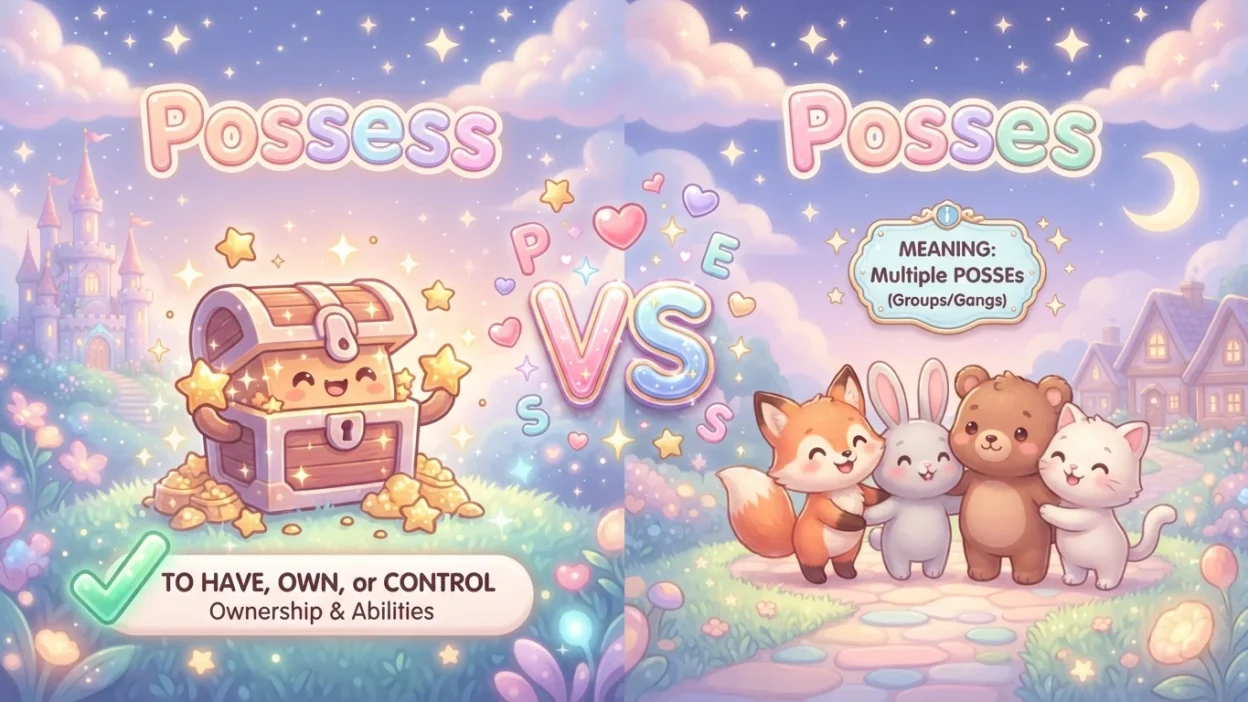
Have you ever written posses when you meant possess? You’re not alone! These two words are commonly confused because they look almost identical. However, they have different meanings, and only one of them is usually correct when talking about ownership or having something.
In this guide, you’ll learn the difference between possess vs posses, their meanings, examples, common mistakes, and an easy memory trick to help you remember which word to use.
Quick Answer
- Possess ✅ — Correct when you mean to own, have, or control something.
- Posses ⚠️ — A real word, but it has a completely different meaning.
Examples:
- She possesses excellent communication skills.
- They possess valuable historical documents.
What Do Possess and Posses Mean?
Although these words look similar, they do not mean the same thing.
What Is Possess?
Possess is a verb that means:
- To own something.
- To have a particular quality or ability.
- To control or influence someone or something.
Examples:
- She possesses remarkable talent.
- They possess extensive knowledge of history.
- He possesses great leadership skills.
- The museum possesses several rare artifacts.
What Is Posses?
Posses is also a real English word, but it is the plural form of posse.
A posse means:
- A group of people gathered for a common purpose.
- Historically, a group assisting law enforcement.
- Informally, a close-knit group of friends or associates.
Examples:
- Several posses participated in the historical reenactment.
- The sheriff organized local posses to help search the area.
- Different fan posses attended the convention.
Because posses is uncommon, many people accidentally use it when they actually mean possess.
Possess vs Posses Comparison Table
| Feature | Possess | Posses |
|---|---|---|
| Correct English Word | ✅ Yes | ✅ Yes |
| Part of Speech | Verb | Plural noun |
| Meaning | To own or have something | More than one posse |
| Used in Everyday English | Very Common | Rare |
| Commonly Confused? | Yes | Yes |
Why Is “Possess” Usually Correct?
When you’re talking about ownership, abilities, or characteristics, the correct word is always:
- Possess ✅
Examples:
- Possess knowledge.
- Possess confidence.
- Possess valuable skills.
- Possess property.
If you remove the final s, you completely change the meaning of the word.
Examples of Possess in Sentences
- She possesses incredible artistic talent.
- They possess the necessary qualifications.
- He possesses excellent problem-solving skills.
- The company possesses several international patents.
- Few people possess such determination.
- We all possess unique strengths.
- The library possesses thousands of rare manuscripts.
Examples of Posses in Sentences
- The sheriff assembled several posses.
- Historical posses often assisted local authorities.
- Various fan posses gathered at the festival.
- The museum displayed information about frontier posses.
Common Mistakes People Make
Many writers accidentally:
- Use posses when they mean possess.
- Remove one of the final “s” letters.
- Assume both spellings mean ownership.
- Miss the typo while proofreading.
Incorrect:
- ❌ She posses great leadership skills.
Correct:
- ✅ She possesses great leadership skills.
Incorrect:
- ❌ They posses valuable information.
Correct:
- ✅ They possess valuable information.
Simple Memory Trick
💡 Memory Trick
- Possess = To have or own something.
- Posses = More than one posse.
Rule: If you’re talking about ownership or abilities, always use possess with two “s” letters at the end.
When Should You Use Possess?
Use possess when talking about:
- Ownership
- Skills and abilities
- Personal qualities
- Knowledge and experience
- Control or influence
Examples:
- Possess confidence
- Possess talent
- Possess property
- Possess information
- Possess leadership skills
When Should You Use Posses?
Use posses only when referring to:
- Multiple posses
- Historical law enforcement groups
- Groups of people called posses
Examples:
- Frontier posses
- Local posses
- Historical posses
American vs British English
There is no difference between American and British English.
Both varieties use:
- ✅ Possess (to own or have)
- ✅ Posses (plural of posse)
The meanings remain the same worldwide.
Related Words and LSI Keywords
- possess meaning
- possess definition
- posse meaning
- possess or posses
- English spelling
- commonly confused words
- vocabulary guide
- grammar rules
- language learning
- proofreading
- English usage
- writing correctly
- word comparison
- possess skills
Tips for Remembering the Difference
- Use possess when talking about ownership or abilities.
- Remember that posses is simply the plural of posse.
- If you mean “to have something,” choose possess.
- Check whether you’re talking about a group of people or ownership.
- Proofread words that end in double letters carefully.
Frequently Asked Questions
Is posses a real word?
Yes. It is the plural form of posse, but it is relatively uncommon.
Which is correct: possess or posses?
If you mean “to own or have something,” possess is correct.
What does possess mean?
It means to own, have, control, or exhibit a particular quality or characteristic.
What does posses mean?
It refers to more than one posse, which is a group of people acting together.
Is possess used in American and British English?
Yes. Both varieties of English use the same spelling and meaning.
Can I use posses instead of possess?
No. The two words have completely different meanings and are not interchangeable.
Summary
The difference between possess vs posses is important because both are real English words. Possess means to own, have, or display something, while posses is simply the plural form of posse, referring to multiple groups of people.
Whenever you’re writing about abilities, qualities, or ownership, always choose possess. If you’re talking about several posses from a historical or group context, then posses is the correct word.

Cedric Halewood is known for his intricate historical narratives.
His work reflects a deep fascination with lost civilizations.
He lives near the coast, where he finds inspiration in the sea.