
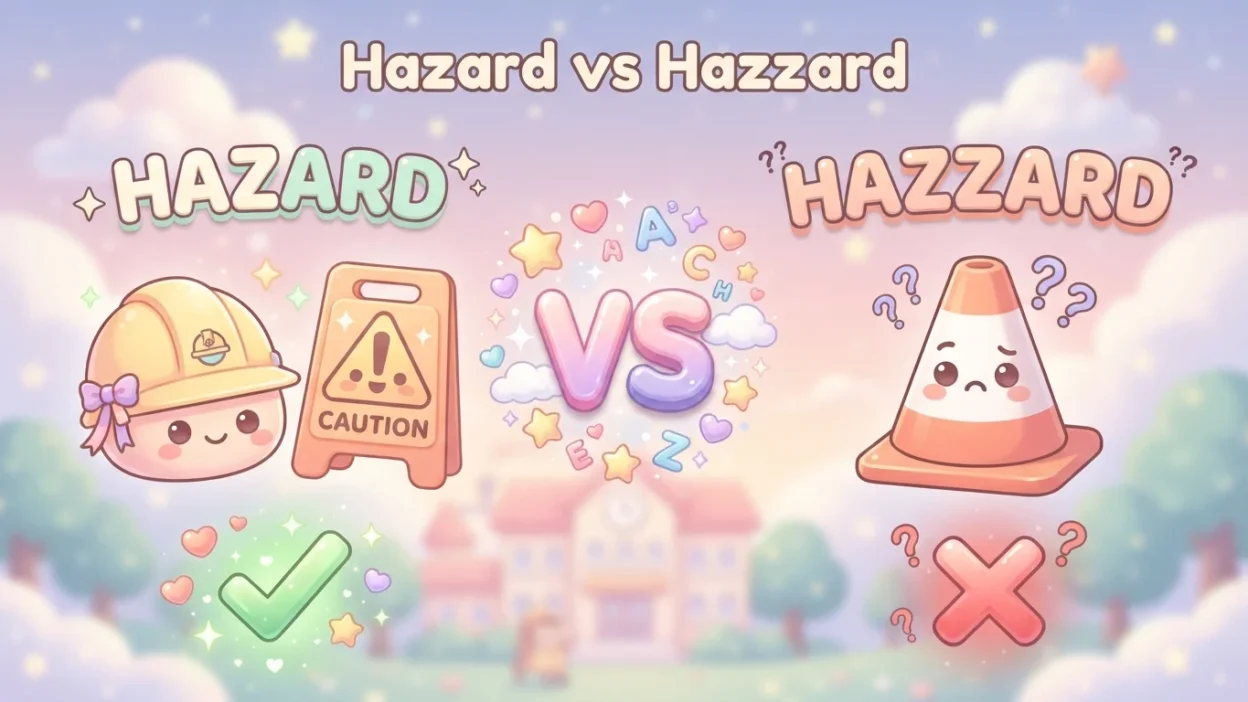
Have you ever written hazzard when you meant hazard? You’re not alone! The extra “z” can easily sneak into this word because of how it’s pronounced. However, only one spelling is correct in standard English when referring to danger or risk.
In this guide, you’ll learn the difference between hazard vs hazzard, their meanings, examples, common mistakes, and an easy memory trick to help you remember the correct spelling.
Quick Answer
- Hazard ✅ — Correct spelling.
- Hazzard ❌ — Incorrect spelling (unless it’s part of a proper name or surname).
Use hazard whenever you’re talking about danger, risk, or something that may cause harm.
Examples:
- Wet floors are a safety hazard.
- Smoking is a major health hazard.
What Do Hazard and Hazzard Mean?
Although these words look similar, only one is the standard English spelling.
What Is Hazard?
Hazard is both a noun and, less commonly, a verb.
It means:
- Something that presents danger or risk.
- A potential source of harm or injury.
- To risk or venture something in certain contexts.
Examples:
- The broken staircase is a serious hazard.
- Chemical spills can become environmental hazards.
- Driving during heavy fog creates a traffic hazard.
- Workers must identify workplace hazards before beginning their tasks.
What Is Hazzard?
Hazzard is not the correct spelling of the English word hazard.
However, it can appear as:
- A surname (for example, “Hazzard”).
- Part of a proper name or title.
If you’re writing about danger, risk, or safety, you should always use hazard.
Hazard vs Hazzard Comparison Table
| Feature | Hazard | Hazzard |
|---|---|---|
| Correct English Word | ✅ Yes | ❌ No (for danger or risk) |
| Dictionary Entry | Yes | Only as a proper name |
| Meaning | Danger or potential harm | Proper noun or surname |
| Used in Formal Writing | Yes | Only when referring to a name |
| Used in Everyday English | Very Common | Rare |
Why Is “Hazard” Correct?
The correct spelling is:
H-A-Z-A-R-D
It contains only one letter “z.”
Many people mistakenly double the “z” because English has words like:
- Buzzard
- Fizz
- Puzzle
However, hazard has always been spelled with a single z.
Therefore:
- Hazard ✅ — Correct.
- Hazzard ❌ — Incorrect for general English usage.
Examples of Hazard in Sentences
- Leaving toys on the stairs is a tripping hazard.
- The sign warned visitors about electrical hazards.
- Poor lighting can create workplace hazards.
- Firefighters are trained to recognize potential hazards.
- Ice on the road poses a serious driving hazard.
- Exposure to toxic chemicals is a health hazard.
- Employers must reduce safety hazards whenever possible.
Common Mistakes People Make
Many writers accidentally:
- Add an extra “z” and write hazzard.
- Spell the word based on pronunciation.
- Confuse it with surnames that use two “z” letters.
- Miss the typo while proofreading.
Incorrect:
- ❌ This chemical is a serious hazzard.
Correct:
- ✅ This chemical is a serious hazard.
Simple Memory Trick
💡 Memory Trick
- Hazard has one danger and one Z.
- Think: “One risk, one Z.”
Rule: If you’re talking about danger or safety, use only one “z” in hazard.
When Should You Use Hazard?
Use hazard when talking about:
- Workplace safety
- Health risks
- Environmental dangers
- Traffic hazards
- Fire hazards
- Chemical hazards
Examples:
- Safety hazard
- Health hazard
- Fire hazard
- Environmental hazard
- Workplace hazard
- Road hazard
When Should You Use Hazzard?
Use Hazzard only when it is:
- Someone’s surname.
- Part of a business or proper name.
Examples:
- Mr. Hazzard attended the meeting.
- Hazzard Consulting Group.
If you’re referring to danger or risk, never use hazzard.
American vs British English
There is no difference between American and British English.
Both varieties use:
- ✅ Hazard
- ❌ Hazzard (except as a proper name)
The spelling is identical throughout the English-speaking world.
Related Words and LSI Keywords
- hazard meaning
- safety hazard
- health hazard
- fire hazard
- environmental hazard
- English spelling
- commonly misspelled words
- vocabulary guide
- grammar rules
- language learning
- proofreading
- English usage
- word comparison
- workplace hazard
Tips for Remembering the Difference
- Remember that hazard uses only one “z.”
- Think: one risk, one Z.
- Double-check words that are commonly misspelled.
- Never add an extra “z” unless you’re writing a proper name.
- Use spell check if you’re unsure.
Frequently Asked Questions
Is hazzard a real word?
Not as the standard English word for danger. It may be used as a surname or proper noun.
Which is correct: hazard or hazzard?
Hazard is the correct spelling when referring to danger or risk.
What does hazard mean?
It means something that may cause harm, injury, or danger.
Why do people spell hazard as hazzard?
Many people mistakenly double the “z” because of pronunciation or familiarity with similarly spelled words.
Is hazard used in American and British English?
Yes. Both varieties use the same spelling.
Can I use hazzard in formal writing?
Only if it is someone’s name. Otherwise, use hazard.
Summary
The difference between hazard vs hazzard is simple. Hazard is the correct spelling and refers to danger, risk, or something that may cause harm. Hazzard is not the standard English spelling and is used only as a proper name or surname.
Whenever you’re writing about safety, health, or risks, remember this easy rule: one risk, one Z. That simple trick will help you spell hazard correctly every time.

Alistair Fenwicke is a quiet observer of rural life and forgotten histories.
His novels explore memory, solitude, and the passing of time.
He writes from a small countryside cottage surrounded by fields.